Wednesday, October 9, 2013

Pre-sales closing crunch in Toronto? And... Vancouver foreclosures running at 6-7 per working day.


Debt is endemic. They use lines of credit to make mortgage payments. They routinely increase the size of their home loans to renovate. Four in ten people now say they have trouble paying their monthly bills. And yet 70% own a house. Prices have been bloated by cheap money, not greater income.
That's a quote from one of Garth Turner's posts (May 16th, 2013)

Mortgage brokers, realtors and developers have seen a surge the last few months in people who bought pre-construction condos two to three years ago “scrambling” to get financing to close deals. 
Some have had to walk away from deposits worth tens of thousands of dollars. Others have been forced to borrow from family — or against their principal residence — to come up with final payments on condos that lenders are no longer keen to finance, according to interviews with a number of players in Toronto’s condo industry. 
Hardest hit have been the self-employed who had pre-approvals from lenders when they bought their pre-construction units. But now, with the unit almost complete and final payments due, they are being told they need 35 to 50 per cent down, instead of just 20 per cent of the purchase price, unless they want to rely on secondary lenders offering rates that can hit double digits. 
Many investors who bought units intending to flip them on completion, or rent them out for a few years, have also been shocked to find they thought they had pre-approvals, but they are no longer being honoured in the wake of tighter lending rules imposed by Ottawa.
Can you imagine what things will be like if the Federal Government responds to the idea that mortgage debt is a threat to the economy?

Or if interest rates really do start to rise?

On another note, an interesting post over on Vancouver Condo Info from Ham Solo


From the start of the last paragraph: "Looking at a couple of weeks of data, adjusting for double-counting, we are seeing Vancouver foreclosures totalling about 6-7 per working day."

==================

Photobucket
Email: village_whisperer@live.ca
Click 'comments' below to contribute to this post.

Please read disclaimer at bottom of blog.

Tuesday, October 8, 2013

FP: Mortgage debt putting our national economy at risk.


Interesting article in the Financial Post yesterday. Titled Stephen Harper told mounting mortgage debt is putting ‘our national economy at risk’, the news article details how the Federation of Canadian Municipalities, made up of member cities representing 90% of the nation’s population, have told the Prime Minister that the high cost of housing was the most “urgent” financial issue facing Canadians today.
We have been warned before, and often. The federal government and the Bank of Canada, in particular, have lectured us about the evils of sky-high consumer debt and still-creeping house prices — and the mounting threat to the economy — as rock-bottom interest rates inevitably begin to rise...

Canada Housing and Mortgage Corp., the Crown agency responsible for insuring mortgages to approved buyers, uses a 30% threshold of total household income going to housing. Anything above that, and consumers could end up over their heads.

Dallas Alderson, director of policy and program at the Canadian Housing and Renewal Association, said one-quarter of Canadian are over that limit.
What do they want the Prime Minister to do?
“We believe that as the government sets its priorities for the next two years, it should address the high-cost of housing in Canada, the most urgent bread-and-butter issue facing Canadians today."
Of course when these groups ask the Federal Government to intervene, it usually means more subsidies, which is the type of meddling in the past which has created the mess in the first place.  Remember, greatly increasing CMHC's balance sheet was all about making housing 'affordable'. Notes the FP article...
Finn Poschmann, vice-president of research at the think-tank C.D. Howe Institute, said Ottawa has “little jurisdiction and almost no practical capacity to deliver housing.”

“Past attempts to do so, through CMHC for example, have produced financial disasters for the people who participated and put CMHC in grave financial situation.” he said.

“We wouldn’t want to see that again, nor the federal mortgage agency deeply underwater and as similar U.S. agencies have been, through the course of much more recent financial disasters.”
Curiously no one suggests removing the punch bowl which created the sky-high housing values to begin with.

Yanking that punch bowl away will trigger a very painful process.  But it's the long term solution that is required.

Speaking about the punch bowl of ultra low interest rates, the Globe and Mail notes that GM Canada chief frets over credit-driven car sales.
The president of General Motors of Canada Ltd. is worried that ultra-cheap auto loans could be causing Canadian vehicle sales to spike just as home sales did during the U.S. housing bubble.

Canadians are on pace to drive more than 1.73 million new vehicles off dealers’ lots this year, breaking the record of 1.703 million, but that’s a higher level than economic indicators suggest sales should be, Kevin Williams told The Globe and Mail’s editorial board Monday.


Part of the reason, he noted, includes eight-year, interest-free loans being offered by some auto companies. His comments highlight again the hot-button issue of consumer debt, singled out by Finance Minister Jim Flaherty and the Bank of Canada as a critical concern before the inevitable rise in interest rates.


Mr. Flaherty has focused on mortgage debt, but auto loan debt has been rising in the fierce fight among auto makers for market share and their battles with each other and Canada’s Big Six banks in the auto lending market.

Auto loan debt rose 8.6 per cent in the second quarter from year-earlier levels, outpacing the increase of 6.1 per cent in total debt, according to numbers compiled by Equifax Canada.

Consulting firm J.D. Power and Associates said last month that 64 per cent of Canadians who finance vehicle purchases are taking on terms of six years or longer.

The longer terms are designed to make monthly payments as low as possible, Mr. Williams said, but they mean in some cases buyers will return to dealers for a new vehicle still owing money on the vehicle they’re trading in.
The unwinding of all of this is going to be very, very painful.

==================

Photobucket
Email: village_whisperer@live.ca
Click 'comments' below to contribute to this post.

Please read disclaimer at bottom of blog.

Friday, September 20, 2013

Are you ready for the $1.2 million converted garage as your home?


Yesterday we told you about the upcoming auction of a 526 square foot 'laneway' house in Vancouver.

Laneway houses are one of the 'solutions' for increasing density on the Wet Coast.  Instead of building a garage, use the space for a self-contained rental suite.

But they aren't just being used as mortgage helpers anymore.  As noted in yesterday's post, they are now being marketed as separate properties. The 526 square foot mansion profiled in our last post is 'valued' at $500,000.

And as stunningly stupid as that sounds, how about the $1million + lane way home?

Well it's here.  Above is a new listing (pictures yet to come) for a laneway house at 2330 W. 7th Avenue in Vancouver with an asking price of $1,278,000.  From the listing description:
Welcome to the most desirable coach house in the highligh sought-after Kitsalano neighbourhood. A home that instantly feels right. Lots of private outdoor space, open concept layout, hardwood floors throughout, in-floor radiant heating,vaulted ceilings, built-in speakers and designer series Viking appliances are just some of the many features in this home. Architecture by Alexander Ravkov Inc, Interior and Design and Construction by Open Concept Development. Full 2-5-10 New Home Warranty. Elevate your lifestyle with this magnificent new home!
We'll update with pictures when they become available.

==================

Photobucket
Email: village_whisperer@live.ca
Click 'comments' below to contribute to this post.

Please read disclaimer at bottom of blog.

Thursday, September 19, 2013

How expensive is Vancouver? Converted Garage's now being auctioned off as detached homes


Laneway houses. The latest fad where, instead of building a garage, developers are allowed to construct a small 'laneway' house.

Usually these creations are considered a 'revenue generator', a secondary suite.

But how about buying the laneway shack outright as your primary house?

Up for auction will be this 516 square foot - yes a house smaller than some living rooms - laneway house. This tiny house will be auctioned off live at the Interior Design Show West (IDS West) at the Vancouver Convention Centre on Sept. 21. There is no minimum bid, but the house is valued at $500,000. All proceeds from the sale will support the Alzheimer's Society of B.C.

Marevelous.

==================

Photobucket
Email: village_whisperer@live.ca
Click 'comments' below to contribute to this post.

Please read disclaimer at bottom of blog.

Wednesday, September 18, 2013

News item - BC NDP leader Adrian Dix resigns


Hat tip: Saj Karsan

==================

Photobucket
Email: village_whisperer@live.ca
Click 'comments' below to contribute to this post.

Please read disclaimer at bottom of blog.

Tuesday, September 17, 2013

How to be a Vancouverite


Too many things bang-on in this humorous clip.

Hat tip: Ben Rabidoux

==================

Photobucket
Email: village_whisperer@live.ca
Click 'comments' below to contribute to this post.

Please read disclaimer at bottom of blog.

Monday, September 16, 2013

Another case of 'Newsvertising', this time in the National Post


On the weekend we shared with you the cover of the Financial Post Magazine (pictured above).

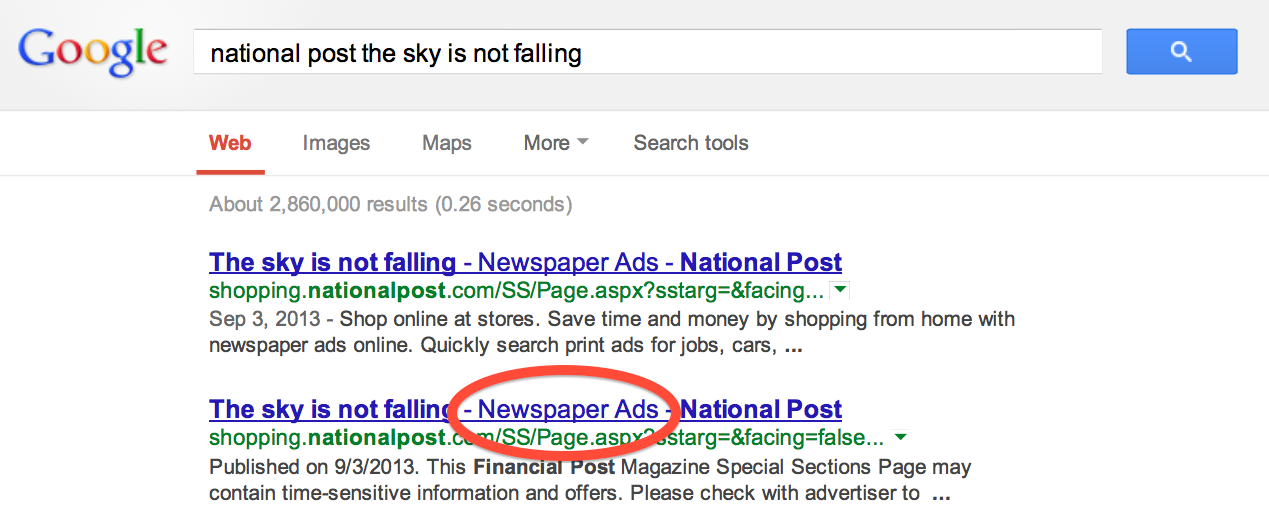
It appeared on September 3rd, 2013 in the National Post newspaper and had a stunning headline: "THE SKY IS NOT FALLING - Why real estate doomsayers continue to be wrong"

Pretty powerful message. Forwarded as friendly 'chiding', it represents the quintessential example of media manipulation in real estate today. To the average person, this article appears to be a 'news story'. 

But as one of our faithful readers noticed in the comments section of yesterdays blog post, it's not a news article - it's an adverting feature; an advertisement dressed up to look like a news story.

Online, the article is contained in the "Special Sections' of the National Post (click on all images to enlarge):


For those who follow this blog regularly, when you see 'Special Sections', the spidey senses start to tingle. Google the article headline and you discover EXACTLY what this article is:


That's right. Google makes it very clear it's not a news article, its a newspaper ad, the content written by a real estate shill who paid to have it inserted in the paper.

Faithful readers will recall we covered a similar misleading article in the Vancouver Province back on March 26, 2013 and discussed it again here.

Desperate for advertising dollars, the mainstream media is increasingly willing to take paid advertisements and present them as actual news stories with little or no indication that what you are reading isn't real news.

Naturally the real estate industry will pay handsomely for the chance to mold public opinion under the guise of legitimate news. Who wouldn't when you dealing with an industry where Billions of dollars are spent based on 'consumer confidence'?

But when the print media sells it's journalistic integrity like this, is it all that surprising that they have become an unsustainable proposition?

==================

Photobucket
Email: village_whisperer@live.ca
Click 'comments' below to contribute to this post.

Please read disclaimer at bottom of blog.

Friday, September 13, 2013

A Minsky Moment precursor?


The Financial Post front page says: "THE SKY IS NOT FALLING: why the real estate doomsayers continue to be wrong."

Full story here.

==================

Photobucket
Email: village_whisperer@live.ca
Click 'comments' below to contribute to this post.

Please read disclaimer at bottom of blog.

Monday, September 9, 2013

Globe and Mail on the Condo Market: Lots of supply, low demand, prices softening.


In case you missed it, there was an article in the Globe and Mail on Friday titled, "Vancouver condo buyers take a second look", and the picture it painted was anything but rosy.
Derek Hynes was thinking like a lot of Vancouverites when he purchased his one-bedroom condo in one of Surrey’s new towers. He thought its value would rise each year, enough to make the purchase an investment in his future. He’d build equity until he had enough to purchase a bigger place, maybe even the down payment on a house.
Of course what Hynes is discovering is quite the opposite.  As the G&M notes, the expectation of buyers like Hynes is that that every home should build equity, a hangover from the pre-2008 years, when it seemed that real estate had nowhere to go but up, up, up. Average income earners were purchasing presale units and flipping them by the time they were completed, pocketing $50,000 or so in the process.

But those days are long over and articles like this one in the Globe show that a shift is underway.
As many condo owners who purchased five years ago and are trying to sell today can attest, the equity simply did not materialize. They are often breaking even, or selling for slightly more or less. Today, a condo in Vancouver is no longer viewed as a winning investment, so much as affordable housing and forced savings plan.

And if you consider that mortgage payments are still higher than those in Toronto, condos aren’t even that affordable. A recently released real estate report on Canadian cities says: “Despite the 2012 drop in Vancouver’s median condominium price and a further decline expected in 2013, the area’s affordability is forecast to remain the weakest by far among this report’s eight cities, both this year and throughout the forecast.”
Say it isn't so?

Apparently Hynes, purchased his 620 sq. ft. condo for $182,000 (which was $7,000 below the asking price) and he was recently thinking of selling the unit until he saw that his neighbour on the same floor, with the same suite, has just listed for $179,000.

Talk about a kick in the groin.
“I thought it would at least keep its value, so I’m surprised,” Mr. Hynes says. “If it had kept its value, I definitely would have sold right now.”
Hynes says his work colleagues, friends and relatives are facing the same situation. His cousin just sold her condo after renting it out for five years, and she lost money on it.
“It was for the exact same reason I’m losing out,” Mr. Hynes says. “Because there are so many condos in the area.”
What sellers are discovering, according to the article, is that there are too many new condos. Since the economic slump of 2009, condo starts have been on the rise, and above the 20-year average ratio of starts-to-population growth. Developments were going up almost as if it were 2007 again.
“This left the inventory of completed but unsold apartment condominiums very high by the past decade’s standards,” says the Genworth/Conference Board of Canada report, which provided those numbers.

With the slump in prices, sales have recently picked up. The benchmark price of an apartment decreased 1.1 per cent from August, 2012, to $366,100 in August this year, according to the Real Estate Board of Greater Vancouver. Sales last month went up 40 per cent over August, 2012.

“Even though the real estate market is booming, the prices mostly remain the same,” says Vadim Marusin, who’s the founder of Estateblock.com, a new real estate search engine that maps the Multiple Listing Service listings
Urban Analytics’ Michael Ferreira tracks the market on a quarterly basis, and he sees a condo glut that’s softening prices.
“We’ve seen the unsold inventory of product under construction increase steadily over the last year. Not to the point of concern for oversupply, but certainly to the point where buyer urgency is not as great.”
Tell that to the people like Hynes who are watching their condo values drop in price since 2008 instead of going up.
Because buyers know there is another building coming up, they aren’t pressured to buy, adds Urban Analytics’ analyst Jon Bennest.

“In some markets where there’s a lot of supply and not as much demand, it’s hard to say that we’ll see a price increase. In others where there is less supply and consistent demand, we do see those areas increasing. So it’s very specific to the submarket,” says Mr. Bennest.
Enter Bob Rennie and his "Transportation, transportation, transportation" mantra.

The bulls will claim that with the city population steadily growing by about 37,000 people a year, the condo will remain the only affordable housing option for a lot of people. And the people with real equity – foreign investors and local boomers – will continue to look to them for investment.

But how long will we continue to cling to the dream that wealthy foreigners will support and maintain our over inflated market?

For property owners like Hynes, who are already in a loss position,  they are now like the stock buyer who refuses to cut their losses.
Hynes says he’ll hang onto his condo long enough to see that happen.

“I’m in a situation where I cannot afford to sell it, so I’m going to be renting it out, probably next month.
(Hynes now has a family and says he will rent out his condo and use the money to rent another place, in an area with better value.)
“For me, it feels as if I am moving backward in life, but I have no choice, because I need to move on because I have a family now. I am going to move out and go rent a basement suite in Coquitlam.

“I know a lot of people can’t afford their mortgages because there are tons of cheap basement suites in Coquitlam.”
Exactly.

You can't help but survey the scene and think of the Financial Times' conclusion of the debt situation in China we talked about in our last post: "Plenty of tinder, lots of fuel, all it needs is a spark"

And when that spark comes you know things will ignite rather quickly.


==================

Photobucket
Email: village_whisperer@live.ca
Click 'comments' below to contribute to this post.

Please read disclaimer at bottom of blog.

Saturday, September 7, 2013

China's Debt Addiction: "Plenty of tinder, lots of fuel, all it needs is a spark" - Financial Times


Many believe that when China's bubble bursts, Vancouver's housing bubble will well and truly implode. 

Until five years ago, China’s economy relied remarkably little on debt. But China lost its debt inhibition in late 2008 when the global financial crisis erupted. With growth slowing sharply and 20 million people losing their jobs overnight, the government unleashed a giant stimulus that was powered almost entirely by bank loans. The debt genie was out of the bottle – and it has been extremely difficult since then for China to stuff it back in. 

In this video from the Financial Times, Simon Rabinovitch reports from Guiyang.

(hat tip 'Best Place on Meth')

==================
Photobucket
Email: village_whisperer@live.ca Click 'comments' below to contribute to this post.
Please read disclaimer at bottom of blog.

Friday, September 6, 2013

"Money for nothing - Inside the Federal Reserve" Canadian Premier @ Vancouver International Film Festival Sept. 29, Oct. 5, & Oct. 8


Those who have followed this blog know the emphasis we have placed on understanding monetary policy as an important component in knowing our housing bubble.

And an important component of understanding monetary policy is understanding the US Federal Reserve.

On November 15 the movie, "Money for Nothing: Inside the Federal Reserve" had its world premiere at the International Documentary Film Festival in Amsterdam.

Money for Nothing is narrated by Liev Schreiber. It is an independent, nonpartisan, feature-length documentary film.

The cast includes prominent Fed watcher James Grant of Grant's Interest Rate Observer. Also appearing in the film are former Fed Chairman Paul Volcker; investor Jeremy Grantham; former Vice Chairman of the Fed Alan Blinder; Peter Fisher, former Under Secretary of the Treasury for Domestic Finance; Philadelphia Fed President Charles Plosser; Richmond Fed President Jeffrey Lacker; Vice Chair of the Fed Board of Governors Janet Yellen; and many more.

Money For Nothing covers 100 years of Fed history and, in many cases, is quite critical of Fed policies. The film asks the question: Can the Fed learn from its past?

The movie pays homage to Volcker and lays out thoughtful and respectful criticism of former Chairmen Arthur Burns and Alan Greenspan and current Chairman Ben Bernanke, among others.

The movie's director, Jim Bruce, says the goal of the film is to create informed debate that exposes the impact of Fed policy on the U.S. economy and on society (from the Greenspan Put to the Bernanke Put). The film questions the rationale behind today's Fed actions and calls for better policies in the future.

Starting with the Panic of 1907 and ending with the risks on the horizon of today's quantitative-easing quagmire, Money for Nothing dramatically and entertainingly reveals the Fed's ongoing reluctance to shed old ideas. The movie is filled with wonderful narrative and fascinating images that capture the world of finance throughout the Twentieth Century.

On September 29th, October 5th and October 8th, the film will be making it's Canadian Premier with three showings at the Vancouver International Film Festival. Click on the highlighted link over the dates to go to the VIFF website for film details and ticket buying info.

For info on showings in other cities see http://www.moneyfornothingthemovie.org

It should be very interesting.

If you can't view it, the link to the video above is: http://vimeo.com/50095912.

You can also see it on Youtube at: http://youtu.be/cMxGvdgzfHw.

==================

Photobucket
Email: village_whisperer@live.ca
Click 'comments' below to contribute to this post.

Please read disclaimer at bottom of blog.

Thursday, September 5, 2013

Vancouver Real Estate agent dismisses August numbers as "meaningless information"


As realtor Larry Yatkowsky tells us, the press release from the Greater Vancouver Real Estate Board is all warm and fuzzy because of the August real estate numbers.
According to the Board, “August activity in the Greater Vancouver housing market finished well above last year’s pace and slightly below the 10-year average for the month.” To this is added that residential property sales in Greater Vancouver increased 52% compared to the same month in 2012. The not so fuzzy stuff is that August sales declined 14.7% from the month before and less fuzzy is that the market is still 4.6% below the 10 year average.
So the bottom line is that the market is still well below average.  So real estate isn't exactly churning along at the gang buster hype the news would have you believe.  It's just not incredibly dismal as what we've witnessed over the preceding 8 months.

Interesting.

That's a message that John Grasty, a real estate agent from Port Moody, would like to make clear to you.

Grasty is a real estate agent who bills himself as a 'homeowner advocate'. And he is front and centre in a 24hours newspaper article that proclaims 'Real estate numbers can deceive.

Now we all know the real estate industry are masters of the type of number crunching that would make even theoretical physicists blush, but its rare that we hear dissenting commentary from members within the industry.  And Grasty wants you to temper your reaction to the industry hype.

In the article, 24hours gives us the Industry spin that says real estate sales in Vancouver are reported to be on the upswing since last year but then throws cold water on that news by telling us those same numbers are being questioned by Grasty:
The B.C. Real Estate Association released figures in July showing a 32% dollar increase in home sales compared to July 2012. Analyst Brendon Ogmundson said considering how bad last year’s real estate sales were, the new numbers show a balanced market.

The association also released a report in August predicting residential sales to increase another 3.9% by the end of the year.

“The market is generally strengthening,” said Ogmundson. “When we look at year-to-year numbers are a little skewed because sales were so weak last year, but generally sales in the Vancouver region are improving and have been since about May.”
But Grasty says there isn’t much point to such analysis of the market.
“The only thing that counts is what happened most recently in sales to determine market value,” said Grasty. “If there’s a ton of product on the market, then chances are we’re in a buyers’ market.”
He said a major problem with the view of large markets is certain areas may not be reflected accurately. Just because homes in some areas are selling doesn’t mean the entire market is selling, he said.
“What’s happening when you average it all out is meaningless information,” said Grasty, adding that because some people take the predictions too seriously he has to burst their bubble when they list their home for too high a price.
What are you saying John, that the garbage we get from the real estate cartel is 'meaningless'? Can't say we disagree.

And as if to hammer that point home, the 24hours article ends with the perfect stereotypical quote from BC Real Estate analyst Brendon Ogmundson:
Ogmundson said it’s always a good time either for buyers or for sellers.
Of course it is. It's ALWAYS a good time to make a commission, right Brendon?

==================

Photobucket
Email: village_whisperer@live.ca
Click 'comments' below to contribute to this post.

Please read disclaimer at bottom of blog.
Wednesday, September 4, 2013

Wed Post #2: Huffington Post carries story of 'fake mansion' being marked down $25 million.


On Tuesday we told you  how West Van's infamous 'fake mansion', once Canada's most expensive listing at $38 million, had been marked down by $25 million.

We wondered if the Vancouver Sun or Province newspaper would pick up on the story with the same gusto shown back in February when they helped the fake pictures go viral around the world, but to date there's been no response (thus reinforcing their inevitable slide into irrelevance).

But that doesn't mean the mainstream press is ignoring the story.

The Huffington Post has picked up the ball and run with it: Canada's Most Expensive House Marked Down by $25 Million (hat tip: Many Franks):
One day you're Canada's most expensive house, the next you're just a teardown on a ritzy piece of land.

A seaside property located at 3810 Marine Drive in West Vancouver, which was the country's priciest listing last February, has been marked down from $38 million to $12,888,000. That's a hefty drop of $25 million and change.

Current listing agent Lionel Lorence, couldn't say why the original asking price was so high, but acknowledged there was little reality behind the colossal tag.

"The real estate values on the West Vancouver waterfront are rich prices, but this one when it came out, at $37.9 million, seemed to be exorbitant," he told The Huffington Post B.C.

The house itself is a teardown, but the value is in the land, The North Shore Outlook reported in February.

The rancher bungalow built by a shipping magnate in 1964 sits on a 34,000-square-foot lot with unobstructed views of the waterfront, with enough space to subdivide the property into three estates.

That's how West Vancouver realtors Laura McLaren and George Tsavdaris came up with the price at the time, figuring that any of three lots could be worth $10 million, while the house itself could go for $7.9 million, they told the newspaper.

The agents may have been a tad hopeful in pitching the prospect of a subdivision, said UBC real estate expert Tsur Somerville.

"It seems very, very optimistic on what they'd be able to get from the city in terms of a rezoning or a subdivision," he said.

Canada's most expensive home today is anything but a teardown. For $35 million, you can have a nine-bedroom Shaughnessy mansion with stained-glass windows, an art deco parkade and an oak-panelled elevator.
Tsur Somerville paints the realtor's responsible for that debacle - Laura McLaren and George Tsavdaris - as a 'tad optimistic.'

Personally we say Tsur is being a 'tad' polite.

==================

Photobucket
Email: village_whisperer@live.ca
Click 'comments' below to contribute to this post.

Please read disclaimer at bottom of blog.

Wed Post #1: What will the government do with a stubborn real estate market? Hit it again, of course.


“That deafening silence you hear is the sound of the Canadian housing bears gone quiet. Not only has the resale market absorbed last year’s round of mortgage rule tightening, but the supposedly at-risk banks have just recorded a unanimously better-than-expected earnings season, with a handful of dividend increases to boot.”
Those are the goading comments of Bank of Montreal economist Robert Kavcic, comments contained  in a research note he sent out on Friday.

And while this housing bear blog may have taken a summer break, we are far from quiet.

We are reminded of our January 13, 2013 post in which we talked about a Bank of Canada study suggesting lower home prices were a national priority.
A substantial downturn in prices – say, 10 to 20 per cent – would, in theory, not only reduce mortgage debts for new home buyers, but, significantly, push down non-mortgage debt to the tune of 4 to 8 per cent. That would get Finance Minister Jim Flaherty and Bank of Canada Governor Mark Carney a lot closer to solving the country’s household debt problem, reducing what is considered a serious risk to the stability of the Canadian economy.
And if lower home prices are a 'national priority', you can be sure the Bank of Canada and the OFSI are far from finished in the efforts to achieve that goal.

Which is why it is not surprising that Canada's banking 'regulator eyes tighter mortgage rules.'
Canada’s banking regulator has been gathering detailed mortgage information from financial institutions, in what could be a precursor to changes in the rules for home loans.

The Office of the Superintendent of Financial Institutions (OSFI) has spent months considering a tightening of mortgage rules for lenders, a decision that’s being weighed as the housing market begins to pick up after a year-long slump. That slide began when Finance Minister Jim Flaherty tightened the rules for mortgage insurance in July, 2012.

Policy-makers in Ottawa, including OSFI head Julie Dickson, have been concerned consumers are taking on too much debt and that house prices have risen too much. Toronto-Dominion Bank economists estimate that home prices are 8 per cent above what they’re actually worth, nationally. The average selling price of existing homes in July was 8.4 per cent higher than a year earlier, driven by a resurgence in the pricier markets of Vancouver and Toronto.

Years of ultra-low interest rates have spurred consumers to take on more mortgage debt than they might have otherwise. To rein the market in, Ottawa has tightened the rules around mortgage insurance four times since 2008 – Mr. Flaherty’s latest move cut the maximum amortization period for an insured home loan to 25 years from 30. Insurance is mandatory for home buyers who have less than 20 per cent of the purchase price of a house as a down payment.
The government and the Bank of Canada have made it clear what they want to occur in the real estate sector.

The next moves should not really come as a great surprise.

==================

Photobucket
Email: village_whisperer@live.ca
Click 'comments' below to contribute to this post.

Please read disclaimer at bottom of blog.
Tuesday, September 3, 2013

Once Canada's 'most expensive listing', asking price for West Van's 'fake mansion' slashed by $25 million (or 66%)


You all remember the infamous 'fake mansion' we told you about back in February 2013?

The notorious tear down property at 3810 Marine Drive in West Vancouver gained worldwide notoriety for it's ridiculous $38 million listing price, the most expensive Canadian real estate listing at the time (it's assessed at a lowly $6,768,500).

This highly promotable fact was embellished by listing agents who profiled the property with extensive interior and exterior pictures of a gaudy, ostentatious mansion.


Just one problem... no such mansion exists. Here is what is actually on the land for sale:

One could argue it was all a brilliant marketing ploy.  

An asking price which made it the most expensive home for sale in Canada along with accompanying pictures of an over the top palace... a sure-fire formula for worldwide media interest, right?

Said one of the listing real estate agents at the time:
“Who’s going to buy this house?” Tsavdaris asked rhetorically. “A king of China will buy this house, or a Bollywood movie star will buy this house.”

More likely, a developer will buy the house and subdivide the property into three separate estates. In fact, there has already been some movement on it.

“We’ve had offers on it but unfortunately they haven’t come up to the price that’s wanted by the seller,” Tsavdaris said. “All the offers we’ve had have been from developers to build three monster homes there. But we’re hoping to find that one candidate from Bollywood or from China that would want to keep it as one property.”
After it was pointed out to the media that the mansion pictures were fake, the listing agents insisted that there wasn't any deliberate attempt to mislead and that the fake photos were merely:
"a rendering of what could be built on this property."
A media frenzy erupted and the online editor of the Vancouver Province was moved to respond to our blog.

So how did that marketing strategy work out?  Did the house ever sell?

Observer, who moderates the excellent blog Vancouver Price Drop, tells us the property is not only still on the market - it has experienced yet another significant cut in it's asking price, the third since it made headlines in February.
  • The February 2013 asking price was for $37.8 million.
  • In March it was cut to $28,888,000.
  • In April it was down to $19,888,000.
  • And on Labour Day weekend the asking price was slashed to $12,888,000.


For those keeping track that's a drop of $25 million or 66%.

(And even at that it's asking price is still double the current assessed value)

$25 million taken off the asking price that made headlines around the world at the start of the year?

Surely this has to be Canada's most reduced property now as Canada's most expensive listing now harbour's Canada's biggest price drop. Do you think the Vancouver Sun or Province will hype this fact in one of their gallery features now?


==================

Photobucket
Email: village_whisperer@live.ca
Click 'comments' below to contribute to this post.

Please read disclaimer at bottom of blog.

Monday, September 2, 2013

Happy Labour Day


==================

Email: village_whisperer@live.ca
Click 'comments' below to contribute to this post.

Please read disclaimer at bottom of blog.


Thursday, August 29, 2013

Perfect Storm?


Yesterday we talked about the Globe and Mail warning you about rising interest rates in an article that suggested ignoring that threat might be the 'biggest financial mistake you might make.'

Today's good news stories come from Business in Vancouver who tell us about a BMO report that says 'Canadian baby boomers  are significantly short on retirement savings'
Baby boomers across Canada have an average shortfall of $430,000 when it comes to their retirement savings, according to BMO Wealth Institute data released August 28.
This is followed up with the wonderful news that 'B.C. consumers still owe the most as personal debt levels rise again.'
The average Canadian consumer’s debt, excluding mortgages, increased in 2013’s second quarter to $27,131, according to a TransUnion report released this morning (August 28).
High debt? No savings for retirement?  Good thing many of us have been playing the real estate lottery, eh?

Which brings to mind our post back in March 2012 warning about Boomer's dumping their overvalued real estate to fund retirement and subsequent posts from Macleans and BMO who ruminated on similar concerns.

But Flippers don't have to worry about that (unless they've ignored the warnings and are currently caught holding), right?

Not so fast.

We also find out today that Tax auditors have targeted condo sellers in the hunt for ‘flippers’.

Seems that anyone who bought a condo unit pre-construction, then sold for a profit without actually moving in, is liable for capital gains tax, and must also repay the GST/HST refund that residents receive.
Folks who’ve sold condos or houses less than a year after taking possession seem to be the prime focus of CRA auditors so far, but tax lawyers are advising clients they could be at risk of a tax bill for at least 50 per cent of any gains made if they’ve sold before living in the property 18 months to two years.
Isn't that special?

Toss in the array of changing mortgage regulations, the weak global economy and the absence of HAM and surely the logical person can see the perfect storm forming.

==================

Photobucket
Email: village_whisperer@live.ca
Click 'comments' below to contribute to this post.

Please read disclaimer at bottom of blog.

Wednesday, August 28, 2013

In the years ahead: the biggest financial mistake you might make?


Couldn't help but key in on a line from a Globe and Mail article this week.
In the years ahead, the biggest financial mistake you make just might be failing to think well in advance about a mortgage coming up for renewal.
It is, of course, an article about the damage rising interest rates might do to those in debt.
The era of pleasant surprises for people renewing their mortgages is over.

After five years of trending lower, mortgage rates have reversed course and started to rise. Aspiring first-time home buyers are being priced out of the market by these increases, but at least they’ve avoided a costly mortgage entanglement. Existing homeowners may simply have to pay more.

... how people will afford higher mortgage payments (?)

We’ve been assured by people in the mortgage industry that homeowners can absorb higher mortgage payments. A 2011 report from the Canadian Association of Accredited Mortgage Professionals said there is “very substantial room” for households to pay higher mortgage rates. Will Dunning, CAAMP’s chief economist, said Monday that he stands by that view.

But the issue is not whether you can afford higher mortgage payments. Rather, it’s what you’ll have to sacrifice to make them.
Sacrifice?

The mere thought is still ridiculous to just about everyone you talk to.  No one can conceive of any kind of dramatic change in rates.

But it's always like that.  

In October 1971, when interest rates were 9.55%...


... people of the day would have thought you were crazy if you were to suggest they would be 20.54% by October of 1981.


Conversely, it you were to tell those people in 1979-1981 that interest rates would have plummeted to 13.75% by October of 1990, they wouldn't have believed you (although they would have cheered the optimism).


Jump 10 more years into the future to October 2000 and rates are an astonishing bargain at 8.08%....


... at least they would have been a bargain to the people of the day.

Jump just over 10 more years to the present, and what to make of the emergency level interest rates of 2.25 -3.25%? Talk to anyone today and the idea of a 6% interest rate is pure fantasy, never mind 8.08%.

If you look at history, the 10 year jumps have brought dramatic change... change which each generation would not have believed at the time.

If the next 10 years brings change again, will it surprise? More significantly, will you allow yourself to be surprised?

==================

Photobucket
Email: village_whisperer@live.ca
Click 'comments' below to contribute to this post.

Please read disclaimer at bottom of blog.

Monday, August 26, 2013

Netherlands Real Estate Bubble Bursts - BBC


ht - Ben Rabidoux

==================

Photobucket
Email: village_whisperer@live.ca
Click 'comments' below to contribute to this post.

Please read disclaimer at bottom of blog.

Monday, August 5, 2013

Will Return Shortly


Hello all.  

Thanks for all the emails enquiring as to the recent prolonged absence. It never ceases to amaze just how many stop by this little corner of the internet each day.

And while emails (and comments) may have gone unanswered, they are all read - and appreciated. Thank you for taking the time.

Hopefully regular posts will resume shortly.


==================

Photobucket
Email: village_whisperer@live.ca
Click 'comments' below to contribute to this post.

Please read disclaimer at bottom of blog.