==================
Click 'comments' below to contribute to this post.
==================
I was in the process of writing a post to answer some silver questions from the past few days when I came across this. I will try and answer those questions later.
If you have been following the silver story on the COMEX, you know that the short squeeze in silver is heating up and with 8 days left in the delivery month of March the situation is getting intense.
As of Monday there remained 896 contracts representing 4,480,000 oz of silver which were left to be serviced (delivered). This represents a full 50% of the March contracts which still have to be delivered.
Various analyst's have commented that never in silver COMEX history has an amount still standing for delivery been equal to the amount already served this late in the month.
With 8 days left, an average of 560,000 oz must be serviced on each and every trading day until the end of this month. To our analyst's it is quite obvious that the COMEX does not have the silver available to service the patiently waiting contract holders.
This past weekend, however, there has been a curious development that is setting off alarm bells.
JP Morgan Chase was just granted a silver vault licence on the COMEX. And the licence was granted lightening speed compared to other licence's.
The respected online site Seeking Alpha asks:
Alpha then connects the dots.
When silver is 'delivered' on these COMEX contracts, it is often a simple computer transaction. The vast amount of physical bars 'delivered' in a settlement never actually leave the warehouse. They are simply 'credited' to the new owner and left in the warehouse (with the appropriate storage fees charged). Taking actual delivery of thousands of ounces of physical silver and moving it to your own storage location can be a costly process.
In the past, JP Morgan had to 'send' silver to HSBC, Brinks, Scotia Mocatta and/or the Delaware Depository in order to "deliver" it on COMEX. JP Morgan would have this silver already on deposit there and title ownership would be transferred to the contract holders upon settlement. HSBC, Brinks, Scotia Mocatta and/or the Delaware Depository would then confirm this with the contract holder.
But overnight JP Morgan has been granted it's own vault licence.
As Alpha notes:
In other words JP Morgan can claim they have the silver and it has been transferred to the new owner (when in fact there is no silver to be had) and the vault won't dispute this claim.
Therefore if JP Morgan doesn't have the necessary 4,480,000 oz of silver they have short sold by March 31st, they can 'deliver' fictitious silver and advise the contract holders their fictitious silver is 'waiting' for them in the JP Morgan vault.
Unless a customer demands immediate pickup and transportation of the physical silver, how does a customer know the silver is actually there? And even if pickup is demanded, paperwork and arrangements can delay the process of actual delivery up to a month.
Now that the third parties of HSBC, Brinks, Scotia Mocatta and/or the Delaware Depository have been eliminated, all customer's have is JP Morgan's guarantee/promise that the silver is there.
It's a shrewd, clever move. And it buys JP Morgan precious time to locate physical silver to deliver for the March contracts.
Seeking Alpha is already asking readers to pass on if anyone has any positive or negative experiences with the newly licensed J.P. Morgan vault.
Meanwhile JP Morgan has just tossed another ball in the air in it's ponzi juggling act.
==================
Email: village_whisperer@live.ca
Click 'comments' below to contribute to this post.
Thought we would take a moment and take a look at silver again today.
According to analyst Harvey Organ, there remain 923 notices (or contracts) to be filled for the March Delivery period. Each contract is for 5,000 oz's so this represents 4,615,000 oz's still waiting to be delivered.
We are now equally balanced between the number of oz's that have been delivered by the COMEX this month with the number of oz's waiting to be delivered.
And while the COMEX has until the end of the month to deliver this silver, observers note that there has NEVER been a month where we have reached the halfway point and there remains 50% of the outstanding silver undelivered.
This is your greatest bit of evidence that silver is in short supply.
COMEX inventories are divided into registered and eligible categories. It would be most useful to think of these two categories as dealer and investor inventories, respectively. Registered inventories are committed to be delivered to fulfill maturing contracts. Eligible inventories are often stored in COMEX bonded warehouses to allow the owner the option to make the metal available to fulfill COMEX contracts, but there is no obligation for the owner to make the commodity available for the purpose.
The inventories that do exist may also be subject to the claims of other creditors.
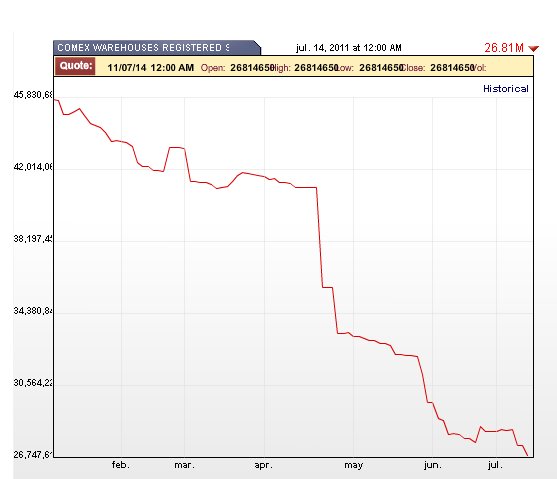
Clearly the COMEX vaults (on the dealer side), which supposedly have 53 million oz's in reserve, are probably empty (the silver having been leased out to other entities in the giant silver ponzi and not available at this time).
Oh my!
So what does that mean for the 923 contracts which are currently standing for delivery?
Well... there's an interesting thread playing out on a yahoo chatboard right now.
The poster claims that he has bought 3 of those COMEX contracts (150,000 oz of silver) and wanting physical delivery. He states the COMEX has advised he may not be getting his silver delivery, but they have offered him shares of the exchange traded fund SLV plus a premium of 70%.
The key element of this story, of course, is that the COMEX is supposed to be THE key pricing mechanism for the price discovery of the true value of silver.
If this, and similar stories, are true than the COMEX is now an extremely broken pricing mechanism since it cannot gauge real supply and demand. There is a demand for silver, the silver isn't available, so the price should be moving higher in order to make the silver available to those who want it NOW.
More importantly, if there's a shortage of a specific commodity you can't have a certain party (hello JP Morgan Chase) naked shorting in order to manipulate the price down. You can short a contract if you have a supply of the commodity to back it up, it's illegal to short if you can't.
You will hear the argument that COMEX commodity contracts are mostly traded by investors who never intend to take physical delivery. Instead, they normally exit their contract before maturity or replace it with another contract with a maturity further in the future. As a result of this practice, the available inventories held to make contract deliveries only cover a small fraction of outstanding contracts.
The fact that so many want physical delivery right now, the COMEX defenders will claim, is an anomaly.
But as demand for silver increases, the reality is that this situation is not an anomaly.
And the reality is that JP Morgan and HSBC are probably naked shorting huge amounts of silver that they can't even supply to the market.
If the short squeeze continues, the dam will have to burst and the spot price of silver will have to rise dramatically to reflect the current supply/demand situation.
We continue to watch the COMEX situation with keen interest.
==================
Email: village_whisperer@live.ca
Click 'comments' below to contribute to this post.
An evening post for you. Make sure to check out the earlier post "Is a desperate JP Morgan now the only large institution shorting the Silver market?"
The numbers are in from the COMEX and what is developing is unprecedented in COMEX history.
The number of open contracts standing for delivery of physical silver for the March deliver dropped from 1876 to 1675 for a drop of 201 contracts (each contract representing 5,000 ounces of silver), but there were only 5 delivery notices today.
And it's that lack of physical delivery that is the story.
According to Harvey Organ, "for the 5th straight day we have had little notices to deliver. Actually the only delivery has been through the customer who loaned his silver to the dealer to settle upon 1.2 million oz. The 201 contraction of OI for March can only mean that these were settled with cash and a handsome profit."
It is very clear the COMEX is seriously stressed to deliver the physical silver for the March delivery.
The topic of JP Morgan's massive short increase in February is generating lots of discussion in the blogosphere. The fact that JP Morgan increased their short position by 5,880 contracts (or 29.4 million ounces) in a month where the price of silver rose by 25% is astonishing. The general consensus is that the price of silver would almost assuredly be over $50/oz right now if JP Morgan had not dumped 30 million ounces of paper silver on the market. The fact that silver rose by $7 while this wsas occuring is a testiment to the huge demand for silver.
It is worth noting that the current premium to NAV of the Sprott Physical Silver fund is now 20%.
If you are unfamiliar with the terms, regular open-end mutual fundsh are bought and sold directly from the fund company at the net asset value (NAV) of their portfolio securities.
ETFs and closed-end funds trade at prices determined by the market forces of supply and demand. A fund that trades at a price higher than its NAV is said to trade at a premium to its NAV.
Sprott is currently trading at a premium of 20% over it's net asset value.
This is a strong indication of the reality that actual phyiscal silver is valued higher than the price that manipulated paper silver is trading at.
==================
Email: village_whisperer@live.ca
Click 'comments' below to contribute to this post.
As you will recall from this post on March 1, there were 4,250 contracts representing 21,250,000 oz of Silver which are standing for physical delivery this week in the delivery month of March.
Furthermore, early evidence from the COMEX seemed to indicate that the COMEX was severly stressed to provide physical Silver for these contracts.
According to analyst Harvey Organ, since then the Open Interest standing for delivery first fell from 4,250 contracts to 2,833 (1,417 contracts settled) but there were only deliveries on 250 contracts. This indicates the rest settled for cash.
(Which as you will recall was the whole objective in the rumour set out in Part 5: The Short Squeeze).
Organ reports that on the second day of settlement, the Open Interest fall from 2,833 contracts to 2,251. But there were only 42 delivery notices, meaning 540 contracts appear to have settled for cash.
(Remember each contract represents 5,000 ozs of Silver).
Yesterday Organ advises that "a miniscule 9 contracts (45000 oz) were served today. This is the third straight day that the deliveries have been tiny which indicate that the vaults are empty of silver metal. 2,242 contractsor 11,210,000 oz remain to be served upon. We have lost approximately 8.4 million oz to cash settlements these past two days."
And the rumour mill is cranking up about those cash settlements.
The same group that purported to lay out the plan for the short squeeze that we covered in Part 5 of our Silver series have surfaced on a couple of chatboards stating that they are amongst the group that have been paid out.
In announcing this development, there are some very interesting claims made. We have no way of validating this and as such it MUST be treated as rumour. However, here is a screenshot of what was posted (click on image to enlarge):
The group is claiming they were paid an 80% premium because the COMEX simply couldn't deliver on the contracts that are outstanding. An 80% premium means that they were paid at an equivilant of over $50 an ounce to go away.
There is no way to confirm if this is true. However, as Harvey Organ notes, for three days the number of deliveries of physical silver has been very small. This is highly unusual and indicates that the COMEX doesn't have the physical silver to deliver to those standing for physical.
In this enviroment, a premium of $50/oz in fiat cash is not unreasonable. And it is you clearest indication yet that silver at $34/oz is not only cheap, but highly undervalued.
More as this story plays out.
==================
Email: village_whisperer@live.ca
Click 'comments' below to contribute to this post.
Organ went on to note that in the official transactions for silver, there were no deposits of any kind into the dealer nor the customer. This is very strange in a delivery month for silver. On the customer side of the ledger, there was a withdrawal of 378,386 oz of silver.
Organ speculates that the situation at the silver comex is quite dire as they must resort to withdrawals from customer inventory to settle futures contracts on the first day of settlement week. Quoting Organ:
Silver has hit fresh 30 year highs the past two days. Is silver shooting up in price as a desperate scramble ensues to procure physical?
We'll watch events closely.
==================
Email: village_whisperer@live.ca
Click 'comments' below to contribute to this post.
Evening Gang. Part 4 is not ready tonight, but what a wild day for those of us who do follow silver. If you click on the image above, it will enlarge for you showing you how silver was raided today.
Why the massive drop?
Is the silver supply issue suddenly all better?
Did we suddenly discover a couple billion ounces laying around somewhere?
Did the U.S. suddenly balance its budget?
Are all of the U.S. states suddenly solvent?
Nope... it was a raid, pure and simple. Designed to drive away the massive open interest of buyers who are still standing for delivery of physical silver in March.
Today was options expiry for Silver and the Cabal launched a massive attack to drive the price down. As you can see in the graph, we went from over $33.20 down to $31.70, a huge drop of $1.50 in a very short period of time.
In any other era, this would have sent Silver cascading lower still and kept it down for months afterward. It is truly a testament to the paradigm shift we are seeing in precious metals that not only did Silver not cascade downward in price, but that it actually rebounded and, as this is written, sits at $32.52.
The Comex is facing a dilemma. And it all has to do with sourcing physical silver (more on this in Part 4 of our series).
How difficult is it to find large amounts of silver?
King World News had a great interview with David Madge, director of bullion sales at the Royal Canadian Mint.
When asked if the RCM is having trouble acquiring silver Madge responded,
Madge goes on to say,
When asked what this means for the price of silver and how long this condition is expected to persist Madge stated,
So here you have the Royal Canadian Mint telling us that they expect it to become even more difficult in the future to secure supplies of silver. As King World notes, this is an extremely important testimonial regarding how tight the silver market is because the information is coming directly from the Royal Canadian Mint itself.
Although I haven't posted Part 4 (The Short Squeeze) yet, we are closing in on the cut off for March delivery for physical silver from the COMEX and open interest for the delivery of physical silver remains massively high.
As mentioned yesterday COMEX silver inventories are at 4 year lows. Total dealer inventory is now 42.16 million ounces and total customer inventory is now at 60.68 million ounces, giving a combined total of 102.847 million ounces.
Today's open interest stands at 28,000 contracts. To give you a sense of how massive that is, 28,000 contracts = 140,000,000 oz's still standing for delivery.
And if the Royal Canadian Mint is having difficulty sourcing additional silver, you know the COMEX is in a desperate position.
Tomorrow should be an interesting day indeed on the silver markets.
==================
Email: village_whisperer@live.ca
Click 'comments' below to contribute to this post.
Email: village_whisperer@live.ca
Click 'comments' below to contribute to this post.
Last December, when President Obama announced a tentative deal with Congressional Republicans to extend the Bush-era tax cuts at all income levels for two years, you could clearly see the writing on the wall.
Extending those tax cuts will cost $900 Billion - equal to QE2. In essence we had QE3.
And as the political realities of the mounting debt issues of the US Federal Goverment met head on with the burgeoning debts of the individual US States and cities, there is no practical way out of the debt problem – none.
QE4, 5 and 6 are all but assured.
And it's not just America.
As I wrote last May, the story of the coming decade is one of soverign debt and how nation's respond to it.
I wrote then that this is already creating a mini-panic and rush on precious metals, a trend which will only intensify. Almost a year later, that demand has most definately intensified.
For large scale buyers of precious metals, the primary source to acquire Silver is via the COMEX.
So before talking about what is happening in Silver, we must first understand the COMEX and how it works.
What is the Comex?
There used to be two exchanges in New York. The New York Mercantile Exchange and the Commodity Exchange, Inc (COMEX). In 2006 these two exchanged merged and became one. It is now the New York Mercantile Exchange (NYMEX) but is divided into two parts, the NYMEX Division upon which is traded such commodities as oil, gas, palladium and platinum and so forth, and the COMEX Division on which gold, silver copper and aluminum is traded. On this exchange are traded 'Future Contracts' of gold and silver.
Futures Trading
Futures trading is the basic action of entering into a legal contractual agreement with another (known or usually not known) individual to exchange money or assets of some value at some time in the future and with the pre-determined price (called a futures price) based on the underlying asset. Such an asset could be stock, an interest rate even or, in this case gold or silver.
So traders agree to exchange gold/silver (or equivalent cash flows) at a future date.
When you enter into these contracts you are betting that the value or price of that asset or stock or gold is going to be at a certain value at a predetermined time in the future. At that time, when the contact is completed and 'settlement date' arrives, you or the other party cough up with the difference between what was originally paid and what the settlement price is.
One of the perceived advantages of futures trading is that you do not have to put up all the money needed for the contract but usually only a percentage. Usually around 10%. This means that people can trade with a smaller amount. It is rather like going to the races and placing a bet for 1000 dollars but only putting 100 dollars down. If you lose you have to come up with the 1000 dollars of course but if you win you have only needed 100 dollars to play the game. There are some other factors, of course, but that's the primary gist.
Both parties of a futures contract must fulfill the contract on the settlement date. The seller then delivers the commodity to the buyer, or, more often than not, it is a cash-settled future, and cash is transferred from the futures trader who sustained a loss to the one who made a profit.
Incidentally, you can bet both ways of course, that the price will go up or down.
To take actual phyical delivery of the silver in a contract, you will need to wait until the term of the contract expires and you can take delivery. This is called taking a long term. Various entities, such as banks for example, take a short term. They have no intention of taking delivery and so, with the ten percent leverage mentioned earlier, they can take enormous amounts of contracts and sell them short, keeping the price down and, in effect, manipulating the gold and silver price.
But if you intend to take possession you will have to ante up the whole amount required to complete that contract and you would have to wait until the contract expires before you can organise and take delivery.
For example, if a contract was bought today, and the price on the gold contract was between $695 - $735 per ounce, the full value of the contract you bought would be $69,500 - $73,500 per 100-troy ounce. Likewise if the price on the silver contract was between $9.74 - $9.16 per ounce, then it would be $48,700 - $45,800 per 5,000 troy-ounce contract.
These figures would not include any commission charges incurred going through a broker of course and are just an example to illustrate how it works.
Of course, if you did not want to take possession of the metal you could simply enter a position without posting the full contract value, but instead post around 10 percent (The actual percentage may vary depending on your broker and other factors). This is the "margin" which is posted "in good faith". Price can go through some dramatic changes in the any futures market and if the price of gold drops significantly you might be called upon to add funds to your account to maintain your position. (called a maintenance margin) or you might find your position is liquidated. There is usually a risk maintenance level and if your account falls below that level then you would need to top up your account with the requisite funds.
Now, when the time comes to take delivery you will get a Notice of Delivery and the full amount will be debited from your account. So you would be required to have the full contract value deposited in your account with your broker at the price the contract was originally purchased. There would be a few days of processing at the end of the contract but then you would be able to take possession, usually a couple of weeks later.
You can do this in three ways.
You will receive a receipt, which in effect is like a stock certificate, and you could store that. The gold would be in storage in a vault and you would be up for some storage charges, This premium, compared to the gold price, will be minuscule. The gold is kept in storage for you and you can take physical delivery anytime you want of course. This is the first method.
The second is that you could have the gold bullion shipped to a warehouse. You can be put in touch with the vault that contains your gold (generally in or around New York, US) and have brinks or an Armored car transfer your gold to a warehouse or bank of your choosing. There would be more costs involved with this but, again, the charges would not be very much compared to the value of the gold bullion.
Of course you can avoid doing any of this by simply depositing the full value of the contract when you establish the position. Note, you can decide not to take delivery of course at any time and close out your metals position and take a profit or loss depending on the price movement.
However, IF you want to take it out of the Comex warehouse and have it stored elsewhere then it would be your responsibility to organise this. This would be typically done through a security shipping service and arranged storage at a bank vault.
If your intent is to actually receive the physical metal, it is held in storage at specific "delivery points." It is your responsibility to make the arrangements to do this. There are fees associated with removal from the storage facility. In addition, if the metal is taken out of storage, it cannot be sold for delivery on the exchange without being re-assayed.
Tomorrow we'll talk about the banking cabal manipulation of the Comex, something you will see on a massive scale in overnight trading of silver tonight in a desperate attempt to bring the price of silver down.
==================
Email: village_whisperer@live.ca
Click 'comments' below to contribute to this post.
History of Central Banks and why we must End the Federal Reserve
- Ralph Nader on CNN
The author(s) of the posts on this site are not investment advisors and they do not offer investment advice. They try to provide some hopefully useful data with sources - especially concerning real estate - and then add their own analysis.
All the content on this website is solely an expression of the author's personal interests and is posted as free-of-charge opinion and commentary. Nothing here is intended as investment advice. If you seek investment advice, consult a registered, qualified investment advisor.