Showing posts with label JP Morgan. Show all posts

Wednesday, November 16, 2011

Keeping the balls in the air


The email inbox overflows from yesterday's posting on the political attack video about Vancouver's Mayor Moonbeam, clearly striking a nerve on various sides of the civic political spectrum.

Today, however, we switch gears and go back to world's debt problems.

As we have commented before, debt will be the issue of this coming decade... specifically Sovereign Debt. 

The ticking time bomb in this mess is the financial product known as 'derivatives', vehicles which Warren Buffet labeled as "financial weapons of mass destruction".

I am fond of saying that what we experienced in 2008 was a deep, financial earthquake - the repercussions of which we do not fully appreciate nor understand.

I maintain that viewpoint even today.

The chain of events set into motion in 2008 still has a long way to play out. A massive amount of private and public debt  has accumulated and the system needs to allow this debt to unwind, no matter how painful this process will be (and it will be painful).

We cannot have meaningful recovery until this happens.

But Western governments have not allowed this to happen. They have intervened to prevent the pain.

The slate needs to be wiped clean but the problem is eliminating all these debts, deficits and unfunded social entitilements will trigger the gorilla in the room: the $600 trillion of derivatives created by the banks.

This is why the Euro zone and the PIIGS is such an important topic.

Bloomberg hilighted this today by reporting that JP Morgan and Goldman Sachs have disclosed to shareholders those two banks alone have have sold protection on more than $5 trillion of debt globally (much of it dependant on the debt of Greece, Italy and Spain).

Bloomberg notes, "as concerns mount that those countries may not be creditworthy, investors are being kept in the dark about how much risk U.S. banks face from a default. Firms including Goldman Sachs and JPMorgan don’t provide a full picture of potential losses and gains in such a scenario, giving only net numbers or excluding some derivatives altogether."

The banking system has enabled the creation of an unsustainable mountain of debt.

What we have watched since 2008 has been nothing more than a complex juggling act that has - so far - failed to deal with the root of the problem: eliminating the debt.

The crisis that looms on the horizion will be the biggest event in our lives and understanding/preparing for it will be the most important step you will ever take.

Future generations will look back upon the 25-year period after 2008 in a way that dwarfs the 25-year period that followed 1929.

==================

Email: village_whisperer@live.ca
Click 'comments' below to contribute to this post.
Please read disclaimer at bottom of blog.

Saturday, September 24, 2011

Desperate times, desperate measures


The idea that the Federal Reserve might need to 'engineer' a stock market crash has been brought up numerous times over the past two years in the blogosphere by other commentators.


As the current year has moved along, it has become abundantly clear that the Federal Reserve must initiate another round of Quantitative Easing.

The problem is that, rather than helping the economy, the last round of Quantitative Easing just pushed commodity prices through the roof. Especially the price of Gold, Silver and Copper. 

So the pressure on the Fed not to ease has become immense.

It has lead many to wonder if the Fed might allow the stock market to tank in order to facilitate demand for QE3.

In the midst of this debate, as commodity prices have gone through the roof, the topic of derivatives has added an interesting angle.

The latest quarterly report from the Office Of the Currency Comptroller was just released and it presents in a crisp, clear and very much glaring format the fact that the top 5 banks in the US now account for a massively disproportionate amount of the derivative risk in the financial system.

Specifically, of the $250 trillion in gross notional amount of derivative contracts outstanding (consisting of Interest Rate, FX, Equity Contracts, Commodity and CDS) among the Top 25 commercial banks, a mere 5 banks account for 95.9% of all derivative exposure.

Earlier today Zero Hedge pondered if Morgan Stanley is sitting on an FX derivative time bomb.

And just last Saturday this blog wondered about the almost $80 trillion dollar derivative monster that JP Morgan was sitting on.

JP Morgan's massive short position in Silver is tied to a substantial number of derivatives which are triggered if the price of Silver remains above $36 per ounce for more than 60 consecutive trading days.

Is it a coincidence that the last time this deadline loomed (in early May, 2011) we saw a giant Silver smackdown?

Back then five margin hikes on traders in 8 days forced massive liquidation by investors trading on credit.

It triggered a sell-off that cascaded the paper price of Silver down to the mid $32.00 level, thus defusing the looming derivative time bomb.

Fast forward to September 2011.

After the May smackdown, Silver rebounded into the low $40 range despite massive shorting by JP Morgan.  On September 14th we outlined for you how the September CFTC Bank Participation report indicated that the four large US banks (primarily JP Morgan) had increased their silver shorts by 809 contracts in August from 23,775 to 24,584.

This was an increase of 4.05 Million ounces to the manipulative short position in silver in a single month. More importantly the total naked short position is up to 24,584 contracts.

It meant that JP Morgan has rebuilt their massive silver short position almost entirely back to the 25,412 contract position held prior to the giant short squeeze of August 2010.

This was all done in a frantic effort to beat Silver down below $36. But despite this massive manipulative downward pressure on the spot paper price of Silver, JP Morgan was facing another showdown with the Silver derivative time bomb.

Worldwide demand for Silver and Gold during this latest phase of the Sovereign debt crisis failed to dampen demand. Rather than drive drive investors away from the metal after the May smackdown because it is too volatile, buyers continued to accumulate Silver and the spot price was nearing another 60 consecutive trading days above the crucial $36 mark.

Derivative contracts on Gold were also nearing their tipping point.

When the Federal Reserve held their rare 2 day FOMC meeting last week, expectations were rampant that QE 3 would be announced in addition to measures like 'Operation Twist'.

When the Fed failed to impliment QE 3, the market tanked.

Was it a deliberate move?

Is a temporary minor market collapse a much lesser evil than allowing the top bank on the derivative list (JP Morgan) to implode from derivative exposure?

Not announcing QE 3 triggered a collapse in stock prices which had been pricing in the QE 3 announcement.  This forced liquidation.

And when we say 'liquidation', we mean wide-spread liquidation. Massive liquidation across asset classes such as currencies, bonds, commodities and stocks. All moved swiftly and sharply in a direction that screamed - Seek safety! Raise cash! Get liquid.

It's hard to imagine the Fed was ignorant of the impact not moving forward with QE3 would have.

Then, on Friday while stocks and the dollar all paused from the frantic selling, Gold and Silver were hammered. And the selling looked to be more calculated than incidental as it has been throughout the week.

There is little doubt that some of this is the association with usual gaming of the COMEX option expiration next week, and the potential delivery situation on that exchange with their unusually thin supplies and concentrated short positions held by a few of the banks.

But the trading volume in Gold on Friday was monstrous...in the neighbourhood of 340,000 contracts net.

In Silver net volume was an out-of-this world 114,000 contracts. This volume represented more than 100% of silver's total open interest. Just think about that for a second.

Then came the CME announcing a margin increase of 21% for Gold and 16% for Silver.

Warren Buffet famously called derivatives "financial weapons of mass destruction."

We were reaching a point where those derivaties could have wiped out JP Morgan and the other big four banks.

Desperate times called for desperate measures.  And it was desperate measures that were enacted this week to bring commodities down.

I would suggest to you that the stock market collapse this past week was but collateral damage in a far more significant battle.

==================
Email: village_whisperer@live.ca
Click 'comments' below to contribute to this post.
Please read disclaimer at bottom of blog.

Saturday, September 17, 2011

Epic? (updated)


The big news today is rampant rumours of an impending Greek default and it has some speculating that the big day may come as soon as September 20th.

The thinking is that Greece has two big bonds with coupon payments due that day totalling 769 Million Euro. So if the IMF wanted to avoid letting another billion euro go down the drain, September 20th would be a good day to do it.

Then there is the US Federal Reserve.

The Fed has their rare 2 day FOMC meeting starting on September 20th.

Maybe the fact these two events fall on the same day is a coincidence, but what better way to be prepared for new emergency policies than to have to act on a Greek default?

Speaking of FED rumours, financial analyst David Rosenberg has been speculating that the outcome of the FOMC meeting could produce stimulus far greater than what anyone is expecting.  "If Bernanke wants to juice the stock market, then he must do something to surprise the market. 'Operation Twist' is already baked in, which means he has to do that and a lot more to generate the positive surprise he clearly desires."

All of this is clearly spooking China.

As Ambrose Evans-Pritchard notes in The Telegraph, a key rate setter for China's central bank let slip that Beijing aims to run down its portfolio of US debt as soon as safely possible.

"We would like to buy stakes in Boeing, Intel, and Apple, and maybe we should invest in these types of companies in a proactive way. Once the US Treasury market stabilizes we can liquidate more of our holdings of Treasuries," he said.

This appears to be the  first time that a top adviser to China's central bank has uttered the word "liquidate" in relation to US Treasuries. Until now the policy has been to diversify slowly by investing the fresh $200bn accumulated each quarter into other currencies and assets – chiefly AAA euro debt from Germany, France. 

And what size of a 'liquidation' are we talking about?

It is estimated that over $2.2 trillion US Dollars is held by SAFE (State Administration of Foreign Exchange), the bank's FX arm. 

Finally, the last tidbit in the rumour mill for today focuses on the infamous JP Morgan.

As we posted yesterday, a detailed class-action lawsuit has been publicly released on the silver price manipulation activities by JPM. The suit outlines exactly how JP Morgan has been conducting it's manipulation including specific names and titles of those JPM employees involved.

But the rumours focus, not on the Silver manipulation lawsuit, but on JPM's outstanding derivative position.

As faithful readers probably already know, JP Morgan is sitting on a $80 trillion plus derivatives monster.

Derivatives are securities whose value depends on the values of other basic underlying securities. Derivatives have exploded in use over the past two decades. They include such well known instruments as futures and options which are actively traded on numerous exchanges and as well numerous over-the-counter instruments such as interest rate swaps, forward contracts in foreign exchange and interest rates, and various commodity and equity derivatives.

And as noted at the end of this 2009 Business Week article, JP Morgan has the face-value equivalent of a mind-boggling $87 trillion in derivatives on its books.

Although your dutiful scribe cannot confirm it with a credible citation, the chatter is that if the price of Silver remains above $36 per ounce by mid/late October, the first of JPM's derivative bombs will denonate in their faces.

October always seems to be a volitle month in the world of global finance.

But if even only one of these stories plays itself out, October 2011 could be an epic month for the ages.

---------------------------------------------------------
Update
---------------------------------------------------------

Former U.K. Prime Minister Gordon Brown is speaking at the World Economic Forum in the Chinese port city of Dalian today and his candor is nothing short of astounding.
  • "European banks are grossly under-capitalized and the debt crisis is more serious for the region than the 2008 meltdown as governments are constrained by fiscal pressures. In 2008, governments could intervene to sort out the problems of banks. In 2011, banks have problems, but so too do governments."
That, in a nutshell, says it all.

But Brown went on and noted that while the ECB is part of the short-term solution, it needs additional assistance. The European Financial Stabilization Mechanism, which is run by the European Union’s 27-nation executive arm, is “not enough.”. “Substantially more resources” are required.
  • “The euro area problem is now moving to the center. The euro cannot survive in its present form, it’s going to have to be reformed dramatically. We are, I think, at an hour to midnight in the way that we look at this issue.”
A debt problem cannot be resolved with the creation of more debt, which is what authorities have been trying to do. 
  • “European banks as a whole are grossly under-capitalized. We’ve now got the interplay between banks that are not properly capitalized and sovereign debt problems that have arisen partly because we’ve socialized or accepted responsibility for the banks’ liabilities.”
Do you think you will ever hear such candor from the likes of US Federal Reserve Chairman Ben Bernnake?


==================
Email: village_whisperer@live.ca
Click 'comments' below to contribute to this post.
Please read disclaimer at bottom of blog.

Friday, September 16, 2011

Friday Post #2: The case against JP Morgan for Silver Manipulation

Faithful readers know this blog is extremely bullish on Silver and agrees with those who call Silver the 'Opportunity of the Decade'.

Those same readers also know this blog writes extensively on the manipulation of the Silver price on the COMEX.

With that in mind we bring you the latest lawsuit filed in US Courts alleging Silver manipulation by JP Morgan.

This lawsuit, filed on September 12th, is not the first one we have seen filed against JP Morgan for Silver price manipulation, but it is the first that provides details on JPM's specific manipulation techniques.

If the topic of Silver interests you, this is a must read.

11-09-12 FINAL Consolidated Class Action Complaint

==================
Email: village_whisperer@live.ca
Click 'comments' below to contribute to this post.
Please read disclaimer at bottom of blog.

Wednesday, September 14, 2011

Silver and the massive JP Morgan short position


Faithful readers who follow this blog know that we extol the virtues and opportunities of Silver. 

The metal has been call 'The Opportunity of the Decade' by the likes of Eric Sprott of Sprott Asset Management.

But at the same time many of you have found Silver to be extraordinarily frustrating.

The precious metals are highly manipulated by the banking cartel's who are in line with the US Federal Reserve policy of market intervention to support the US Dollar.

And when it comes to Silver, the banking cartel is almost singlehandedly represented by JP Morgan which holds the largest short position in any commodity in the history of commodities trading.

In 2010, as summer wound down, we were very excited about the prospects for Silver.  It appeared conditions were lining up for a giant short squeeze which would force short covering by JP Morgan. The end result would be a significant increase in the price as this squeeze occurred.

Here is how the Silver spot price played out from August 2010 to April 2011.

In August 2010, Silver was sitting at just over $18 per ounce and jumped up to $19.00 (click on all images to enlarge).


During September 2010 we saw the spot price soar from $19.50 to $22.00.


In October 2010, Silver went from $22.00 to an intra month high of over $24.00.


In November 2010, Silver had a low of $24.00 and hit highs of almost $29.00.


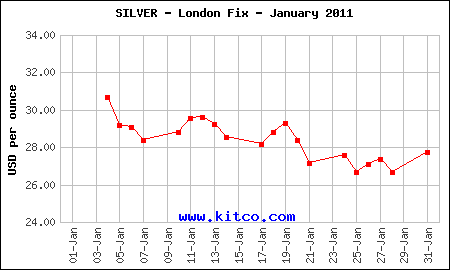
December 2010 saw Silver on a roller coaster ride from $28.00 to over $30.60.


In January 2011, Silver got beaten down from $31.00 to $27.90.


Silver rebounded with a vengeance in February 2011 and went from $28.00 to just under $34.00.


In March 2011, Silver went from $34.00 to $38.00.


Then, in April 2011, Silver soared from $38.00 to over $49.00 per ounce.


Since then Silver has been beaten down and hovers in the $40.00 range.

You don't see much coverage of this short squeeze in the press. Most mainstream pundits and reporters have assumed that it was speculative buying that caused Silver's huge rise from $18.00 to $49.75.

There is no doubt that a lot of speculative money was starting to enter the fray towards the end of the winter run.

However, in futures markets, huge moves like we say from August 2010 - April 2011 are often the result of short squeezes.

And have no doubt, this is exactly what happened in Silver.

sentimentrader.com is a great resource and produced the following chart. It is produced from data compiled from the Commitment of Traders Report.  The chart shows both the Silver open interest and the speculative long position had been trending down prior to August 2010 and outlines for us exactly why Silver spiked in price.


Both Silver's open interest and the speculative long position continued to decline during the massive price move from $18.00 - $49.75. 

When open interest falls but price rises, its a short squeeze.

The same thing happened with Cotton just a few months earlier and the Commitment of Traders Report tells us that the commercial traders (which includes JP Morgan) were covering their shorts massively.

How much did they cover?

Back in August 2010 the size of that naked short position was 25,412 contracts.

Remember, each contract representing 5,000 ounces of Silver. That means JP Morgan held paper promises they had sold for over 127 million ounces of Silver (127,060,000).

And during the short squeeze JP Morgan likely covered 24 million ounces of their naked short silver position at a massive loss.

This is why Silver rose so dramatically in value.

It wasn't because Silver was in a bubble. It wasn't because of irrational speculation by average investors. It was JP Morgan covering their naked short silver position at a massive loss.

That's why this blog was so excited and focused on the short squeeze in Silver that analysts were expecting in the fall of 2010.

So what's happened since then?

Well... in May we saw the famous 'take-down' of Silverr.  Five margin hikes on traders in 8 days forced massive liquidation by investors trading on credit.  This was combined with massive short selling once again by JP Morgan.

Silver plunged from $49.75 to to $33.00 then recovered to hover around the $40.00 mark.


The September CFTC Bank Participation report indicates that four large US banks increased their silver shorts by 809 contracts in August from 23,775 to 24,584.

This is an increase of 4.05 Million ounces to the manipulative short position in silver in a single month. More importantly the total naked short position is up to 24,584 contracts.

Grasp what has happened here.

JP Morgan has been rebuilding their silver short position almost entirely back to the 25,412 contract position held prior to the massive short squeeze in August 2010. 

Worldwide demand for Silver and Gold during the latest phase of the Sovereign debt crisis is going berserk. Rather dampen demand and drive investors away from the metal because it is too volatile, buyers continue to accumulate Silver.

The banking cartel is desperately flooding the paper market with paper promises of Silver and Gold in a frantic attempt to keep a lid on the prices of both Silver and Gold.

And as panic slowly grips Europe in the unfolding debt quagmire, demand is increasing even more.

Another short squeeze is looming on the horizon... with a corresponding huge jump in the price of Silver.

Are you ready to take advantage of it?

==================
Email: village_whisperer@live.ca
Click 'comments' below to contribute to this post.
Please read disclaimer at bottom of blog.

Thursday, September 8, 2011

Thur Post #2: Is Silver setting up for a massive price explosion at the end of September?


It's interesting to watch the movements of Silver in and out of the COMEX today.

Over the past 4 months there has only been 1 deposit of  deliverable Silver into JP Morgan's eligible vault.

But today JP Morgan announced they had increased their eligible COMEX Silver inventory from 180,247 ounces to 586,381 ounces.  That's a 225% increase overnight!

With the likely announcement of Quantitative Easing 3 by the US Federal Reserve in 2 weeks, Silver observers are wondering if this is a sign that JPM is gearing up for a massive amount of longs actually standing for delivery in September? 

If so Silver may be getting ready for a huge move up at the end of month/beginning of October.

==================
Email: village_whisperer@live.ca
Click 'comments' below to contribute to this post.
Please read disclaimer at bottom of blog.

Tuesday, May 24, 2011

UK government committee launches investigation into monopolistic trading practices by JP Morgan on London Bullion Exchange


Interesting item has come across Reuters earlier today. 

As many of the manipulative silver practices utilized by JP Morgan have been shifted away from the CFTC's reach at the COMEX and onto the London Bullion Exchange, news comes out that a UK government committee asking the UK Office of Fair Trading to launch an investigation into the activities of large dealers on the London Metal Exchange.

The allegations are that the four large companies that own LME registered warehouses are engaging in 'restrictive' business practices.  JP Morgan, as owner of warehouser Henry Bath, is specifically named in the allegations.

The UK Committee's allegations can be found here. From the link:
  • MARKET DOMINANCE
  • 79. We heard that there were large companies dealing metals within the UK and an allegation was made by the MMTA that a company through a subsidiary may be behaving in an anti-competitive manner: on the London Metal Exchange there are four very large companies that own the very warehouses that people deliver metal into, J.P. Morgan is one of them.
  • They own a company called Henry Bath. They are, therefore, a ring-dealing member of the exchange and they also own the warehouse. That is restrictive. They were also reported, at one point, to have had 50% of the stock of the metal on the London Metal Exchange.[113]
  • 80. We would be concerned if the ownership of metals storage warehouses by a dominant dealer on the London Metals Exchange were to be anti-competitive. We would also be concerned if a dealer who had the resources to own over 50% of stock on the London Metals Exchange impeded the correct functioning of the market.
  • 81. We use this report to bring the alleged activities of large dealers on the London Metals Exchange to the attention of the Office of Fair Trading. We would be concerned if a dealer were undermining the effective functioning of the market and we look for assurance that the market is functioning satisfactorily.
The LME's initial response is that the assertion is "unjustified and completely out of context".

==================
Email: village_whisperer@live.ca
Click 'comments' below to contribute to this post.
Please read disclaimer at bottom of blog.

Saturday, March 26, 2011

More commentary on the problems at the Silver COMEX

If you have been following the Silver COMEX story you might be interested in this.

Dave Kranzler of the Golden Truth gives his thoughts on the JP Morgan controversy about the establishment of it's own vault. Kranzler had 3 contracts (15,000 ounces) standing for delivery in March. He offered these thoughts on Friday.

  • The COMEX goes "Extend And Pretend" On JP Morgan's paper silver short. And in the process has likely perpetrated and enabled the continuation of the biggest fraud in the financial markets.

    By now everyone knows about the absurd imbalance between JPM's short position in the silver futures market and the availability of physical silver at the COMEX and in their ETF fund:SLV.

    To review, JPM's short position is several multiples of the amount of reported physical silver that is available for delivery at the Comex. For purposes of this commentary, I will set aside any discussion about whether or not the reported inventory is actually there or not. Of course, you would have to be either ignorant of the facts or an idiot to believe that it is.

    It was announced 10 days ago that JPM was approved by the CME to operate a COMEX metals storage vault. While on the surface this is no big deal, the manner in which JPM managed to get around the full review process has raised a lot of knowledgeable eyebrows in the precious metals market, especially in the context that JPM - by far - has the largest short position in paper silver in the universe, in addition to also having the largest proprietary position in OTC gold and silver derivatives.

    Again, both states of existence would be no big deal as long as the world could verify with its own eyes that JPM actually has the ability to deliver the underlying physical metal represented by the firm's absurdly massive short position.

    That is the crux of the problem.

    Show me the metal you can deliver and feel free to make markets and short away.

    Otherwise there needs to legally enforced scrutiny. The CME, with its hastened approval of JPM as a vault operator has demonstrated that it is unwilling to enforce legal scrutiny. Furthermore, The JPM COMEX vault news tells us all we need to know about the extent to which the bullion banks... will go to fight their problem with precious metals.

    Operating a gold and silver vault will now enable JPM to exploit the fact that most metals players who take delivery of their metal typically let it remain at COMEX vaults for safekeeping. Again no big deal, because it is convenient and saves delivery fees, as long as the owners of the metal hold the vault operators accountable.

    In other words, if more players stand for delivery than JPM has available to actually physically deliver, JPM can just notify the owner that delivery has been made to its vault without ever having to make the actual delivery unless the owner asks for delivery into a private depository off the COMEX. It has long been suspected that all of the current vault operators, especially HSBC and Scotia, engage in this "fractional" bullion banking scheme, but now that JPM has entered the vault storage game, there is no doubt in my mind that the COMEX is running low on deliverable metal.

    And by extension, it also serves to reason that SLV is running low on metal (JPM is the vault custodian for SLV - hmmm...), although I do not, like many, believe that SLV is empty. Again, a lot of commentators out there squawk about SLV being empty without ever having bona fide actual proof. I think from the standpoint of probability analysis, SLV is at least 1/3 covered (at any given time a large holder can exchange his SLV shares for delivery of metal - my bet is that SLV has enough to cover this present value of this possibility). I believe the COMEX is less than 1/3 covered and this is why JPM had to rush into the vaulting business and jammed thru its approval by skirting the standard rules.

    Everyone who trades this stuff knows that there is a massively inordinately large amount of outstanding silver contracts still open with last delivery day being next Thursday March 31st.

    As of today there were still 632 open contracts representing 3.16 million ounces of silver. I have never seen this large amount of open contracts so late in the delivery process. And given that the COMEX is reporting as of yesterday that over 41 million ounces of silver are available for delivery, it tends to raise a lot of skepticism about the amount of silver that is actually physically there to be delivered.

    Historically, most open contracts in a delivery month get filled within the first two weeks of that month. If this view is correct, it would make sense then that JPM wanted to rush through the approval of a licensed vault that it make phantom deliveries into and no one would know the difference unless they ask for delivery out of the vault.

    Again, probability analysis would say that very little of that silver will be called upon like that (by the way, anyone can track the reported flows of silver in and out of COMEX vaults at the CME website: you can also track daily changes in open interest, etc on that site, that's how I know that very little metal that is delivered actually is demanded from the COMEX vaults).

    Essentially JPM is playing a game of chicken.

    Since JPM likely does not have the resources to make good on the actual physical delivery of all of the silver that is standing for delivery, the next best alternative is to play the odds and deliver electronic silver into a surreptitiously approved vault and anticipate that most, if not all, of the deliverees (the "stoppers") will never ask for private delivery.

    Our fund stood for delivery of 3 contracts this month. We were given notice on one of them right after first notice day and that silver was made available by HSBC to be picked up by our carrier and delivered to our private depository within the appropriate time frame.

    HSBC, however, changed the rules on the other 2 contracts.

    We were notified that the silver for the other two contracts was being delivered last week. Why they waited 3 weeks to notify us on the other two is open for conjecture. HOWEVER, this time HSBC informed my partner that in order for us to send a carrier to pick up the bars he had to fill out a bunch of paperwork and send a copy of his driver's license and that it would take HSBC five days to process everything. Today being the 5th day, we called for a status update. They informed him that he had to send them a copy of his passport because his driver's license had expired. I'm not sure how long it would have been before they notified us of that fact if we had not called.

    The point here is that we are now seeing all kinds of tactics being legally - and illegally - employed in order to make the process of taking delivery of metal from the COMEX more burdensome and further enabling the big ponzi scheme to keep going on there.

    The fact of the matter stands that events like the JPM vault and the sudden new delivery requirements of HSBC serve to further amplify the fact that the COMEX and SLV are running out of actual physical silver and the desperation to hide this fact is growing stronger.

    While I still don't expect that a COMEX delivery default will occur this month, or even this year, the cracks in the system are growing wider and one of these days we will wake up in the morning to find gold and silver prices that are several multiples higher than the day before and the bid/ask spread in the markets for these products will be a country mile wide. THAT is a day that will fun watch.

==================

Email: village_whisperer@live.ca

Click 'comments' below to contribute to this post.

Please read disclaimer at bottom of blog.

Tuesday, March 22, 2011

The Silver shell game gets bigger

I was in the process of writing a post to answer some silver questions from the past few days when I came across this. I will try and answer those questions later.

If you have been following the silver story on the COMEX, you know that the short squeeze in silver is heating up and with 8 days left in the delivery month of March the situation is getting intense.

As of Monday there remained 896 contracts representing 4,480,000 oz of silver which were left to be serviced (delivered). This represents a full 50% of the March contracts which still have to be delivered.

Various analyst's have commented that never in silver COMEX history has an amount still standing for delivery been equal to the amount already served this late in the month.

With 8 days left, an average of 560,000 oz must be serviced on each and every trading day until the end of this month. To our analyst's it is quite obvious that the COMEX does not have the silver available to service the patiently waiting contract holders.

This past weekend, however, there has been a curious development that is setting off alarm bells.

JP Morgan Chase was just granted a silver vault licence on the COMEX. And the licence was granted lightening speed compared to other licence's.

The respected online site Seeking Alpha asks:

  • Why was JPM awarded a vault license almost overnight, avoiding the lengthy vetting process others must undergo? Why did it happen in the middle of a major COMEX silver delivery month, during a massive worldwide silver short squeeze, at a time when physical silver is in severe shortage?

Alpha then connects the dots.

When silver is 'delivered' on these COMEX contracts, it is often a simple computer transaction. The vast amount of physical bars 'delivered' in a settlement never actually leave the warehouse. They are simply 'credited' to the new owner and left in the warehouse (with the appropriate storage fees charged). Taking actual delivery of thousands of ounces of physical silver and moving it to your own storage location can be a costly process.

In the past, JP Morgan had to 'send' silver to HSBC, Brinks, Scotia Mocatta and/or the Delaware Depository in order to "deliver" it on COMEX. JP Morgan would have this silver already on deposit there and title ownership would be transferred to the contract holders upon settlement. HSBC, Brinks, Scotia Mocatta and/or the Delaware Depository would then confirm this with the contract holder.

But overnight JP Morgan has been granted it's own vault licence.

As Alpha notes:

  • If a short seller must deliver a commodity, and the commodity is not readily available, there is no better way to buy extra time than to be able to deliver into its own vault. Most of the metal will never leave the vault, and most delivered metal that will leave the vault won't leave right away. Indeed, paperwork tasks of transferring title can consume a few days. Thus, a late delivery may not be noticed if it is to the short seller's own vault if the vault operation staff chooses to remain silent.

In other words JP Morgan can claim they have the silver and it has been transferred to the new owner (when in fact there is no silver to be had) and the vault won't dispute this claim.

Therefore if JP Morgan doesn't have the necessary 4,480,000 oz of silver they have short sold by March 31st, they can 'deliver' fictitious silver and advise the contract holders their fictitious silver is 'waiting' for them in the JP Morgan vault.

Unless a customer demands immediate pickup and transportation of the physical silver, how does a customer know the silver is actually there? And even if pickup is demanded, paperwork and arrangements can delay the process of actual delivery up to a month.

Now that the third parties of HSBC, Brinks, Scotia Mocatta and/or the Delaware Depository have been eliminated, all customer's have is JP Morgan's guarantee/promise that the silver is there.

It's a shrewd, clever move. And it buys JP Morgan precious time to locate physical silver to deliver for the March contracts.

Seeking Alpha is already asking readers to pass on if anyone has any positive or negative experiences with the newly licensed J.P. Morgan vault.

Meanwhile JP Morgan has just tossed another ball in the air in it's ponzi juggling act.

==================

Email: village_whisperer@live.ca

Click 'comments' below to contribute to this post.

Please read disclaimer at bottom of blog.

Friday, March 18, 2011

So what's happening over at the COMEX with Silver?

Thought we would take a moment and take a look at silver again today.

According to analyst Harvey Organ, there remain 923 notices (or contracts) to be filled for the March Delivery period. Each contract is for 5,000 oz's so this represents 4,615,000 oz's still waiting to be delivered.

We are now equally balanced between the number of oz's that have been delivered by the COMEX this month with the number of oz's waiting to be delivered.

And while the COMEX has until the end of the month to deliver this silver, observers note that there has NEVER been a month where we have reached the halfway point and there remains 50% of the outstanding silver undelivered.

This is your greatest bit of evidence that silver is in short supply.

COMEX inventories are divided into registered and eligible categories. It would be most useful to think of these two categories as dealer and investor inventories, respectively. Registered inventories are committed to be delivered to fulfill maturing contracts. Eligible inventories are often stored in COMEX bonded warehouses to allow the owner the option to make the metal available to fulfill COMEX contracts, but there is no obligation for the owner to make the commodity available for the purpose.

The inventories that do exist may also be subject to the claims of other creditors.

Clearly the COMEX vaults (on the dealer side), which supposedly have 53 million oz's in reserve, are probably empty (the silver having been leased out to other entities in the giant silver ponzi and not available at this time).

Oh my!

So what does that mean for the 923 contracts which are currently standing for delivery?

Well... there's an interesting thread playing out on a yahoo chatboard right now.

The poster claims that he has bought 3 of those COMEX contracts (150,000 oz of silver) and wanting physical delivery. He states the COMEX has advised he may not be getting his silver delivery, but they have offered him shares of the exchange traded fund SLV plus a premium of 70%.

The key element of this story, of course, is that the COMEX is supposed to be THE key pricing mechanism for the price discovery of the true value of silver.

If this, and similar stories, are true than the COMEX is now an extremely broken pricing mechanism since it cannot gauge real supply and demand. There is a demand for silver, the silver isn't available, so the price should be moving higher in order to make the silver available to those who want it NOW.

More importantly, if there's a shortage of a specific commodity you can't have a certain party (hello JP Morgan Chase) naked shorting in order to manipulate the price down. You can short a contract if you have a supply of the commodity to back it up, it's illegal to short if you can't.

You will hear the argument that COMEX commodity contracts are mostly traded by investors who never intend to take physical delivery. Instead, they normally exit their contract before maturity or replace it with another contract with a maturity further in the future. As a result of this practice, the available inventories held to make contract deliveries only cover a small fraction of outstanding contracts.

The fact that so many want physical delivery right now, the COMEX defenders will claim, is an anomaly.

But as demand for silver increases, the reality is that this situation is not an anomaly.

And the reality is that JP Morgan and HSBC are probably naked shorting huge amounts of silver that they can't even supply to the market.

If the short squeeze continues, the dam will have to burst and the spot price of silver will have to rise dramatically to reflect the current supply/demand situation.

We continue to watch the COMEX situation with keen interest.

==================

Email: village_whisperer@live.ca

Click 'comments' below to contribute to this post.

Please read disclaimer at bottom of blog.

Wednesday, March 9, 2011

Poison Pill or Act of Desperation?

The Silver community continues to debate the latest developments from JP Morgan.

Last Friday the CFTC released their monthly Bank Participation Report (BPR) which revealed a startling statistic. After 3 months of desperately trying to cover their gigantic short position as the CFTC approached its March 28 deadline to impose position limit rules, the US Banks that control the price of silver decided to go back to their reckless shorting routine...BY A HUGE AMOUNT!

  • On November 2, 2010 those Banks were short 30,760 contracts (each contract representing 5,000 oz of silver).
  • On December 7th, 2010 they were short 26,332 contracts.
  • On January 4th, 2011 they were short 22,658 contracts.
  • And on February 1st, 2011 they were short 19,706 contracts.

For three consecutive months, as the CFTC Enforcement Division began hearings to set position limits, the US Banks were reducing their massive short position.

Then, on March 1, 2011, the latest BPR was posted and this trend was dramatically reversed and the US Bank short position grew by 5,880 contracts to stand at 25,586 contracts.

This is an increase in a short position of close to 30 million ounces. More significantly it appears that while this position was previously held by up to 8 US Banks, now JP Morgan stood alone as the lone short contract holder.

That is a STUNNING amount of new shorts added during the month of February. Even more significant when you consider the price of silver actually managed to RISE 25% during this time.

Had these new shorts not been placed on COMEX silver then the price would almost assuredly have exploded to over $50 per ounce and may have even gone to $100 per ounce.

The moves were clearly designed to keep a lid on the price of silver. But with the March 28th deadline for position limits looming, why would JP Morgan place themselves in such a predicament?

Two plausible reasons are being discussed around the blogosphere, both of which could be at play. I have a third, which I will offer at the end of the post.

(1) A Poison Pill

As the CFTC finally gets serious about enforcing the commodity laws, JP Morgan has tried to close out their 150 million ounce short position but they couldn't do it in time.

Once they saw that they couldn't get out of the hole they had dug for themselves (and as their position went viral in the blogosphere), they had to crank up their shorts to stop the price of silver from going parabolic.

Now they are trapped with no way to cover their short position before the 28th deadline.

In response, have JP Morgan decided on a 'scorched earth' silver shorting strategy? Are they opting to increase the size of their short so much that they become Too Big To Fail in the Silver Market?

Is this a way to protect themselves from the inevitable default in the COMEX silver market?

A skyrocketing silver price would destroy the US Bank short position and "Too Big To Fail" would have to come into play in both the implementation of position limits as well as potentially blaming the CFTC and Dodd-Frank Law for too much regulation which would bring down the US banking system.

The speculaton is that by making JP Morgan's silver position so large that it could threaten the survival of the Bank itself then JP Morgan must be bailed out to protect the entire system... in essence, the increase in shorts are a poison pill.

That brings us to...

(2) The Derivatives Threat

In previous posts we have mentioned the rumour about a group of former JP Morgan commodities employees who had allegedly banded with some hedge funds to execute a short squeeze on JP Morgan's short silver position.

This group has posted numerous messages on internet chatboards and on November 20th, 2010 the following message was posted on a yahoo chatboard:

  • JP Morgan is in worse shape then we ever dared to hope.

    This is what I am now hearing from traders on the floor. These traders are not even sure if Blythe knows the full extent of JPM's silver exposure.

    When I first started to realize that JPM has shorted far more silver than they could ever hope to cover, my first question was "why would they do that?" Not only that, why do it with a commodity where you must report your positions through the COT and Bank Participation Report? After all,the whole world can see what you are doing.

    Now I know the answer.

    According to Max Keiser and now a couple of other independent sources, it seems the reasons why first Bear Stearns and now JPM are so desperate to manipulate the price of silver down is due to the fact that BS and JPM shorted billions (yes billions not millions) in ounces of silver through their derivatives.

    Just like Joe Conason at AIG, silver shorting through derivatives have caused literally billions in losses not the millions that we know about publicly. That is why JPM has been so desperate to manipulate the price of silver downward so blatantly.

    If I am right about this, then JPM will be dead when silver hits $60 or so.

    Based upon the COT and BPR, if silver hits $60, JPM will lose around an additional $6 billion dollars, a large number but not nearly large enough to bring down mighty JPM.

    But what is not known is that due to the way that its derivatives are written, JPM's losses are exponential once silver breaks $36 or so. Rumors has it that JPM could be losing as much as $40 billion once silver is above $50. It has something to do with how the derivatives are written with payment tied to the price of silver.

    Since JPM was a price manipulator with respect to the price of silver, JPM assumed that any derivative payments tied to silver would be less than they would be tied to some other index like the CPI or TIPS implied inflation index. JPM's inability to hold down the price of silver relative to other measures of inflation will cause unbelievable losses due to a mismatch in their derivative structures.

    In essence, JPM has bet (a huge amount) through derivatives that silver will never outperform inflation. And why not,since JPM assumed that it will always be able to manipulate the price of silver. We have now come to understand that JPM's loss exposure to silver is much greater than we have ever dared to hope.

In another posting a few days later, this thought line continued:

  • In an effort to clear up some recent confusion regarding my latest posting, I will try to explain what I have recently uncovered.

    JPM's current short silver position is estimated to be approximately 150 million ounces down from the recent 180 million ounces in August. The losses from these positions are easy to figure out. For every $10 rise in the price of silver, JPM will lose $1.5 billion.

    But what I have recently discovered is that through its derivative positions, JPM will lose about 5 times that amount once the price of silver is above $36. And once silver is above $45 dollars, JPM's losses will increase to 8 times the amount of theur losses in their short positions. The reason is that as the price of silver increases, certain provisions get activated which multiplies the losses.

    One reader asks the question why isn't the price of JPM going down to reflect the losses in silver. My answer is that the price of silver is not high enough to begin to trigger losses in their derivative positions. But once silver approaches this critical level say around $36, then you should begin to see the price of JPM stock begin to reflect these losses.

    In fact, traders are saying that once the price of silver surpasses the stock price of JPM, then for every dollar the price of silver go up, JPM should lose around 70 cents or so. This means that if silver hits $60, JPM will be a single digit stock.

    JPM's market cap is around $170 billion. If silver losses are as great as $40 billion in cash, then JPM will be insolvent. Period.

    From your former traders (whom you dismissed so callously)

How valid is this speculation?

I have no idea.

There is certainly a fierce battle being waged around the $36 dollar level which is consistent with the November claims that JP Morgan would be in serious trouble if silver broke above $36.

The third option I have not seen considered by bloggers is that JP Morgan has inside info that the CFTC position limit proposal to be released March 28, 2011 has been sufficiently watered down to be ineffective. This would mean that JP Morgan can go back to their old ways unencumbered and that they have already started to do so.

==================

Email: village_whisperer@live.ca

Click 'comments' below to contribute to this post.

Please read disclaimer at bottom of blog.

Tuesday, December 14, 2010

Silver-Gate Intensifies

Faithful readers will recall my earlier posts on Silver-Gate here, here and here.

Basically the Commodity Futures Trading Commission (CFTC) has alleged that JP Morgan and HSBC have engaged in "fraudulent efforts to persuade and deviously control the price of silver."

In addition over six separate lawsuit have been filed alleging breaches of the Racketeering Influenced and Corrupt Organizations (RICO) Act by these two banks.

Now... the practice of naked short selling has long been a serious issue on Wall Street.

But of what we know about the scope and intent of JP Morgan and HSBC's actions in this particular short-selling scheme... well, it dwarfs any other similar attempt to manipulate a commodities market.

Intense scrutiny and attention has been brought to bear on JP Morgan in the last few months as a result of these investigations. This has severly restricted their ability to fully carry out their actions.

Silver, as a result, has shot up over 65% since August.

Many believe without JP Morgan's manipulation, silver will return to it's historic 1:16 ratio with gold. That would put silver at almost $100/oz instead of the current $29.58.

Critics, of course, say there is no manipulation and that nothing will come of this.

As reported last night on Zero Hedge, JP Morgan has come out and admitted it's massive short position and intends to dramatically reduce it.

If the topic interests you, read the Zero Hedge post.

At the moment, many believe the pledge to reduce it's holdings hasn't occurred yet and any claims that it has reduced it's position are just P/R to reduce negative media attention.

The saga still has a ways to play out. However... I suspect the almost 70% rise in the value of silver since August is nothing compared to what lies ahead.

Overnight, silver has surged another $0.30 when I wrote this (about 10:30pm last night). Action in silver is very high.

With that in mind, here is an analysis from the daily report of a silver trader I follow:

  • The total silver comex open interest fell by 935 contracts to 129,712 from Friday's reading of 130,647. The front delivery month OI registered today at 483 dropping 46 contracts from Friday reflecting the 50 notices sent down for servicing. The estimated volume today on the comex was an astoundingly high 111,854. The banking cartel threw everything at the longs trying to keep the price from escalating. The confirmed volume on Friday, ie. the day of the raid was also very high at 63,196. So if I feel that 63,196 is high you can just imagine what traders are wondering when they see an estimated volume at 111,854. By the way, that represents 555 million oz of silver or about 1 years production. Makes sense to me!! It looks like the bankers will try another raid tomorrow as the volume supplied today was just too much. The bankers are trapped and they will do just about anything trying to extricate themselves from their massive short positions in both silver and gold.

==================

Email:
village_whisperer@live.ca

Click 'comments' below to contribute to this post.

Please read disclaimer at bottom of blog.
Sunday, December 5, 2010

Ready to launch?

Yesterday I posted this Cartoon Bear explanation of the JP Morgan Silver Manipulation saga...

The video, as you discover at the end of the cartoon, was put together by the website Silvergoldsilver. Viewers are invited to visit the website to make purchases of physical silver if they found the video persuasive.

Well... the video has gone viral and caught the imagination of a lot of people.

And many of those people seem to have been converted. So much so that as of yesterday the company is not taking any orders and is sold out of all products. The company will not be accepting any new orders until December 6 (see their website).

This is only part of the intense interest building for the opening of markets on Monday.

November saw the start of an intense Internet campaign by Mike Krieger and Max Keiser to attack and destroy JP Morgan (the design you see posted at the top of this post is the logo for their campaign). The central component of the campaign is: if every person buys an ounce of silver JP Morgan and its massive synthetic silver short position will have no choice but to cover and face unprecedented margin calls. This could possibly lead to an end for JP Morgan.

By no coincidence, during the month of November the US mint sold a record amount of silver American Eagle coins.

Last Thursday the Krieger/Keiser campaign went mainstream with this article in the Guardian newspaper.

Silver is up 50% since August and as of Friday was once again flirting with the all important $30 dollar level.

This level is significant as outlined in Paul Brodsky’s presentation and comments delivered to the BCA Fall Investment Conference in New York on October 25, 2010.

Brodsky, and his partner Lee Quaintance, spent over twenty years as bond traders, running government and credit trading desks for one of the world’s largest banks and on the buy-side running fixed income investment funds prior to opening a macro fund.

Brodsky speculates that silver will hit resistance levels of $30, then $64 before going onto $140 an ounce in the very near future.

The events of the last month are culminating this week in what many observers expect will be a very wild week for both silver and gold.

I know I will be watching with keen interest.

Let's see what happens.

=================

Email: village_whisperer@live.ca

Click 'comments' below to contribute to this post.

Please read disclaimer at bottom of blog.

Wednesday, November 3, 2010

Update #2: Silver-Gate heats up

You will recall back on October 28th I talked about 'Silver-Gate', allegations by Commodity Futures Trading Commission (CFTC) Commissioner Bart Chilton that JP Morgan and HSBC have engaged in "fraudulent efforts to persuade and deviously control the price (of silver)."

Intensifying the issue is this development.

A separate lawsuit has now been filed n the Southern District of New York alleging breach of the Racketeering Influenced and Corrupt Organizations (RICO) Act.

Steve Berman, co-counsel of plaintiff law firm Hagens Berman Sobol Shapirof said:

  • "The practice of naked short selling has long been a serious issue on Wall Street. What we know about the scope and intent of JP Morgan and HSBC's actions in this short-selling scheme dwarfs any other similar attempt to manipulate a commodities market."

A significant element of this development is that the Plaintiffs are seeking that the court enjoin JP Morgan and HSBC from continuing their alleged conspiracy and manipulation of the silver futures and options contracts market.

Here is the content of a Hagens Berman internal statement on the case:

  • JP Morgan Chase & Co. (NYSE: JPM) and HSBC Securities Inc. (NYSE: HBC) face charges of manipulating the market for silver futures and options in violation of federal commodities and racketeering laws, according to a lawsuit filed in the U.S. District Court for the Southern District of New York.

    The suit – which alleges violation of the Commodity Exchange Act and the Racketeering Influenced and Corrupt Organizations (RICO) Act – alleges that the two banks colluded to manipulate the market for silver futures starting in the first half of 2008 by amassing huge short positions in silver futures contracts they had no intent to fill, but did so to force silver prices down to their benefit.

    According to the lawsuit, JP Morgan and HSBC used a variety of methods to coordinate their manipulation of the market for silver futures contracts, signaling when to flood the COMEX market with short positions, which caused the price of silver futures and options contracts to crash.

    In addition, the lawsuit states that both JP Morgan and HSBC still maintain highly concentrated holdings in short positions in silver futures and options, giving both banks the ability to continue manipulating the price of silver.

    Plaintiffs’ attorneys have asked the court to certify the case as a class action and enjoin JP Morgan and HSBC from continuing their alleged conspiracy and manipulation of the silver futures and options contracts market. Attorneys also ask the court to award damages and attorneys’ fees to the class.

    If you have information you believe is important to the case, please contact Hagens Berman at 206-623-7292 or by e-mail at JPMorgan@hbsslaw.com

It gets better and better with each passing day.

==================

Email: village_whisperer@live.ca

Click 'comments' below to contribute to this post.

Please read disclaimer at bottom of blog.

Thursday, October 28, 2010

Afternoon Update on Silver-Gate

Following up on Silver-Gate (see this morning's post) comes this news...

JPMorgan Chase & HSBC have been hit with two lawsuits by investors who accused them of conspiring to drive down silver prices.

The accusation is that these two banks manipulated the market for COMEX silver futures and options contracts from the first half of 2008 by amassing huge short positions in silver futures contracts that are designed to profit when prices fall.

The lawsuits were filed one day after the Commodity Futures Trading Commission proposed regulations to give it greater power to thwart traders who try to manipulate prices. The CFTC began probing allegations of silver price manipulation in September 2008.

As we mentioned this morning, CFTC Commissioner Bart Chilton has publicly stated that there had been "fraudulent efforts to persuade and deviously control" silver prices.

Earlier this year, the CFTC began looking into allegations by a London trader that JPMorgan was involved in manipulative silver trading.

==================

Email: village_whisperer@live.ca

Click 'comments' below to contribute to this post.

Please read disclaimer at bottom of blog.