Faithful readers know this blog is bullish on precious metals, particularly silver.
Some followers have lamented about the dearth of posts on the topic as of late. Reality is the movement in real estate is the bigger story right now. Silver and Gold have been in holding patterns and there hasn't been much to talk about.
That may be about to change.
And it is the British newspaper, the Daily Telegraph, that catches our attention today.
Silver will increase in value five times over the next three years, according to mixed asset fund manager Ian Williams.
"Silver is about to enter a sustained bull market that will take the price from the current level of $32 an ounce to $165 an ounce and we expect this price to be hit at the end of October 2015," he predicted.
"This forecast is based entirely using technical & cyclical analysis and is in keeping with the mathematical form displayed so far in the bull run that has taken Silver from $8 an ounce in 2008 to its current price of $32 an ounce – having hit $50 an ounce in 2011."
Mr Williams said that the silver price was more volatile than gold, but that he expected silver to continue to dramatically outperform gold.
The Charteris manager said that macro fundamentals were supportive for the silver price, such as the re-election of President Obama, who supports Ben Bernanke's policy of quantitative easing.
Darius McDermott of Chelsea Financial Services agreed that QE means good news for precious metals.
"Strong demand for precious metals will remain as long as we have QE, which do well with each round of money printing. QE is bound to lead to inflation at some point and at that time, real assets will do best," he said.
"Investing in a fund that holds a range of precious metals gives you positive diversification and less reliance on just gold."
China needs to add to its gold reserves to ensure national economic and financial safety, promote yuan globalization and as a hedge against foreign- reserve risks, Gao Wei, an official from the Department of International Economic Affairs of Ministry of Foreign Affairs, writes in a commentary in the China Securities Journal today. While gold prices are currently near record highs, China can build its reserves by buying low and selling high amid the short-term volatility, Gao writes in newspaper. China’s gold reserve is “too small”, Gao says
Gao Wei is a Chinese official with a key political post. And he has just given the first hint that China is preparing to give its official gold far greater focus.
China has not given an update of its official holdings of Gold in nearly 4 years (2009). At that time they reported they moved from 500 tonnes to just over 1000 tonnes.
The Chinese government is secretive about its gold diversification and buying and does not disclose gold purchases to the IMF.
In 2009, State Council advisor, Ji said that a team of experts from Shanghai and Beijing had set up a task force to consider expanding China’s gold reserves. Ji was quoted as saying "we suggested that China's gold reserves should reach 6,000 tons in the next 3-5 years and perhaps 10,000 tons in 8-10 years”.
China is likely to have been quietly accumulating another 1,000 or 2,000 tonnes in recent years.
Whenever they do announce their updated holdings, it will no doubt create the same firestorm of interest it did back in 2009. The very low level of the People's Bank of China's gold reserves vis-à-vis their massive foreign exchange exposure and compared to western counterparts gold reserves is of continuing concern to the Chinese.
When the time comes that China releases an IMF update on its official reserve holdings, the impact on the price of gold will be measured in days if not hours.
Much like the impact on our real estate, it is not hard to foresee what is coming for both Silver and Gold.
Haven't done too many posts on precious metals for you lately, but your dutiful scribe has not changed his outlook on the precious metals front.
The mainstream media is alive with precious metals talk.
Above, Bloomberg is out with a story telling us Silver could hit $50 by the end of 2012.
Meanwhile, over on CNBC, the latest CNBC Commodities Corner was discussing Gold. With the yellow metal nearing $1,800 again the panel attempted to claim gold is ‘in a bubble’ and that ‘nobody actually needs gold.‘ Therefore those wishing to allocate a portion of their funds to gold should utilize an ETF.
One of their guest's, Managing Director & CIO at Swiss Asia Capital - Juerg Kiener, calmly shot down all of CNBC’s arguments stating, ‘Gold is actually money. When you believe that gold is actually money, would you rather have your money in your pocket, or give it to a loan shark? Physical ownership in your own hands is key!‘
Regarding CNBC’s claims gold is in a bubble Kiener replied: ‘I’ve never seen a bubble in which investors’ allocation is under 1%‘.
Nothing to sway the debate for either side, but interesting to see the discussions in the MSM.
Finally, for those interested in the topic... the latest report from Eric Sprott.
Do Western Central Banks Have Any Gold Left???
By: Eric Sprott & David Baker
Somewhere deep in the bowels of the world’s Western central banks lie vaults holding gargantuan piles of physical gold bars… or at least that’s what they all claim. The gold bars are part of their respective foreign currency reserves, which include all the usual fiat currencies like the dollar, the pound, the yen and the euro.
Collectively, the governments/central banks of the United States, United Kingdom, Japan, Switzerland, Eurozone and the International Monetary Fund (IMF) are believed to hold an impressive 23,349 tonnes of gold in their respective reserves, representing more than $1.3 trillion at today’s gold price. Beyond the suggested tonnage, however, very little is actually known about the gold that makes up this massive stockpile. Western central banks disclose next to nothing about where it’s stored, in what form, or how much of the gold reserves are utilized for other purposes. We are assured that it’s all there, of course, but little effort has ever been made by the central banks to provide any details beyond the arbitrary references in their various financial reserve reports.
Twelve years ago, few would have cared what central banks did with their gold. Gold had suffered a twenty year bear cycle and didn’t engender much excitement at $255 per ounce. It made perfect sense for Western governments to lend out (or in the case of Canada – outright sell) their gold reserves in order to generate some interest income from their holdings. And that’s exactly what many central banks did from the late 1980’s through to the late 2000’s. The times have changed however, and today it absolutely does matter what they’re doing with their reserves, and where the reserves are actually held. Why? Because the countries in question are now all grossly over-indebted and printing their respective currencies with reckless abandon. It would be reassuring to know that they still have some of the ‘barbarous relic’ kicking around, collecting dust, just in case their experiment with collusive monetary accommodation doesn’t work out as planned.
You may be interested to know that central bank gold sales were actually the crux of the original investment thesis that first got us interested in the gold space back in 2000. We were introduced to it through the work of Frank Veneroso, who published an outstanding report on the gold market in 1998 aptly titled, “The 1998 Gold Book Annual”. In it, Mr. Veneroso inferred that central bank gold sales had artificially suppressed the full extent of gold demand to the tune of approximately 1,600 tonnes per year (in an approximately 4,000 tonne market of annual supply). Of the 35,000 tonnes that the central banks were officially stated to own at the time, Mr. Veneroso estimated that they were already down to 18,000 tonnes of actual physical. Once the central banks ran out of gold to sell, he surmised, the gold market would be poised for a powerful bull market… and he turned out to be completely right – although central banks did continue to be net sellers of gold for many years to come.
As the gold bull market developed throughout the 2000’s, central banks didn’t become net buyers of physical gold until 2009, which coincided with gold’s final break-out above US$1,000 per ounce. The entirety of this buying was performed by central banks in the non-Western world, however, by countries like Russia, Turkey, Kazakhstan, Ukraine and the Philippines… and they have continued buying gold ever since. According to Thomson Reuters GFMS, a precious metals research agency, non-Western central banks purchased 457 tonnes of gold in 2011, and are expected to purchase another 493 tonnes of gold this year as they expand their reserves.1 Our estimates suggest they will likely purchase even more than that. The Western central banks, meanwhile, have essentially remained silent on the topic of gold, and have not publicly disclosed any sales or purchases of gold at all over the past three years. Although there is a “Central Bank Gold Agreement” currently in place that covers the gold sales of the Eurosystem central banks, Sweden and Switzerland, there has been no mention of gold sales by the very entities that are purported to own the largest stockpiles of the precious metal. The silence is telling.
Over the past several years, we’ve collected data on physical demand for gold as it has developed over time. The consistent annual growth in demand for physical gold bullion has increasingly puzzled us with regard to supply. Global annual gold mine supply ex Russia and China (who do not export domestic production) is actually lower than it was in year 2000, and ever since the IMF announced the completion of its sale of 403 tonnes of gold in December 2010, there hasn’t been any large, publicly-disclosed seller of physical gold in the market for almost two years.4 Given the significant increase in physical demand that we’ve seen over the past decade, particularly from buyers in Asia, it suffices to say that we cannot identify where all the gold is coming from to supply it… but it has to be coming from somewhere.
To give you a sense of how much the demand for physical gold has increased over the past decade, we’ve listed a select number of physical gold buyers and calculated their net change in annual demand in tonnes from 2000 to 2012 (see Chart A).
CHART A (click on image to enlarge):
Numbers quoted in metric tonnes.
† Source: CBGA1, CBGA2, CBGA3, International Monetary Fund Statistics, Sprott Estimates.
†† Source: Royal Canadian Mint and United States Mint.
††† Includes closed-end funds such as Sprott Physical Gold Trust and Central Fund of Canada.
^ Source: World Gold Council, Sprott Estimates.
^^ Source: World Gold Council, Sprott Estimates.
^^^ Refers to annualized increase over the past eight years.
As can be seen, the mere combination of only five separate sources of demand results in a 2,268 tonne net change in physical demand for gold over the past twelve years – meaning that there is roughly 2,268 tonnes of new annual demand today that didn’t exist 12 years ago. According to the CPM Group, one of the main purveyors of gold statistics, the total annual gold supply is estimated to be roughly 3,700 tonnes of gold this year. Of that, the World Gold Council estimates that only 2,687 tonnes are expected to come from actual mine production, while the rest is attributed to recycled scrap gold, mainly from old jewelry. The reporting agencies have a tendency to insist that total physical demand perfectly matches physical supply every year, and use the “Net Private Investment” as a plug to shore up the difference between the demand they attribute to industry, jewelry and ‘official transactions’ by central banks versus their annual supply estimate (which is relatively verifiable). Their “Net Private Investment” figures are implied, however, and do not measure the actual investment demand purchases that take place every year. If more accurate data was ever incorporated into their market summary for demand, it would reveal a huge discrepancy, with the demand side vastly exceeding their estimation of annual supply. In fact, we know it would exceed it based purely on China’s Hong Kong gold imports, which are now up to 458 tonnes year-to-date as of July, representing a 367% increase over its purchases during the same period last year. If the imports continue at their current rate, China will reach 785 tonnes of gold imports by year-end. That’s 785 tonnes in a market that’s only expected to produce roughly 2,700 tonnes of mine supply, and that’s just one buyer.
Then there are all the private buyers whose purchases go unreported and unacknowledged, like that of Greenlight Capital, the hedge fund managed by David Einhorn, that is reported to have purchased $500 million worth of physical gold starting in 2009. Or the $1 billion of physical gold purchased by the University of Texas Investment Management Co. in April 2011… or the myriad of other private investors (like Saudi Sheiks, Russian billionaires, this writer, probably many of our readers, etc.) who have purchased physical gold for their accounts over the past decade. None of these private purchases are ever considered in the research agencies’ summaries for investment demand, and yet these are real purchases of physical gold, not ETF’s or gold ‘certificates’. They require real, physical gold bars to be delivered to the buyer. So once we acknowledge how big the discrepancy is between the actual true level of physical gold demand versus the annual “supply”, the obvious questions present themselves: who are the sellers delivering the gold to match the enormous increase in physical demand? What entities are releasing physical gold onto the market without reporting it? Where is all the gold coming from?
There is only one possible candidate: the Western central banks. It may very well be that a large portion of physical gold currently flowing to new buyers is actually coming from the Western central banks themselves. They are the only holders of physical gold who are capable of supplying gold in a quantity and manner that cannot be readily tracked. They are also the very entities whose actions have driven investors back into gold in the first place. Gold is, after all, a hedge against their collective irresponsibility – and they have showcased their capacity in that regard quite enthusiastically over the past decade, especially since 2008.
If the Western central banks are indeed leasing out their physical reserves, they would not actually have to disclose the specific amounts of gold that leave their respective vaults. According to a document on the European Central Bank’s (ECB) website regarding the statistical treatment of the Eurosystem’s International Reserves, current reporting guidelines do not require central banks to differentiate between gold owned outright versus gold lent out or swapped with another party. The document states that, “reversible transactions in gold do not have any effect on the level of monetary gold regardless of the type of transaction (i.e. gold swaps, repos, deposits or loans), in line with the recommendations contained in the IMF guidelines.” (Emphasis theirs).
Under current reporting guidelines, therefore, central banks are permitted to continue carrying the entry of physical gold on their balance sheet even if they’ve swapped it or lent it out entirely. You can see this in the way Western central banks refer to their gold reserves. The UK Government, for example, refers to its gold allocation as, “Gold (incl. gold swapped or on loan)”.
That’s the verbatim phrase they use in their official statement. Same goes for the US Treasury and the ECB, which report their gold holdings as “Gold (including gold deposits and, if appropriate, gold swapped)” and “Gold (including gold deposits and gold swapped)”, respectively (see Chart B). Unfortunately, that’s as far as their description goes, as each institution does not break down what percentage of their stated gold reserves are held in physical, versus what percentage has been loaned out or swapped for something else.
The fact that they do not differentiate between the two is astounding, (Ed. As is the “including gold deposits” verbiage that they use – what else is “gold” supposed to refer to?) but at the same time not at all surprising. It would not lend much credence to central bank credibility if they admitted they were leasing their gold reserves to ‘bullion bank’ intermediaries who were then turning around and selling their gold to China, for example. But the numbers strongly suggest that that is exactly what has happened. The central banks’ gold is likely gone, and the bullion banks that sold it have no realistic chance of getting it back.
ECB Data as of July 2012. Bank of Japan data as of March 31, 2012.
* European Central Bank reserves is composed of reserves held by the ECB, Belgium, Germany, Estonia, Ireland, Greece, Spain, France, Italy, Cyprus, Luxembourg, Malta, The Netherlands, Austria, Portugal, Slovenia, Slovakia and Finland.
** Bank of Japan only lists its gold reserves in Yen at book value.
Our analysis of the physical gold market shows that central banks have most likely been a massive unreported supplier of physical gold, and strongly implies that their gold reserves are negligible today. If Frank Veneroso’s conclusions were even close to accurate back in 1998 (and we believe they were), when coupled with the 2,300 tonne net change in annual demand we can easily identify above, it can only lead to the conclusion that a large portion of the Western central banks’ stated 23,000 tonnes of gold reserves are merely a paper entry on their balance sheets – completely un-backed by anything tangible other than an IOU from whatever counterparty leased it from them in years past. At this stage of the game, we don’t believe these central banks will be able to get their gold back without extreme difficulty, especially if it turns out the gold has left their countries entirely.
We can also only wonder how much gold within the central bank system has been ‘rehypothecated’ in the process, since the central banks in question seem so reluctant to divulge any meaningful details on their reserves in a way that would shed light on the various “swaps” and “loans” they imply to be participating in. We might also suggest that if a proper audit of Western central bank gold reserves was ever launched, as per Ron Paul’s recent proposal to audit the US Federal Reserve, the proverbial cat would be let out of the bag – with explosive implications for the gold price.
Notwithstanding the recent conversions of PIMCO’s Bill Gross, Bridegwater’s Ray Dalio and Ned Davis Research to gold, we realize that many mainstream institutional investors still continue to struggle with the topic. We also realize that some readers may scoff at any analysis of the gold market that hints at “conspiracy”. We’re not talking about conspiracy here however, we’re talking about stupidity. After all, Western central banks are probably under the impression that the gold they’ve swapped and/or lent out is still legally theirs, which technically it may be.
But if what we are proposing turns out to be true, and those reserves are not physically theirs; not physically in their possession… then all bets are off regarding the future of our monetary system. As a general rule of common sense, when one embarks on an unlimited quantitative easing program targeted at the employment rate (see QE3), one had better make sure to have something in the vault as backup in case the ‘unlimited’ part actually ends up really meaning unlimited. We hope that it does not, for the sake of our monetary system, but given our analysis of the physical gold market, we’ll stick with our gold bars and take comfort as they collect more dust in our vaults, untouched.
Interesting little development in the world of high finance today.
Bloomberg has announced that an unnamed Canadian bank has filed suit against at least seven firms including JP Morgan over conspiracy to manipulate the price of interest rate swap derivatives for more than three years.
The lawsuit is contains a trove of documents that are shedding light on the manipulations going on. The issue is significant because Interest rate swaps artificially support the bond market by creating massive demand for bond trades that are embedded into these swaps.
From Bloomberg:
JPMorgan Chase, Deutsche Bank AG (DBK) and HSBC Holdings Plc (HSBA) are among at least seven firms accused by another bank of participating in a conspiracy to manipulate the price of derivatives worldwide for more than three years.
The unnamed bank, seeking immunity, told Canada’s Competition Bureau that traders and cash brokers conspired to influence the Yen London interbank offered rate from 2007 to 2010 to profit on interest-rate derivative positions linked to the benchmark. The bureau spelled out the probe in documents it filed with the Ontario Superior Court in May.
The documents, shown yesterday to Bloomberg News by court clerks, offer one of the most detailed accounts yet as watchdogs in Europe, Asia and the U.S. look into concerns that firms conspired to manipulate interest rates serving as benchmarks for trillions of dollars of financial products. Canada also is investigating Citigroup Inc. (C), Royal Bank of Scotland Group Plc (RBS), ICAP Plc (IAP) and RP Martin Holdings Ltd., the court documents show.
It is important you understand the volume and value in this market.
Current figures aren't available but as of 2007, JP Morgan held $61.53 trillion in total OTC swap derivatives. BOA held $23 Trillion, Citibank $19.9 Trillion, HSBC $2.1 Trillion and Wachovia held $3.1 Trillion in OTC swaps, which are probably now on Wells Fargo's books. Combined, the top 5 US banks held $110 Trillion in OTC swaps as of 2007.
These figures has likely increased significantly in size over the past 5 years as the financial system teeters on the verge of collapse.
Compare this $110 Trillion with the next next top 20 banks (they held a mere $1 Trillion in OTC swaps combined!)
Of this total $111 Trillion, an astonishing 65% of these books are Interest Rate (IR) Swaps.
This massive trading of OTC Interest rate swap derivatives creates massive artificial demand (no end user is purchasing the bond...this is merely trading for trading's sake), which results in an artificially high price for said bonds. This suppresses interest rates and keeps them at severely and artificially low levels.
As the blog Silver Doctors outlines, this is how you can see 3.5% 30 year rates when actual inflation is running 8-10% annually. Massive artificial demand is created for bonds due to an unimaginable volume of Interest rate swaps tradei back and forth among the US Treasury's proxies of JPM, Citi, HSBC, etc.
JPMorgan's interest rate swap book alone requires $41.4 BILLION in bond purchases PER DAY in order to properly hedge the growth in these swap books, plus an additional $30.3 BILLION in bond purchases PER DAY to hedge maturing interest rate swaps that need to be rolled-over and replaced. All just to keep a static book.
It has been documented that just during Q4 of 2007, JPMorgan alone required $71 Billion worth of bonds daily just to hedge its interest rate swap book.
According to the US Treasury, during Q3 of 2007 the Treasury required a total of $105 Billion in debt borrowings. Assuming the treasury sold 100% of its Q3 2007 offerings to JPMorgan, $105 Billion would satisfy about a day and a half of hedging requirements for JPM's swap book. Clearly it is physically impossible for JPM to be hedging this type of volume and is one of the reasons critics say it is clear that JP Morgan is actually an arm of the US Federal Reserve.
Critics also say that this is why gold and silver are so stridently suppressed, as they would otherwise blow the whistle on this whole ponzi game of finance.
It is also why the developments in Europe with Greece, Portugal, et al is so important. If default takes place, not only would there be a serious mainstream move into gold and silver (and the metals would significantly rise to their unmanipulated, free-market values) but at this point JPM's OTC derivatives would kick in JP Morgan would have to pay out on their $61.53 Trillion derivative position.
This would without question take down the entire financial system.
Back on March 8, 2010 we posted that the swirling economic ill winds continue to blow strong in Europe and we ignore what is going there at our own peril.
We wrote that there was an inevitable shift occurring in the great economic crisis of 2008 - 2010 (now 2011).
The first wave caused individual people and companies to face bankruptcy. The looming second wave now threatens entire governments.
Sovereign Debt is the key issue of this decade.
And unlike the Russian financial crisis of 1998, in which Russia was allowed to default on their debt, or the Argentine economic crisis of 1999-2002, when Argentina declared default in 2002, the main players in the European Debt Crisis - the PIIGS nations - will not be allowed to default.
The reason that European Sovereign Debt cannot be allowed to fail and default is because the five largest US banks hold trillions of dollars of credit default swap Over The Counter (OTC) derivatives guaranteeing that garbage debt against failure.
If European Debt is allowed to fail, the Western financial world implodes.
Ergo... Sovereign Debt cannot be allowed to fail.
That is why this blog has been such a staunch proponent of precious metals. The only way to stop the implosion of the Western financial world is to engage in Quantative Easing to infinity.
Today is seems we can now clearly see the inevitable starting to play out.
Early this morning Forbes wondered aloud if a big European bank come close to failing last night?
European banks, especially French banks, rely heavily on funding in the wholesale money markets. Did a major bank have difficulty funding its immediate liquidity needs?
The question was asked because last night The US Federal Reserve, the Bank of England, European Central Bank, the Bank of Japan, the Swiss National Bank, and the Bank of Canada moved in a coordinated action to provide liquidity to the global financial system.
Peter Schiff summarized what these actions mean:
Today’s unprecedented announcement by the world’s most powerful central banks was a loud and clear bell ringing to buy precious metals. The move, disguised as an attempt to help the fragile state of the global economy, is in reality a move to prop up failing banks in Europe and the US.
By reducing interest rates paid for dollar swaps, central bankers are in effect increasing the quantity of global dollars in circulation.
This is the pure definition of inflation: increasing the money supply. And today it was increased profoundly.
Schiff contends this may be one of the most important economic events of the year.
As Goldman Sachs made all too clear today, this is merely the beginningas more and more inflationary actions have to be undertaken by central banks to save banks from being crushed by untenable debt loads.
Whether they succeed in overturning the deflationary tsunami is unknown. What is certain is that they will bring fiat currencies to the verge of viability (and beyond) in trying.
Q.E. to infinity has begun.
Sovereign Debt cannot be allowed to fail as the US dollar will weaken, inflation will rise, and Gold/Silver will soar.
It has been an incredible week in Euroland and we haven't written much lately about Gold and Silver.
Obviously if you follow this blog, you know we remain highly bullish on the prospects for both metals. There may be some short term issues as positions are liquidated in the MF Global bankruptcy, but one only have to look at how the Chinese are desperately acquiring the metals to understand what lies on the horizon.
Dan Collins, over at the blog Financial Sense, recently took a look at Silver and China.
Collins notes that Chinese investment in silver has exploded since last year, with the trading volume going exponential.
The China Daily reported yesterday that the trading volume of silver forwards on the Shanghai Gold Exchange (SGE) surged 751% year-on-year in 2010. Meanwhile, the volume in September of this year was more than six times that of the same period in 2010.
That is a stunning demand for Silver.
Chinese commercial banks are now selling silver to investors in the hundreds of tons. One example is the Industrial and Commercial Bank of China Ltd (ICBC), China's biggest lender which launched paper silver trading for individual investors in August of last year.
The other large Chinese Banks have also introduced silver trading. The trading volume of ICBC's paper silver products alone reached 300 tons in the first half of 2011, almost four times the figure for the whole of 2010.
That's right, one Chinese bank alone sold 300 tons or over 10.5 million ounces of silver in only 6 months.
In only their first year of trading, ICBC bank alone will sell over 20 million ounces of silver which alone would represent over 2% of the total amount of silver mined on earth for the entire year.
The key factor to pay attention to is that most of these silver purchases are forward contracts and not the actual physical silver. What happens when Chinese investors demand physical silver instead of paper silver?
Demand for precious metals in China is skyrocketing. High inflation and a lack of investment options are feeding the demand.
With new housing regulations bringing housing investment to a standstill, investors are looking for new ways to invest cash. The housing market looks to go down and the stock market is widely viewed as corrupt and risky.
Gold and silver are becoming increasingly popular.
It's yet another reason why we remain bullish on the prospects for Silver.
You will notice that in overnight trading Silver got hammered down to the low $26.00 mark.
The Shanghai Gold Exchange, the Asian counterpart to the CME, hiked their margins on Silver by 20%. This follows the CME move on Friday which hiked margins on that exchange by 16%.
Will we see multiple margin hikes like we saw at the end of April/beginning of May 2011?
Stay tuned... this will be a week to remember in precious metals. Silver has already swung from $26.00 to $30.00 and back to $28.00 this morning.
To characterize this time as one of 'violent volatility' is almost an understatement.
Faithful readers who follow this blog know that we extol the virtues and opportunities of Silver.
The metal has been call 'The Opportunity of the Decade' by the likes of Eric Sprott of Sprott Asset Management.
But at the same time many of you have found Silver to be extraordinarily frustrating.
The precious metals are highly manipulated by the banking cartel's who are in line with the US Federal Reserve policy of market intervention to support the US Dollar.
And when it comes to Silver, the banking cartel is almost singlehandedly represented by JP Morgan which holds the largest short position in any commodity in the history of commodities trading.
In 2010, as summer wound down, we were very excited about the prospects for Silver. It appeared conditions were lining up for a giant short squeeze which would force short covering by JP Morgan. The end result would be a significant increase in the price as this squeeze occurred.
Here is how the Silver spot price played out from August 2010 to April 2011.
In August 2010, Silver was sitting at just over $18 per ounce and jumped up to $19.00 (click on all images to enlarge).
During September 2010 we saw the spot price soar from $19.50 to $22.00.
In October 2010, Silver went from $22.00 to an intra month high of over $24.00.
In November 2010, Silver had a low of $24.00 and hit highs of almost $29.00.
December 2010 saw Silver on a roller coaster ride from $28.00 to over $30.60.
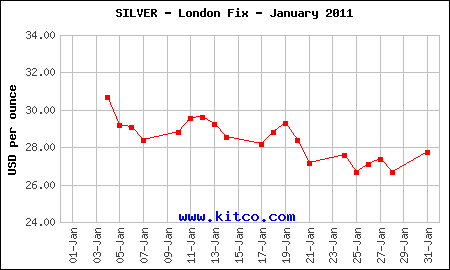
In January 2011, Silver got beaten down from $31.00 to $27.90.
Silver rebounded with a vengeance in February 2011 and went from $28.00 to just under $34.00.
In March 2011, Silver went from $34.00 to $38.00.
Then, in April 2011, Silver soared from $38.00 to over $49.00 per ounce.
Since then Silver has been beaten down and hovers in the $40.00 range.
You don't see much coverage of this short squeeze in the press. Most mainstream pundits and reporters have assumed that it was speculative buying that caused Silver's huge rise from $18.00 to $49.75.
There is no doubt that a lot of speculative money was starting to enter the fray towards the end of the winter run.
However, in futures markets, huge moves like we say from August 2010 - April 2011 are often the result of short squeezes.
And have no doubt, this is exactly what happened in Silver.
sentimentrader.com is a great resource and produced the following chart. It is produced from data compiled from the Commitment of Traders Report. The chart shows both the Silver open interest and the speculative long position had been trending down prior to August 2010 and outlines for us exactly why Silver spiked in price.
Both Silver's open interest and the speculative long position continued to decline during the massive price move from $18.00 - $49.75.
When open interest falls but price rises, its a short squeeze.
The same thing happened with Cotton just a few months earlier and the Commitment of Traders Report tells us that the commercial traders (which includes JP Morgan) were covering their shorts massively.
How much did they cover?
Back in August 2010 the size of that naked short position was 25,412 contracts.
Remember, each contract representing 5,000 ounces of Silver. That means JP Morgan held paper promises they had sold for over 127 million ounces of Silver (127,060,000).
And during the short squeeze JP Morgan likely covered 24 million ounces of their naked short silver position at a massive loss.
This is why Silver rose so dramatically in value.
It wasn't because Silver was in a bubble. It wasn't because of irrational speculation by average investors. It was JP Morgan covering their naked short silver position at a massive loss.
That's why this blog was so excited and focused on the short squeeze in Silver that analysts were expecting in the fall of 2010.
So what's happened since then?
Well... in May we saw the famous 'take-down' of Silverr. Five margin hikes on traders in 8 days forced massive liquidation by investors trading on credit. This was combined with massive short selling once again by JP Morgan.
Silver plunged from $49.75 to to $33.00 then recovered to hover around the $40.00 mark.
The September CFTC Bank Participation report indicates that four large US banks increased their silver shorts by 809 contracts in August from 23,775 to 24,584.
This is an increase of 4.05 Million ounces to the manipulative short position in silver in a single month. More importantly the total naked short position is up to 24,584 contracts.
Grasp what has happened here.
JP Morgan has been rebuilding their silver short position almost entirely back to the 25,412 contract position held prior to the massive short squeeze in August 2010.
Worldwide demand for Silver and Gold during the latest phase of the Sovereign debt crisis is going berserk. Rather dampen demand and drive investors away from the metal because it is too volatile, buyers continue to accumulate Silver.
The banking cartel is desperately flooding the paper market with paper promises of Silver and Gold in a frantic attempt to keep a lid on the prices of both Silver and Gold.
And as panic slowly grips Europe in the unfolding debt quagmire, demand is increasing even more.
Another short squeeze is looming on the horizon... with a corresponding huge jump in the price of Silver.
A chartered chartered accountant who entered the investment industry as a research analyst at Merrill Lynch. In 1981, he founded Sprott Securities (now called Cormark Securities Inc.), which today is one of Canada's largest independently owned securities firms. After establishing Sprott Asset Management Inc. in December 2001 as a separate entity, Eric divested his entire ownership of Sprott Securities to its employees.
Sprott is a huge Silver bull and we have profiled his thoughs numerous times before.
And he remains resolute in his views on Silver which he reiterated yesterday:
“It could be a wild ride here. As you know there are groups that are short silver and they’ve lost a lot of money already. I think they are very active in the market and create these days where there are sudden downdrafts, but sure enough silver always comes back. The physical buyers always wear down the paper pushers.”
“I think silver will outperform gold in the next decade. If silver should trade at a 16 to 1 ratio (to gold), it will probably trade at 10 to 1 because things tend to overshoot. Let’s use Jim Sinclair’s $12,000 target, that would suggest $1,200 silver, which is a thirty bagger from here.”
“The outlook for gold stocks is particularly exciting right now. I think we can get a 50% move out of the gold stocks between now and December 31st. And of course if gold and silver really get lit up here, I mean who knows? We could go up hundreds of percent in these gold stocks in the next eighteen months.”
“It could be very explosive as more and more people worry about (1) fiat currencies, (2) sovereign debt and (3) bank deposits. It would take very little to spill into gold to make a dramatic difference in where the price will be.”
Sprott's comments are particularly poignant in light of yesterday's G7 announcement.
The G7 is in full panic mode. It is now certain that the G7 will attempt some major intervention over the next 48 hours to inject a last dose of hope into capital markets to avoid Monday becoming an epic collapse.
To that end the G7 issued a statement titled Tackling Slowdown, Supporting Banks
“Monetary policies will maintain price stability and continue to support economic recovery. Central Banks stand ready to provide liquidity to banks as required... We will take all necessary actions to ensure the resilience of banking systems and financial markets. In this context we reaffirm our commitment to implement fully Basel III. We reaffirmed our shared interest in a strong and stable international financial system, and our support for market- determined exchange rates. Excess volatility and disorderly movements in exchange rates have adverse implications for economic and financial stability. We will consult closely in regard to actions in exchange markets and will cooperate as appropriate.”
As we have said numerous times... not only is QE3 assured. So is QE4, 5 and 6.
It's interesting to watch the movements of Silver in and out of the COMEX today.
Over the past 4 months there has only been 1 deposit of deliverable Silver into JP Morgan's eligible vault.
But today JP Morgan announced they had increased their eligible COMEX Silver inventory from 180,247 ounces to 586,381 ounces. That's a 225% increase overnight!
With the likely announcement of Quantitative Easing 3 by the US Federal Reserve in 2 weeks, Silver observers are wondering if this is a sign that JPM is gearing up for a massive amount of longs actually standing for delivery in September?
If so Silver may be getting ready for a huge move up at the end of month/beginning of October. ==================
To those who follow Silver, anticipation is rising that this fall could see another big spike in the value of the metal as several important factors come together.
Silver's open interest on the COMEX continues to contract. 112,000 is considered rock bottom and the current OI is below that at 111,735. With an OI nearing 110,000, the risk of a major raid or dip in silver is considered extremely low. Analyst's believe this is because the banking cartel is loathe to provide any paper shorts with the high demand currently being shown.
Then there is the intensifying expectation of QE3, a factor sure to drive even more investment into both Silver and Gold.
For the chartists, the demand for Silver is setting up very bullishly.
Silver's 50 day moving average is crossing over its 100 day moving average, an extremely strong sign. The last time silver's 50DMA cleared its 100DMA was back in September of 2010 (when silver was trading near $23/oz).
The crossover of moving averages has some speculating that Silver could power past $50 early this fall. Then we could see it rapidly run up to $70-$75 once the all-time nominal high is convincingly taken out - much the same as silver shot from $22 to $50 once the bull market high of $21.35 was taken out in Sept 2010.
Faithful readers will recall that when Silver shot from $18 to almost $50 in late 2010/early 2011, the surge was propelled by a short squeeze on Silver.
While the squeeze was occuring, the Silver community was divided as to the legitimacy of a group of ex-JP Morgan traders fired by Blythe Masters in July of 2010 who were supposedly leading the short squeeze charge.
Known as the 'Wynter Benton group', they were alleged to have been looking to wreck havoc on JPM using their own naked silver shorts.
Messages they posted through the yahoo chat boards proved to be very accurate about the squeeze occuring in the Silver community.
Recently the group has been active with postings again. We recently profiled their claims that China may soon announce that the middle kingdom is going to add Silver as a reserve asset along with Gold.
The group is also suggesting another coordinated squeeze is on the horizon. Looking at the latest Commitment of Trader's Report we see that JP Morgan covered a massive 4,288 contracts from their short side at higher and higher prices last week. One wonders about the size of the losses they are experiencing.
I'm sure we will have more on the Benton group in the weeks ahead as we watch to see if Silver can break $50 and move towards $75.
As people pour through the massive data dump, the first nuggets (excuse the pun) of information are starting to surface.
And a gem of information has been uncovered in this US Embassy cable. Here is what the US Embassy in China had to say:
3. CHINA'S GOLD RESERVES
"China increases its gold reserves in order to kill two birds with one stone"
"The China Radio International sponsored newspaper World News Journal (Shijie Xinwenbao)(04/28): "According to China's National Foreign Exchanges Administration China 's gold reserves have recently increased. Currently, the majority of its gold reserves have been located in the U.S. and European countries. The U.S. and Europe have always suppressed the rising price of gold. They intend to weaken gold's function as an international reserve currency. They don't want to see other countries turning to gold reserves instead of the U.S. dollar or Euro. Therefore, suppressing the price of gold is very beneficial for the U.S. in maintaining the U.S. dollar's role as the international reserve currency. China's increased gold reserves will thus act as a model and lead other countries towards reserving more gold. Large gold reserves are also beneficial in promoting the internationalization of the RMB."
China is ecstatic that the price of Gold is being suppressed by the Americans. They fully intend to take advantage of it. As they note, "suppressing the price of gold is very beneficial for the U.S. in maintaining the U.S. dollar's role as the international reserve currency."
China has every intent to grow their reserves at these fire sale prices. And if things play out in the direction they are currently heading, $1900/oz will be considered cheap.
Zero Hedge commented on this today as well and they make the connection that anyone with any foresight can see for themselves. To wit: "What happens when "mutual and pension funds finally comprehend they are massively underinvested in the one asset which China is without a trace of doubt massively accumulating behind the scenes?"
The result will be nothing short of a worldwide scramble, not so much for paper, but every last ounce of physical gold.
As we have said before, we do not believe a return to the Gold Standard will be a good thing or that it will happen with full gold backed currency.
What WILL happen is a worldwide rush into Gold and Silver, which will catapult prices parabolically upward.
For those who do follow Silver, one of the most frustrating elements over the past year and a half has been the disappointing performance of shares in Silver mining companies.
While Silver rose from $15 to almost $50, mining shares have (for the most part) not performed quite as well.
Interestingly it is not just the spot price of Silver on the COMEX that is heavily shorted by the banking cartel to support the US dollar. Mining shares also receive the same treatment.
And mining company CEO's are showing signs of signifcant frustration with the practice.
Last week the Globe and Mail reported that the management of Silvercorp Metals (TSX:SVM) recognizes the blatent short manipulation going on with their stock and they plan to take action by buying up their own stock and cancelling the shares.
"The Company is purchasing its own shares because it believes that prevailing market conditions have resulted in Silvercorp's shares being undervalued relative to the immediate and long term value of Silvercorp's portfolio of producing and development properties in China and Canada. The Company notes that the short interest position in its common shares has climbed from 3.6 million as of July 29, 2011 settlement date to 9.6 million as of August 15, 2011 settlement date, the most recent date for which short interest data is known by the Company. Under the existing NCIB the Company intends to acquire up to 10 million common shares. All common shares purchased under the NCIB will be cancelled."
"Pan American is undertaking the Bid because, in the opinion of its board of directors, the market price of its common shares, from time to time, may not fully reflect the underlying value of its mining operations, properties and future growth prospects. The Company believes that in such circumstances, the outstanding common shares represent an appealing investment for Pan American since a portion of the Company's excess cash generated on an annual basis can be invested for an attractive risk adjusted return on capital through the Bid."
The CEO's of these corporations are saying that they have had enough and are starting to fight back. They are basically telling the manipulators that they are preparing to eat up their own shares until they squeeze the shorts like lemons in a juice press.
This represents a non-conspiratory side to the naked short selling argument for you.
Yesterday Ted Butler laid out for you that conditions are mounting for a significant 'Silver Accident'.
And now the mining companies are adding another element to that equation.
The writing is on the wall.
It is only a matter of time before the manipulated paper game hits the wall.
And when it does, Silver is going to move parabolically truly making it the manifestation of what Eric Sprott called the Opportunity of the Decade.
“The Federal Reserve is now a government within a government. It is totally out of control. Congress doesn't control it. It's funded by the banks and we either have constitutional government or we don't."







![[Most Recent Quotes from www.kitco.com]](http://www.kitconet.com/charts/metals/gold/t24_au_en_usoz_2.gif)
![[Most Recent Quotes from www.kitco.com]](http://www.kitconet.com/charts/metals/silver/t24_ag_en_usoz_2.gif)
![[Most Recent Quotes from www.kitco.com]](http://www.weblinks247.com/indexes/idx24_usd_en_2.gif)


