Showing posts with label RBC. Show all posts

Thursday, January 3, 2013

The correction going on in Vancouver is a "fairly sizable one" - RBC


Meet Paul Ferley, Assistant Chief Economist at RBC Capital Markets.

Ferley captures out attention for some comments he made on the Business News Network earlier today.

BNN was running a story on December's real estate numbers which showed Vancouver home sales plummeting again.  BNN started of talking with Cameron Muir, the Chief Economist from the B.C Real Estate Association.

Muir comes on the program carrying the "there is no bubble" standard that he and Tsur Somerville have been pounding for the last little while.

He insists that, after surviving the Great Financial Collapse of 2008, if the Vancouver Real Estate market hasn't collapsed yet then it won't.

As if to point out the absurdity of his comments, while Muir was insisting the Vancouver market has been 'flat' since 2008/2009, BNN flashed across the screen the fact that Vancouver home sales were down 31% year over year in December.
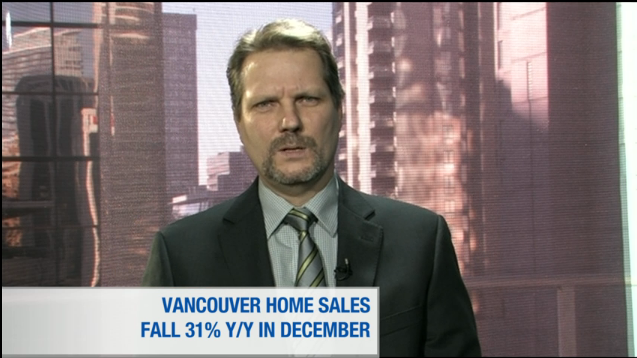

BNN notes how jarring the statistics for sales declines are. Does this not concern Muir?

As always our buddy Cameron dismisses the poor sales, insisting all signs are for positive growth. Muir jumps on the fact that November and December saw sharp pull backs in the number of listings on the market - conveniently ignoring that this happens every year in November and December.

But as we showed yesterday, the number of active listings on the market right now is far higher than in previous years.

BNN contrasts this with comments from Paul Ferley, assistant chief economist at RBC Capital Markets.  Ferley says the bank's research on housing affordability in Vancouver showes that prices in the city had become frothy.
"Certainly the Vancouver numbers have been suggesting stresses in that market with affordability deteriorating and at some point a correction was likely going to have to play out. It was a market looking like it was poised for a correction."
Ferley adds that while prices have yet to fall as dramatically as sales, the city could be headed for "double digit" declines in home prices.
“You're seeing a correction in Vancouver – a fairly sizable one."
The focus on the Spring Market ramps higher with each passing day and the stage is set with Muir and Somerville firmly staking their reputations on a crash not happening.


(hat tip VREAA for Van. Sun image)

==================

Photobucket
Email: village_whisperer@live.ca
Click 'comments' below to contribute to this post.

Please read disclaimer at bottom of blog.

Tuesday, August 21, 2012

Royal Bank says our real estate market is "vulnerable to a marked correction"


Well I think you can definitely say the alarm bells are ringing everywhere you turn now.

Royal Bank is the latest with warnings.  And this is no tiny warning.

No only does RBC tell us the Village on the Edge of the Rainforest may experience a correction.  Canada's biggest bank is now afraid we are vulnerable to a "marked correction."

Says the Huffington Post:
If you haven’t heard yet that Canada’s housing market is facing potentially serious problems, you’ve probably been hiding under a rock, but a recent study and comments from Canada’s top banker are bringing the point home once again.

A report from RBC released Thursday says Vancouver’s housing market is 'vulnerable to a marked correction.' For a market analysis from a major bank, those are pretty strong words.
Strong indeed.

Even scarier than the rhetoric about a looming catastrophe are the hard core statistics from the report:
Typical Vancouver-area homebuyers would need to allocate 92 per cent of their income to carry the costs of a two-storey home (based on market price) and almost 45 per cent for a condominium apartment.”
RBC says they expect house prices in Vancouver to fall between 7 and 12%.

When you consider the average price is already down 20% from last May, this forecast from RBC is devastating news for a city whose economy is reported to be over 30% dependant on real estate.

Perhaps even more disturbing is that the numbers quote by RBC are very conservative compared to what Bank of Canada Governor Mark Carney hinted Wednesday might be the actual scale of a Canadian housing correction.

As the Huffington Post article noted:
In comments to the House of Commons finance committee, Carney said Canada’s housing market is overvalued by 35%! While house prices historically in Canada have hovered around 3.5 times average income, they are now at 4.75 times average income.
In some markets that ratio is worse.

Vancouver housing is estimated to cost 9.2 times the average income.
The tension between Canada’s booming housing market and the weakness in the global economy is at the heart of Carney’s dilemma: Whether to raise interest rates to halt a growing real estate bubble, risking an economic slowdown, or to keep them low, and risk blowing up even larger bubbles in Canada’s economy.

Carney has hinted in recent interest rate decisions that the day is nearing when Canadians will no longer be able to count on historically low interest rates.
The RBC report makes it clear that interest rates will be a major factor in determining the dierction of house prices in the months to come, but highlights a wild card in the equation: Foreign real estate investors who have been snapping up residential properties and driving up house prices.
“Risks will be further heightened by Vancouver-area valuation’s dependence on a strong and steady flow of wealthy foreign buyers and recent immigrants — a phenomenon that is both poorly documented and potentially vulnerable to adverse external shocks."
And that's the kicker.

If the market starts plummeting, not only will the "strong and steady flow of wealthy foreign buyers" further evaporate... you could see those same foreign buyers start dumping properties to cut their losses.

At which point calling it a "marked correction" will be a generous understatement.

==================

Email: village_whisperer@live.ca
Click 'comments' below to contribute to this post.

Please read disclaimer at bottom of blog.

Sunday, March 13, 2011

Royal Bank: BOC rate to double before year end

Bank of Canada Governor Mark Carney has been warning about being prepared for rising interest rates for over a year now.

As part of its economic outlook for 2011, Royal Bank of Canada projects that the Bank of Canada overnight rate will double from 1% to 2% by year-end.

  • Our forecast is that the Bank of Canada will restart its tightening campaign in late May 2011 with the overnight rate forecasted to rise to 2.00% by year-end from 1.00% currently. Interest rates, which have increased in the past three months, are likely to grind higher with short-term interest rates moving up more than longer-term yields. The gradual pace of policy tightening combined with anchored inflation expectations and less fiscal pressures than many other countries will likely result in less upward pressure being exerted on longerterm interest rates resulting in a flatter yield curve and Canadian long-term yields holding below their U.S. counterparts.

==================

Email: village_whisperer@live.ca

Click 'comments' below to contribute to this post.

Please read disclaimer at bottom of blog.

Tuesday, September 28, 2010

Do you see what I see?

As a child, everyone has seen the picture above which is the visual definition of "perception".

Some see the image of a young woman. Others can clearly see the image of an old woman.

Same image, two different perceptions.

And the same can be said of real estate in the Village on the Edge of the Rainforest. Yesterday the little red-headed girl told me she spends her weekends going to open houses, house lust working it's elusive magic.

Sigh.

Don't people see the picture I see?

Bouncing around the Internet today is like going from site to site with confirmation of so many of last year's blog insights playing themselves out in living colour.

Aren't they evident to all?

You've often see me refer to the Vancouver Real Estate Anecdote Archive, a blog which collects anecdotes found on various blogs or in mainstream media. Since most are anonymous, it is impossible to confirm the validity of the comments but they are interesting. What stands out are the number of comments being made by people who are starting to worry about their real estate purchases.

Some recent comments (click on first two words for link):

  • A buddy of mine on the Island put his home on the market in August…..not a sniff. He is freaking out as he had hoped to ‘move-up’ and is carrying a big monthly mortgage.”

    I’m in the financial industry. People are one or two paycheques or missed mortgage payments away from real disaster. I think that bankruptcies will unfortunately become commonplace.”

These comments are reflective of events now unfolding as many of us in the blogosphere have predicted. Yesterday the chief economist of Gluskin Sheff + Associates, David Rosenberg, came out with a report that notes that housing starts, building permits and home prices have slipped.

Canada's recovery from the recession has been fuelled by the boom in the housing sector, a boom which was driven by the emergency level interest rates that sucked so many Canadians into the overpriced housing market over the past year. But that 'stimulus' has run it's course, the 'recovery' is now slowing, and "that goose is no longer laying any golden eggs."

Rosenberg foresees that same scenario we have been fearful of. He expects that a "rising number" of Canadian homeowners won't be able to meet their mortgage payments as interest rates rise and real estate values sink.

"Housing cycles, both up and down, tend to go further than anyone thinks, as we saw occur in the United States, which is still suffering from a post-bubble hangover three years after the initial turn down. Even if this correction in housing is a fraction as harsh as was the case south of the border, the economy, and the financial markets, are likely in for a rude awakening in coming quarters as lower home prices cut into household wealth, confidence and spending plans," said Rosenberg.

This comes out on the same day as a report from the Royal Bank of Canada that says home ownership costs in B.C. are quickly nearing record highs and that the result is that home ownership costs are testing the limits of household budgets. More importantly the report notes that “the Vancouver market is clearly vulnerable to a price correction."

“Generally, we have dismissed the case of housing market bubbles in Canada, but the situation in Vancouver is probably the closest to one in the country,” the report stated.

Interestingly the report calculates that the tenuous Vancouver market chews up more that 65% of pre-tax family income (the highest in the country). But this conclusion is based on buying a house at current prices with 25% down and a 25-year amortized mortgage.

Ummm... does anybody out there have a friend or acquaintance who has bought a house in Vancouver in the last five years who has paid a quarter of the purchase price in cash and has taken out a mortgage that was less than 35 years in length?

Royal's skewed analysis allows it to temper conclusions. Economist's like Rosenberg do not colour their outlook with such diversions.

The fact of the matter is that the finances of most Canadian households are in abysmal shape. As other economic reports have noted, debt is out of control in this country as Canadians have saddled themselves with record mortgage debt (household liabilities now equal 145% of earned income). Six in ten Canadians now live paycheque to paycheque. 40% are not even trying to save money anymore because there is no money left over after daily expenses.

The writing is on the wall for real estate in our little hamlet which sits on the Edge of the Rainforest. We will be ground zero for a massive real estate collapse.

Don't you see what I do?

Meanwhile... more on 'all that glitters'

Bloomberg reports that the U.S. Mint has suspended sales of its 1-ounce American Eagle gold coins after soaring commodity prices led collectors and investors to deplete supplies. It is the first time in two decades that the Mint halted sales of the coins.

==================

Email: village_whisperer@live.ca

Click 'comments' below to contribute to this post.

Please read disclaimer at bottom of blog.

Saturday, September 26, 2009

Time Mortgage Bomb

According to CMHC, 30% of all Canadian mortgages are now variable rate mortgages, up from 3% in 1998. And fixed 5 year terms account for almost 70% of the mortgage market.

So why don't many Canadians take out a 25 year mortgage? They exist. Royal Bank even lists them on their residential mortgage rate page.

It's all about 'affordability', the real estate industry's favorite catchword.

A 7.85% rate on a $555,000 amortized over 35 years results in a monthly payment of $4,420.

You can currently get a 1 year variable rate for 2.35%, which translates into a monthly payment of $2,495.

That's almost $2,000 a month less in payments.

So who in their right mind would opt for a 25 year mortgage? Even a five year rate from Royal (4.19%) will set you back $3,070 a month.

And for all those suckers buyers rushing into the market right now because homes are 'affordable' (i.e. low interest rates), saving $500 a month makes all the difference in the world.

And besides, rates have been relatively low for the past 8 years. They will stay like this for a long time.

And therein lies the looming disaster.

$500 makes all the difference in the world. As rates start to go up, many variable rate mortgage holders won't lock into 10 or 25 year rates. It's too much of a jump.

They won't even lock into a five year rate.

They have rationalized 'affordability' to make the purchase. When rates jump up 2%, the one year variable rate will cost them $500 more. To lock into a 5 year rate will cost them another $500 over that (at least).

The same argument that keeps them in a one year rate, will keep them in that rate then.

Even if some do lock in to a longer term rate, it will be a five year rate - at best.

But the fuse on the Lower Mainland mortgage time bomb will have been lit. And when it explodes this is what it will look like.

As the San Francisco Chronicle reports, the Bay area is sitting on a $30 Billion dollar time bomb of homes purchased with loans known as option ARMs, short for adjustable rate mortgages (Alt-A).

From 2004 to 2008, "one in five people who took out a mortgage loan (for both purchases and refinancing) in the San Francisco metropolitan region got an option ARM," said Bob Visini, senior director of marketing in San Francisco at First American CoreLogic, a mortgage research firm.

With these mortgages, the interest rate will reset after 5 years to a dramatically higher rate. Buyers took them because Alt-A and Option ARM allowed them to enjoy an 'affordable' low interest rate for the first five years. At the end of five years (during the boom years), buyers were advised they could re-negotiate a new mortgage (with a new low five year rate) especially since the value of their home will have risen.

Problem is... housing prices in San Francisco have evaporated... and so has the chance to obtain a new mortgage. It means thousands of buyers in the Bay area are going to be forced to watch their mortgages reset at dramatically higher interest rates as their five year terms expire.

There are over 54,000 option ARMs issued in greater San Francisco with a value of about $30.9 billion.

"In markets where home prices were going up rapidly, more and more borrowers needed a product like this to afford something," said Alla Sirotic, senior director at Fitch Ratings. The loans became a tool for regular people to "stretch" to buy homes that were beyond their means.

Can you see the parallel to what may happend in Canada when mortgage rates start rising?

The sad thing is, if you can, you are in the minority.

==================

Email: village_whisperer@live.ca
Click 'comments' below to contribute to this post.

Please read disclaimer at bottom of blog.