Showing posts with label Interest rates. Show all posts

Friday, April 25, 2014

Bank of Canada: Low Interest Rates Here to Stay?


One of the major themes on this blog (and in real estate) has been interest rates.

Artificially low interest rates to stimulate the economy after the dot com crash of 1999 combined with  emergency level rates after the Great Financial Crisis have created a generation that knows nothing but low, low interest rates.

(Some, like uber Gold bull Jim Sinclair, have predicted interest rates can't be allowed to rise)

And now the new Bank of Canada Governor, Stephen Poloz, has come out and said low interest rates may be here to stay.
Canadians can expect to enjoy relatively cheap borrowing costs for some time to come — even after the economy returns to full capacity and the Bank of Canada starts hiking interest rates, bank governor Stephen Poloz said Thursday.

Poloz says it will likely take until early 2016 before the economy is firing on all cylinders and inflation is back to two per cent. But even when it does Canadians shouldn't expect a sudden increase in interest rates to fight inflation, he told a business group in Saskatoon on Thursday.

"Our economy has room to grow and when we do get home, there is a growing consensus that interest rates will still be lower than we were accustomed to in the past," said Poloz.

"Both because of our shifting demographics and because after such a long period at such unusually low levels, interest rates won't need to move as much to have the same impact on the economy."
Poloz says the new normal will be lower rates than in the past and people should get used to that.


==================

Photobucket
Email: village_whisperer@live.ca
Click 'comments' below to contribute to this post.

Please read disclaimer at bottom of blog.

Wednesday, August 28, 2013

In the years ahead: the biggest financial mistake you might make?


Couldn't help but key in on a line from a Globe and Mail article this week.
In the years ahead, the biggest financial mistake you make just might be failing to think well in advance about a mortgage coming up for renewal.
It is, of course, an article about the damage rising interest rates might do to those in debt.
The era of pleasant surprises for people renewing their mortgages is over.

After five years of trending lower, mortgage rates have reversed course and started to rise. Aspiring first-time home buyers are being priced out of the market by these increases, but at least they’ve avoided a costly mortgage entanglement. Existing homeowners may simply have to pay more.

... how people will afford higher mortgage payments (?)

We’ve been assured by people in the mortgage industry that homeowners can absorb higher mortgage payments. A 2011 report from the Canadian Association of Accredited Mortgage Professionals said there is “very substantial room” for households to pay higher mortgage rates. Will Dunning, CAAMP’s chief economist, said Monday that he stands by that view.

But the issue is not whether you can afford higher mortgage payments. Rather, it’s what you’ll have to sacrifice to make them.
Sacrifice?

The mere thought is still ridiculous to just about everyone you talk to.  No one can conceive of any kind of dramatic change in rates.

But it's always like that.  

In October 1971, when interest rates were 9.55%...


... people of the day would have thought you were crazy if you were to suggest they would be 20.54% by October of 1981.


Conversely, it you were to tell those people in 1979-1981 that interest rates would have plummeted to 13.75% by October of 1990, they wouldn't have believed you (although they would have cheered the optimism).


Jump 10 more years into the future to October 2000 and rates are an astonishing bargain at 8.08%....


... at least they would have been a bargain to the people of the day.

Jump just over 10 more years to the present, and what to make of the emergency level interest rates of 2.25 -3.25%? Talk to anyone today and the idea of a 6% interest rate is pure fantasy, never mind 8.08%.

If you look at history, the 10 year jumps have brought dramatic change... change which each generation would not have believed at the time.

If the next 10 years brings change again, will it surprise? More significantly, will you allow yourself to be surprised?

==================

Photobucket
Email: village_whisperer@live.ca
Click 'comments' below to contribute to this post.

Please read disclaimer at bottom of blog.

Wednesday, June 26, 2013

Bank of England warns banks of risk of sharp global interest rate rise


Reuters is out with an intriguing bit of news.

Mervyn King, the governor of the Bank of England, has issued a stunning warning:
The Bank of England warned banks and borrowers on Wednesday about risks from a potential abrupt rise in global interest rates, and said banks might need to further bolster their capital cushions to protect against this.

The past week has seen a sharp rise in global bond yields since U.S. Federal Reserve Chairman Ben Bernanke said that the U.S. central bank may scale back bond purchases later this year.

BoE Governor Mervyn King said on Tuesday that markets had "jumped the gun" in their sharp reaction to Bernanke's comments, but the BoE's half-yearly Financial Stability Report said more bond yield rises could hurt UK banks, insurers and borrowers.

The BoE said that it had ordered an investigation into the vulnerability of Britain's financial institutions and borrowers to higher interest rates, to report back by September to its new risk watchdog, the Financial Policy Committee.

"Financial institutions and markets are also vulnerable to an abrupt rise in global interest rates. And some UK borrowers remain highly indebted, which could result in losses for UK banks," the FPC said.
It's an intriguing statement because King, as we all know, steps down at the end of this month as the head of the Bank of England.

His replacement? Former Canadian central bank chief Mark Carney, who many economists expect to advocate a long-term commitment to low interest rates as a way to keep down bond yields.

King's call for higher capital requirements has bankers privately complaining that higher capital requirements and limits on leverage are hampering their ability to lend. But this is strongly disputed by the BoE, which says healthier long-term capital levels make it cheaper for banks to borrow.

Wednesday also saw the BoE allow banks to scale back some of the short-term cash they hold against shocks to encourage more lending to the economy.

Many believe the BoE is a long way from tightening monetary policy, and a minority of BoE rate-setters have been voting for more stimulus for the past few months due to the weak state of Britain's economic recovery.

So what gives with Mervyn King and his warnings of a sharp global interest rate rise on the eve of his departure of BoE governor?

Is his looming retirement giving him the freedom to say what he really fears?

==================

Photobucket
Email: village_whisperer@live.ca
Click 'comments' below to contribute to this post.

Please read disclaimer at bottom of blog.

Thursday, June 21, 2012

Thurs Post #2: A tweet to ponder


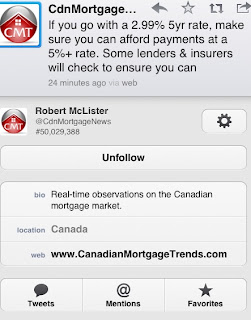
A interesting tweet this afternoon from Canadian Mortgage Trends...
"If you go with a 2.99% 5yr rate, make sure you can afford payments at a 5%+ rate. Some lenders and insurers will check to ensure you can."

==================

Email: village_whisperer@live.ca
Click 'comments' below to contribute to this post.
Please read disclaimer at bottom of blog.

Wednesday, April 25, 2012

Wed Post #2: Even more Carney warnings on interest rates


Bank of Canada (BoC) Governor Mark Carney used an appearance at the House of Commons finance committee to re-stress the central bank’s recent message that rates could have to go up despite global economic uncertainty.

The BoC, which has kept rates at a near-record low of 1% since September 2010, started mentioning last week that a rate increase might be needed because of a stronger economy and underlying inflationary pressures.

More intriguingly, Carney touched base on the real threat lying underneath the surface in Canada.  He stressed Canadians cannot keep borrowing so heavily against the value of their homes.

He said financial authorities were looking closely at levels of household debt and ways to contain the problem.

He also made it clear that too tight a clampdown could hurt economic growth.

So what is to be done?
“Authorities — the bank, the superintendent, CMHC, Government of Canada — are cooperating closely and monitoring the situation … there had been a number of measures that had been taken both by the superintendent, by the government. We have a heightened vigilance with the underwriting practices of the banks. So on a supply side there are a variety of measures that have been taken and are resulting in a slowing of the accumulation. There’s always more that could potentially be done. But these measures, there has to be an element of prudence in balancing the pace of slowing of this phenomena with the underlying growth of the economy.”
Many will howl in protest that Carney is being too slow to turn the taps off.

He knows the damage that is going to be caused and he is trying to cushion it as best he can.

But can you really engineer a soft landing?

I guess we're going to find out.

==================

Email: village_whisperer@live.ca
Click 'comments' below to contribute to this post.
Please read disclaimer at bottom of blog.

Friday, February 24, 2012

Debt Shock? Whatchyou talkin bout Mark?


The end of another week and the focus continues to zero in on negative news for Real Estate.

And, once again, the warnings are coming from Bank of Canada Governor Mark Carney.

"The Bank of Canada has renewed its warning that debt-laden Canadians could face a 'significant shock' if housing prices fall."
Whoa... whoa!

If housing prices fall?  Housing prices don't fall, what are you talking about Mark?

In a series of special reports the Bank of Canada reviewed household debt and changes in the value of Canadian's "single-most important asset" — their homes.

While there has been a steady rise in the ratio of household debt to personal disposable income, house prices have been steadily increasing since 2000, the review said.
"These facts are interrelated, since rising house prices can facilitate the accumulation of debt. Households could, therefore, experience a significant shock if house prices were to reverse."
Whoa, wha??? There he goes again.  Significant shock if house prices were to reverse???

But real estate always goes up!  And what about the Asians?... the rich Asians are going to keep prices high, right?
"The evidence indicates that a significant share of borrowed funds from home-equity extraction was used to finance consumption and home renovation in Canada from 1999 to 2010. Such indebtedness constitutes an important source of risk to household spending, since it makes households more vulnerable to a potential decline in house prices."

Mike, baby, what are you saying? That Canadians have been using their homes like ATM machines just like the Americans did?

Then there was Federal Finance Minister Jim Flaherty:

On Thursday, Flaherty said "people have to be wise . . . in how they look at things."
"Interest rates are going to go up. They have nowhere to go but up. So people need to ensure that they can afford higher mortgage interest. It isn't necessarily for everyone to have most expensive house they could possibly buy, maxing out the 10-year mortgage they can get from a financial institution."

ALRIGHT... STOP RIGHT THERE! Interest rates are going up????

NO WAY... US Federal Reserve Chairman Ben Bernanke said rates were staying low until 2014. Rates are NOT going to go up. You wouldn't do that to us... it would hurt the economy too much.

Clearly Carney and Flaherty must have been munching on magic mushrooms or something before the last press conference.  I mean, what the hell???

==================

Email: village_whisperer@live.ca
Click 'comments' below to contribute to this post.
Please read disclaimer at bottom of blog.

Tuesday, January 17, 2012

Tues Post #1: Battle of the bank rates


A few days ago we told you how Ozzie Jurock was advising his followers that while Vancouver's real estate prices were basically the same this December (2011) over last December (2010), Jurock gave some uncharacteristically negative analysis:

"Well, YES (Vancouver prices are the same this December over last December) ... BUT the December average price of $ 691,000 is a whopping $141,000 or a full 17% lower than the May 2011 average price, which clocked in at $834,000. In fact overall sales decreased 13% over last December but a WHOPPING 34.1% decrease over the 2,515 residential sales in December 2009. Sales of detached properties a decrease of 18.1% from the 769 detached sales recorded in December 2010, and a WHOPPING 30.2% decrease from the 902 units sold in December 2009."

BMO Capital Markets has now come out with their most recent analysis and they expect the December sales to be up 3% compared with a year ago and the average price to have gained 4%.

“Below the surface, however, the story gets a tad more interesting,” economist Robert Kavcic wrote in a report.

Kavcic noted the formerly white-hot Vancouver market is now cooling with sharply lower sales and with prices coming off their highs.

“Looking ahead to 2012, cooler housing activity should prevail as elevated household debt levels, shaky confidence and a weakened job market counter extremely low mortgage rates.”

Mortgages, however, mean revenue for the banks.  

And as the battle for customers intensifies amid a drop-off in consumer borrowing, those very banks are in the process of launching a a counter offensive to combat that shaky confidence and weakened job market.

Some of Canada’s biggest banks are now advertising promotional ultra-low mortgage rates to win market share.

The Bank of Montreal began the offensive with a special discount five-year fixed rate at 2.99% for a limited time.

TD Bank responded with a four-year special fixed rate at 2.99% available until the end of February, while Royal Bank later matched that with its own four-year 2.99% rate offer, along with a seven-year special fixed rate of 3.99 per cent.

In 2008/2009, when the market weakened as the Financial Crisis began, emergency level interest rates were the market saviour.

Without the expected worldwide economic recovery taking hold yet, will interest rates even LOWER than emergency level rates be the panacea?

==================

Email: village_whisperer@live.ca
Click 'comments' below to contribute to this post.
Please read disclaimer at bottom of blog.

Saturday, August 13, 2011

Saturday Post #2: Peter Schiff on interest rates and how a Silver breakout is coming


==================
Email: village_whisperer@live.ca
Click 'comments' below to contribute to this post.
Please read disclaimer at bottom of blog.

Monday, July 18, 2011

Two local housing videos for you...


Another excellent video courtesy of our friends over at Vancouver Condo Info regarding the impact of interest rates on housing prices.

If you haven't seen it, also check out their previous vid below on the roller coaster that is the Vancouver Housing Bubble.


==================

Email: village_whisperer@live.ca
Click 'comments' below to contribute to this post.
Please read disclaimer at bottom of blog.
Saturday, June 18, 2011

Flaherty joins Carney with more interest rate/debt warnings


Yesterday we posted yet another warning from Bank of Canada Governor Mark Carney about debt and interest rates.

Well it wasn't only Carney issuing warnings in the Land of the Maple Leaf. Finance Minister Jim Flaherty also chimed in his concerns.
  • "We have very low interest rates in Canada. We need to remind Canadians that historically low interest rates will not be there forever, that interest rates really only have one way to go and that’s up. So Canadians in terms of their most important – their largest debts, residential mortgages, need to be aware that their monthly payments are going to go up when interest rates go up."
These guys are starting to sound like regular bloggers with all their doom and gloom, aren't they?

What is most interesting is that a survey by the Certified General Accountants Association suggests 58% of indebted respondents are taking on more debt just to pay for daily living expenses like food, housing and transportation.

And if consumers are taking on more debt just to pay for daily living expenses, it deprives them of resources for other purchases, like cars, TVs, appliances, clothes slowing economic activity.

Which means the economy doesn't grow.  Which means income doesn't grow. Throw in rising interest rates and the problems compound.

Can you see it? There is a growing perfect storm here.  And when it breaks, the fallout is going to be wicked.

==================
Email: village_whisperer@live.ca
Click 'comments' below to contribute to this post.
Please read disclaimer at bottom of blog.

Friday, April 15, 2011

Fantasy


So this blog has talked a lot about Silver lately.

As I have repeated ad nausem, the interest in precious metals is simply an extension of the interest in the housing bubble in Real Estate that has been our primary focus these past two years.

The financial system created a housing bubble, that bubble is in the process of collapsing (although Australia and Canada have delayed the effects to date), the response to the fianancial crisis of 2008 has been Quantative Easing, QE is triggering massive currency induced cost-push inflation, and QE will also trigger a massive increase in interest rates.

QE is also nothing more than a way to continue the ponzi scheme that is government debt... hence the huge increase in Silver/Gold and the reason Silver/Gold has yet to see massive growth in values.

Those have basically been our central themes. The nadir of Real Estate as an investment is over and the next great opportunity is precious metals, especially Silver.

On the real estate front here in the Village of the Edge of the Rainforest, there have been a wave of bearish real estate articles.  We have had the Globe and Mail newspaper come out with "Signs point to a severe housing correction in Canada", the National Post commenting on how - in the midsts of a federal election campaign - "Parties are silent on possible housing bubble", more IMF warnings about "Canada's growing debt burden", Canadian Business Magazine commenting that: "Housing: Real Insanity", and a great story on VREAA about how an afternoon TV news story by Vancouver's most prominent local TV station was promoted as 'a housing bubble' feature during the noon newscast and then quickly changed to a story about 'a steady climb' in the evening news story. That station is infamous in Vancouver as being very pro-R/E.

We're at the height of denial now in Vancouver.

On the interest rate/government debt theme, I'd urge you to check out this excellent commentary on the looming spectre of rising interest rates by Charles Hugh Smith.

==================
Email: village_whisperer@live.ca
Click 'comments' below to contribute to this post.
Please read disclaimer at bottom of blog.

Monday, March 28, 2011

Bank of Canada says many are underestimating what's happening

On Saturday Bank of Canada Governor Mark Carney was giving a speech to the annual meeting of the Inter-American Development Bank in Calgary.

He noted that commodity prices could continue to increase for decades (hello Gold and Silver) and encouraged central banks in emerging markets not to delay raising interest rates because inflation pressures will only worsen.

And you know what that means for interest rates, right?

"Everything else being equal, higher commodity prices usually necessitate higher policy rates. Even though history teaches us that all booms are finite, this one could go on for a long time," Carney said.

More warnings, but many want to know WHEN!

"Bringing that message back to Canada — even if the US Federal Reserve stays on hold through 2011, look for the Bank to start responding to rising commodity price pressures before long." BMO economist Douglas Porter said in a commentary.

Many figure it will come after the Federal electiion on May 2nd.

But by far the most significant comment came when Carney said, "some economies are postponing monetary tightening in the hope that old relationships will reassert. Others are resisting capital inflows. And all appear to be underestimating the scale of what's happening."

There are those who will pooh-pooh Carney's comments as more empty warnings.

They ignore at their own peril.

==================


Email: village_whisperer@live.ca

Click 'comments' below to contribute to this post.

Please read disclaimer at bottom of blog.

Monday, February 28, 2011

Peter Schiff on CNBC: Inflation, the collapsing US Dollar and rising interest rates in other countries


Peter Schiff comments on the sweeping inflation raging around the world and the impact it is going to start having on the US dollar. As we have been talking about on this blog for the past year, inflation - not deflation - is going to be our central story.

Speaking of other nations raising interest rates, Russia unexpectedly raised their prime rate again. It now stands at 8%.

And as Schiff says... higher rates will becoming to North America before long.

==================

Email: village_whisperer@live.ca

Click 'comments' below to contribute to this post.

Please read disclaimer at bottom of blog.

Thursday, February 10, 2011

We are much closer to total destruction than you think!


Did that headline catch your attention?

They aren't my words. That was how CNBC summarized someone who has far more intimate knowledge of the financial system than any blogger.

But we'll come back to that.

First off let's focus on interest rates here at home.

As you know, Canadian banks hiked interest rates this week. On the heels of those rate hikes comes Finance Minister Jim Flaherty with a warning that there are even more rate hikes coming.
  • "The recent increase by a couple of the banks is exactly what we expected. And more increases should be coming. We're likely to see higher interest rates as we go forward because interest rates are still very low."

Almost makes quote of the day: "Interest rates are still very low."

That's 'very' low as in, rates are going to go way higher.

The big news story though was occurring south of the border.

As I have said over and over again, we still do not understand - nor do we appreciate - the full depth and breadth of the financial earthquate that hit us in September of 2008.

Yesterday US Federal Reserve Chairman reinforced that point in testimony before the US Congress.

And for all you out there who think the crisis is over and has past, Bernanke's comments are stunning.

Warning that America's fiscal health has deteriorated appreciably since the onset of the financial crisis and the recession, Bernanke told Congress that the US is much closer to total destruction than you think.

CNBC reported the story here.

Said Bernanke:

  • "The unsustainable trajectories of deficits and debt that the Congressional Budget Office outlines cannot actually happen, because creditors would never be willing to lend to a government with debt, relative to national income, that is rising without limit. One way or the other, fiscal adjustments sufficient to stabilize the federal budget must occur at some point. The question is whether these adjustments will take place through a careful and deliberative process that weighs priorities and gives people adequate time to adjust to changes in government programs or tax policies, or whether the needed fiscal adjustments will come as a rapid and painful response to a looming or actual fiscal crisis."

Bernanke is telling Congress what Greenspan was telling us last year.

At some point the Bond market is going to force the issue on America and when it happens, the US Federal Reserve won't be able to stop it.

So for all of you who continue to believe that the government will never let interest rates go up like they did in the 1970s, not only are you ignoring the blogosphere... now it's Flaherty and Bernanke telling you what's coming.

Still not convinced?

==================

Email: village_whisperer@live.ca

Click 'comments' below to contribute to this post.

Please read disclaimer at bottom of blog.

Tuesday, February 8, 2011

On the topic of Interest Rates

In last Friday's post, Enthusiasm and Euphoria, I talked about our real estate market conforming to the classic bubble pattern and that it will be rising interest rates that finally prick the bubble.

Dennison's of the Village on the Edge of the Rainforest simply cannot comprehend the looming implosion that will devastate our hamlet on the wet coast.

Many will concede the devastating impact that double digit interest rates will have... but almost to a mortgage holder, they are adamant that interest rates will never climb that high.

For three decades now capital has become progressively cheaper and more easily available. Many people have come to believe that low interest rates now are the norm as they have gone their entire adult lives knowing nothing else.

For those innocent souls the current shifting sands will be nothing short of a paradigm shift. Even those old enough to have watched how the Internet transformed society (a paradigm shift on a scale not seen since the printing press transformed civilization), oblivion reigns supreme.

As noted in a report by the McKinsey Global Institute since 1980, differences in the cost of capital in most countries have converged as financial markets globalized and risk premiums in developing countries fell.

  • Capital became plentiful, and long-term interest rates declined too — primarily as a result of falling investment in assets such as infrastructure and machinery. Global investment fell dramatically, creating a decline in the demand for capital substantially larger than the growth in supply created by Asian current-account surpluses.

    In other words, the “saving glut” so often cited as a cause for low interest rates really resulted from a decline in global investment.

    Today, however, this trend is reversing. Across Africa, Asia, and Latin America, rapid urbanization is increasing the demand for roads, water, power, housing, and factories. Global investment demand will now rise considerably up to 2030, reaching levels not seen since the postwar reconstruction of Europe and Japan.

    The global appetite to save, however, is unlikely to rise in step, for several reasons. China plans to encourage more domestic consumption. Spending will rise as populations age. Even increased expenditure to address or adapt to climate change will play a part. As a result, the world will soon enter a new era of scarce capital and rising real long-term interest rates. Such rates will in turn constrain investment and could ultimately slow global economic growth by as much as 1 percent a year.

Interest rates will be going up.

And while government has gone out of it's way, particularly since the early 1990s, to supress those rates artificially as a means to stimulate the economy, those days are coming to an end.

Our problem is coming to grips with that fact.

It is expected, nay... considered a right of entitlement, that government will be able to continue forever with that rate suppression.

Does the prophet see the future or does he see a line of weakness, a fault or cleavage that will be shattered as easily predicted events unfold?

As posted here we have read how Mark Carney, the Governor of the Bank of Canada, has warned us about what is coming.

Likewise has Alan Greenspan, former Chairman of the US Federal Reserve.

Even most well known Canadian blogs are detailing rising interest rate warnings this week.

The harmonics inherent in this particular act of prophecy are not all that hard to discern.

Ignoring them is nothing less than an act of defiance in the face of overwhelming logic and evidence to the contrary.

==================

Email: village_whisperer@live.ca

Click 'comments' below to contribute to this post.

Please read disclaimer at bottom of blog.

Thursday, February 3, 2011

It's all about interest rates

Pretty much since the first day this blog started, the fundamental theme has been that the one element that will prick the massive housing bubble being blown in our little hamlet in the Village on the Edge of the Rainforest is interest rates.

Interest rates have been artificially suppressed by the powers that be since the dot com crash after 1999.

All around the world this factor has contributed to a real estate boom.

Here in Canada, cheaper access to mortgage funds combined with an easing of mortgage credit terms have created the liquidity that homebuyers have used to drive the price of real estate skyward.

When interest rates reset to the historic norm (8.25% over the past 20 years), the housing bubble will pop in spectacular fashion.

Today Capital Economics has come out with a bleak report suggesting that the Canadian housing market is likely to suffer the same sort of crash that has plagued countries such as the United States.

The catalyst?

Interest rates, of course.

In an article in today's Globe and Mail newspaper the headline screams, rate hikes could spark house price collapse

According to economist David Madani, “even small rises in official interest rates have been shown to have a big effect on homeowner confidence in other countries under similar circumstances as they can change perceptions towards the housing market very quickly. If the Bank of Canada does resume its monetary tightening this year, this could easily prove to be a tipping point for a house price collapse.”

This is no great surprise. The problem is NO ONE believes interest rates will ever return to those historic norms.

That's why we get ridiculous surveys like the one released by the Canadian Association of Mortgage Professionals last year showing that Canadians are confident they can shoulder higher mortgage payments without too much difficulty, with 84% saying a $300 monthly increase was no problem.

That's because no one evisions any sort of dramatic hike in rates.

Using the CMHC mortgage calculator for a $550,000 mortgage, the current monthly payment amortized over 35 years at 3.75% is $2,377.79.

Hike that rate to the historic 20 year norm of 8.25% and drop the amortization to 30 years (as per the new rule changes for mortgages) and the monthly payment on renewal jumps to $4,078.61.

How many households can handle a $1,700 jump in monthly payments?

Even if the rate only rises to 6%, the monthly payment jumps by almost $900... triple the $300 per month jump the survey says most Canadians can handle.

Capital Economics predicts that "as the central bank raises interest rates, mortgages will become more expensive for Canadians. Add inflation to the mix and prices could fall 25%-35% over the next few years."

The domino effect of a drop far smaller is what triggered the collapse in the United States. Combine this with the fact that our home prices are severely out of whack with elements such as incomes and the cost of renting and you have the recipe for a massive collapse here in Vancouver.

The elephant in the room is interest rates. And many Canadians are in denial that they will ever be allowed to rise above 5% again.

==================

Email: village_whisperer@live.ca

Click 'comments' below to contribute to this post.

Please read disclaimer at bottom of blog.

Thursday, December 16, 2010

What's the issue all about, Charlie Brown?

Oh my... mainstream media, the real estate industry AND the blogopshere are all a twitter about the comments this week from the Bank of Canada Governor, the Finance Minister and the Prime Minister.

And they should be.

But what to make of it all?

You have those who argue the powers to be should be taking away the stimulus punch bowl.

Along that line, even the Banks are saying they can't be expected to resolve the problem and that government needs to change the rules, ie. reducing the allowable amortization period.

According to CMHC’s own mortgage payment calculator, Canadians were able to spend 15% more for a house (using the same downpayment) by merely by moving to a 35-year amortization mortgage from the traditional 25-year version. When the government did this, Canadians did't take the chance the make their mortgages more manageable... they simply plowed forward buying the most house they could thus driving up debt and prices.

Banks can't stop them. So Banks are saying, change the rules.

The next salvo will come from the real estate industry. In fact, it already has. The pressure is already being applied urging officials not to get hysterical about the imminence of a debt crisis. The argument being that we're indebted, but because of the bubbly value of our real estate - we're also wealthy.

(Just like our American cousins were in 2006).

We can see this R/E driven media manipulation on a number of fronts.

Financial Insights breaks down the nonsense argument that we are sidestepping the US collapse.

And VREAA has transcribed a CBC interview that essentially argues that all of our debt is 'good debt'.

The battle has begun.

The end of the CBC interview contains what is the central issue to the whole debate. Says CBC's Ian Hannomansing:

  • “Of course the wild card is interest rates. At historically low levels now, the BOC Governor has pointed out there is no guarantee how long they’ll stay there.”

Ahhh, yes... there it is.

It's all about interest rates, Charlie Brown.

If they stay low - no problem.

If they go up to the historical norm of the last 20 years - huge problem.

And if, as many fear, they return to double digits as the bond market overwhelms both a debt ridden Europe and America... well then we are ground zero for a massive collapse.

It's all about interest rates. And there's a good reason Carney said,

  • “The crisis is not over, but has merely entered a new phase... when interest rates begin to rise again, the repercussions may be swift, fierce and have the potential to catch many [Canadians] with debt loads they can no longer afford."

The debt to asset ratio is a red herring. So is the debate about amortization periods.

The issue is what's coming and the amount of debt everyone is carrying.

All government can do at this point is to try and prevent people from piling on more debt. But that won't diffuse the current debt dilemma.

Strip it all away and all that matters is you and your own personal situation.

Carney has told you what's coming. Are you ready?

==================

Email: village_whisperer@live.ca

Click 'comments' below to contribute to this post.

Please read disclaimer at bottom of blog.

Wednesday, December 15, 2010

Lux Æterna: Cassandra's Nightmare

I recently read an analogy about the stock markets by Jawad Mian of Q Invest which could equally apply to our Canadian Real Estate markets.

In Greek mythology, Cassandra was a princess of the legendary city of Troy, and the most beautiful of King Priam’s daughters.

Cassandra was seduced by Apollo, who gave her the ability to predict the future. But when she refused herself to him, he cursed her by making people disbelieve her predictions.

So Cassandra went around knowing and predicting the future, telling people what was going to happen, but no one ever believed her. She foresaw the fall of Troy, but couldn’t prevent it.

Cassandra is a figure both of sagacity and of tragedy, where her combination of deep understanding and powerlessness exemplify the tragic condition of humankind.

I find the mythic origins of the Greek prophetess and the metaphorical application intriguing in so far as it relates to the Canadian Real Estate markets.

What Cassandra sees is something dark and painful that may not be apparent on the surface of things or that objective facts do not corroborate.

She may envision a negative or unexpected outcome; or a truth which others, especially authority figures, would not accept.

In her frightened, ego-less state, she may blurt out what she sees, perhaps with the unconscious hope that others might be able to make some sense of it. But to them, her words sound meaningless, disconnected and blown out of all proportion.

At the turn of the century, there were some who fretted that higher interest rates might soon return.

Dismissed as scaremongering Chicken Little's who thought the sky was falling, they were further vilified as Central Bankers in the Western World cut interest rates to stimulate the economy out of the dot com collapse.

"The Central Bankers are telling us interest rates will stay low," the housing bulls cried. "Now is the time to buy!"

And they were right.

As the American housing market imploded, and the 2008 Financial Crisis took hold, Central Bankers swore to cut interest rates drastically to resuscitate the economy.

"The Central Bankers are telling us interest rates will stay low," the housing bulls cried. "Housing in Canada will continue to rise!"

And they were right.

But over the last 12 months that has changed.

First it was Alan Greenspan, former chairman of the US Federal Reserve, who started sounding the warning bells.

Then Canada's Central Banker, Mark Carney, started with his warnings.

For most of this year Carney has intoned his cautionary tale: Interest rates will be going up - sharply. Make sure you are ready.

For years the housing bears have been dismissed because the signs coming from the Central Bankers undercut the primary reason the bulls said housing would collapse: interest rates.

Changing viewpoints is a gradual process. Flipping from bullish to bearish, and vice versa is difficult. We remember what most recently rewarded us, and internalize that.

Cassandra has become the archetype for many prophetic characters who are either ignored or cannot be comprehended until after an event has occurred.

Our catastrophic failure to heed caution has much to do with our preference to look at the surface rather than what underlies appearances.

Both Greenspan and Carney are issuing warnings about higher interest rates, mainstream media are regularly publishing stories about the existence of a housing bubble, about our extreme debt situation and the American Experience reflects back at us.

And still the warnings sound meaningless, disconnected and blown out of all proportion.

Sometimes illusions are far more comfortable than reality. That may explain the unchecked optimism many continue to have in regards to the Vancouver Real Estate market.

The housing market will soon start a steady erosion that will scar the life of anyone invested on the wrong side. That erosion will be caused by significantly higher interest rates.

The Greek philosopher Solon said: ‘Observing the numerous misfortunes that attend all conditions forbids us to grow insolent upon our present enjoyments. For the uncertain future has yet to come.’

Greenspan and Carney have made it clear now that the uncertain future is almost upon us.

  • “The crisis is not over, but has merely entered a new phase... when interest rates begin to rise again, the repercussions may be swift, fierce and have the potential to catch many [Canadians] with debt loads they can no longer afford."

Soon the Central Banker safety net will be withdrawn, or the bond market will negate their interference.

Will it be a Requiem for the Canadian Housing Dream? More importantly... will you be forced to mourn your own personal circumstance out of insolence?

==================

Email: village_whisperer@live.ca

Click 'comments' below to contribute to this post.

Please read disclaimer at bottom of blog.

Monday, December 13, 2010

Another significant warning about interest rates...

Time after time I have said that when it comes to the Real Estate Bubble in our little hamlet on the Edge of the Rainforest, the issue is all about interest rates.

When they go up dramatically, the bubble will burst in spectacular fashion.

Until they do, the bubble bears will have to withstand the taunts and barbs of the bulls.

And while bears have uttered the warning for several years now, rates have been artificially suppressed by stimulus initiatives and the bulls have chortled about it every chance they get.

Bears have also had to endure the criticisms from friends and family who chide them because the collapse has not come.

For those of us who can see what is coming, the taunts are insignificant.

Unless property has been bought to be flipped, the time frame is irrelevant. Buying five years ago or buying yesterday is immaterial... interest rates will destroy you because the amount of your mortgage is so massive that the amount still owing cannot withstand the level of interest rates we are about to be saddled with.

And the fact of the matter is most have not bought their real estate to flip.

What we see coming is the day the manipulation of interest rates end - either because governments have decided to withdraw stimulus or because governments can no longer effectively manipulate them (ie. the bond market forces interest rates higher).

And judging by the warnings from those who matter, that will be sooner rather than later.

Bank of Canada Governor Mark Carney has come out with his sternest warning yet of what lies ahead.

In a speech to the Economic Club of Canada today in Toronto, Carney said efforts by various governments to stimulate the economic recovery are keeping borrowing rates low. But...

  • "the crisis is not over, but has merely entered a new phase... when interest rates begin to rise again, the repercussions may be swift, fierce and have the potential to catch many with debt loads they can no longer afford... The Bank of Canada will set interest rates based on inflation, not on whether a large swath of Canadians have taken on too much debt. The bank may also raise interest rates even in a low-inflation environment to discourage risky borrowing."

Honestly... short of pounding you over the head with a shovel, how plainer can the looming future be made for you?

Canadians, of course, will respond with the same fairy tale denial that is almost a mantra now... "the government would never allow interest rates to go very high because it would hurt Canadians too much".

Okey-Dokey... Joe six-pack, allow me to introduce you to Stephen Harper, Prime Minister of Canada:

  • "The [current] situation is the result of individuals' choices, and the government can't control how they spend."

If you didn't catch it, that was your Prime Minister officially hanging you out to dry.

For years the refrain has been "buy now or be priced out forever."

For those who can read the writing on the wall, the refrain has become, "sell now or lose out on those capital gains forever!"

Problem is, too many Canadians are illiterate.

==================

Email: village_whisperer@live.ca

Click 'comments' below to contribute to this post.

Please read disclaimer at bottom of blog.

Thursday, December 9, 2010

Ben Bernanke meet Jon Stewart

In case you didn't see it, Jon Stewart offered his observations on US Federal Reserve Chairman Ben Bernanke's Sunday interview with 60 Minutes.

I can't embed the clip, but you can watch by clicking here.

Bernanke said on Sunday that "one myth that is out there is that we are doing is printing money. We're not printing money."

Bernanke made this statement in response to the Fed's actions of creating money out of thin air and buying government bonds.

Stewart juxtaposes Ben's latest 60 Minutes interview against another 60 Minutes interview the Chairman gave just 21 months ago when he was justifying buying corporate assets from the banks.

  • Bernanke: "To lend to a bank we simply use the computer to mark up the size of the account that they have with the Fed, so it's much more akin, although not exactly the same, it's much more akin to printing money than it is to borrowing."

    Interviewer: "You've been printing money then?"

    Bernanke: "Well... effectively and we need to do that"

So, as Stewart notes, the difference was that then the Fed was creating money out of thin air to buy corporate assets and now it's buying government bonds.

How is it that you were printing money then, but now you're not?

Stewart observes, "I guess Bernanke was looking at the average age of the 60 Minutes viewer and betting that anyone who saw him last year is dead now."

While humorous, it does expose something that many critics are sharply focusing on: Bernanke came on national TV and lied to the American people.

In fact, as Michael Pento of Euro Pacific Captial writes, Bernanke came out and told 2 big lies.

  • Lie #1 - The Fed isn’t printing money. Bernanke stated: “The amount of currency in circulation is not changing…the money supply is not changing in any significant way. What we’re doing is lowering interest rates by buying Treasury securities.” Given that it is the Treasury Department’s Bureau of Engraving and Printing, not the Fed, that actually prints paper money, his statement is technically correct while substantively false. However, Bernanke is buying bank assets with Fed credit. With such an arrangement, printing becomes unnecessary.

    According to gentle Ben, credit created to buy something should not be considered money and has no affect on asset prices? But if that’s true, why is he concentrating his buying in the middle of the Treasury yield curve. His stated purpose is to boost bond prices and lower yields in order to stimulate borrowing and aggregate demand. So pushing up bond prices is an act of inflation. Bernanke similarly contradicts himself by saying that he isn’t creating inflation, while at the same time claiming that his easing campaign is designed to boost asset prices to combat the phantom of deflation.

    And by the way, the Fed is causing money supply to increase significantly. The compounded annual growth rate of M2 is over 7% in the last quarter. Apparently in the eyes of the Chairman, a 7% annualized increase in the broad money supply isn’t considered significant.

    Lie #2- Bernanke is “100 % confident” that, when necessary, the Fed can control inflation and reverse its accommodative monetary policy. He stated, “We’ve been very, very clear that we will not allow inflation to rise above 2 percent. We could raise interest rates in 15 minutes if we have to. So, there really is no problem with raising rates, tightening monetary policy, slowing the economy, reducing inflation, at the appropriate time.” He failed to mention that the Fed doesn’t have the will to drain money from the system, without which all tools are useless. The Fed has consistently demonstrated its unwillingness to take the appropriate actions when necessary. In claiming he is 100% confident in his ability to control inflation, Mr. Bernanke ignores the record that during his tenure he has misdiagnosed the economy.

    In June of 2006, Bernanke culminated his inflation fighting efforts by raising the Fed Funds target rate to 5.25%, after CPI inflation reached 4.2%. But that interest rate was enough to help burst the housing bubble and to spark an international credit crisis. Bernanke was completely unaware that the Fed actions had created an economy that had become completely addicted to artificially-produced low interest rates and inflation.

    Shortly after the collapse of the real estate market and the ensuing truncated deflationary-depression, Bernanke took interest rates to near zero percent. But if the Fed was ever really serious about unwinding excessive leverage, the time had clearly arrived. Instead, the U.S. economy has become more addicted to free money than at any other time in our history.

    Commodity prices are soaring once again and the real estate market, banking sector, and the overall economy cling precariously on the arm of government induced bailouts and low interest rates. Even worse, our government has massively increased its level of debt, which now stands at just below $14 trillion. Once the rate of inflation eclipses the Fed’s 2% target rate, which appears likely, how then will the Fed raise rates to contain it? Could the economy then withstand an increase in the cost of home ownership? Most importantly, when will Mr. Bernanke find it politically tenable to dramatically increase debt service payments for the Federal government? In truth, there is never a convenient time to have a severe recession or a depression. Unfortunately, reality can be extremely inconvenient.

    Bernanke was accurate in saying that the economy is not expanding at a sustainable pace. Of course, his prescription was the same as it always is; print more money in the misguided belief that inflation will lead to growth. As such, he indicated that it’s possible that the Fed may actually expand bond purchases beyond the $600 billion announced last month. (Remember that the $600 billion comes after the $1.7 trillion that has already been printed, which failed to produce anything much beyond a weaker dollar). Therefore, the country can look forward to yet more inflation, continued anemic GDP growth, a poorer citizenry, and a vastly lower standard of living.

All of this is followed by news that US Treasuries have suffered their biggest sell off since the collapse of Lehman Bros (see reprint of Financial Times story on this blog).

Thus when QE is supposed to be lowering interest rates, they are rising.

This dynamic is the one which all the R/E shills in the Village on the Edge of the Rainforest remain oblivious/ignorant to.

Bernanke can say he will keep interest rates low for years to come. But the market vigilantes have the ultimate say.

I've posted on this blog numerous times the fears stated by former Federal Reserve Chairman Greenspan that this could happen.

Dramatically higher interest rates are coming. It's only a matter of time.

And when they come, as Bank of Canada Governor Mark Carney has been warning for months now, you don't want to be holding debt of any significance that you can't service at interest rates at the historic norm (8.25% or higher).

People mock the Bears because the collapse has not come yet and anyone who has bought in the last 7 years is way ahead than if they had listened to the Bears.

But unless they cash in on that equity now, hardly any of those buyers will survive what is coming.

Which is why two and a half years ago I became a staunch real estate bear and highly advocate liquidating debt, eschewing debt accumulation and investing to prepare for what is coming.

Regrettably few will appreciate the advice until it is too late.

==================

Email: village_whisperer@live.ca

Click 'comments' below to contribute to this post.

Please read disclaimer at bottom of blog.