Showing posts with label BCREA. Show all posts

Thursday, September 5, 2013

Vancouver Real Estate agent dismisses August numbers as "meaningless information"


As realtor Larry Yatkowsky tells us, the press release from the Greater Vancouver Real Estate Board is all warm and fuzzy because of the August real estate numbers.
According to the Board, “August activity in the Greater Vancouver housing market finished well above last year’s pace and slightly below the 10-year average for the month.” To this is added that residential property sales in Greater Vancouver increased 52% compared to the same month in 2012. The not so fuzzy stuff is that August sales declined 14.7% from the month before and less fuzzy is that the market is still 4.6% below the 10 year average.
So the bottom line is that the market is still well below average.  So real estate isn't exactly churning along at the gang buster hype the news would have you believe.  It's just not incredibly dismal as what we've witnessed over the preceding 8 months.

Interesting.

That's a message that John Grasty, a real estate agent from Port Moody, would like to make clear to you.

Grasty is a real estate agent who bills himself as a 'homeowner advocate'. And he is front and centre in a 24hours newspaper article that proclaims 'Real estate numbers can deceive.

Now we all know the real estate industry are masters of the type of number crunching that would make even theoretical physicists blush, but its rare that we hear dissenting commentary from members within the industry.  And Grasty wants you to temper your reaction to the industry hype.

In the article, 24hours gives us the Industry spin that says real estate sales in Vancouver are reported to be on the upswing since last year but then throws cold water on that news by telling us those same numbers are being questioned by Grasty:
The B.C. Real Estate Association released figures in July showing a 32% dollar increase in home sales compared to July 2012. Analyst Brendon Ogmundson said considering how bad last year’s real estate sales were, the new numbers show a balanced market.

The association also released a report in August predicting residential sales to increase another 3.9% by the end of the year.

“The market is generally strengthening,” said Ogmundson. “When we look at year-to-year numbers are a little skewed because sales were so weak last year, but generally sales in the Vancouver region are improving and have been since about May.”
But Grasty says there isn’t much point to such analysis of the market.
“The only thing that counts is what happened most recently in sales to determine market value,” said Grasty. “If there’s a ton of product on the market, then chances are we’re in a buyers’ market.”
He said a major problem with the view of large markets is certain areas may not be reflected accurately. Just because homes in some areas are selling doesn’t mean the entire market is selling, he said.
“What’s happening when you average it all out is meaningless information,” said Grasty, adding that because some people take the predictions too seriously he has to burst their bubble when they list their home for too high a price.
What are you saying John, that the garbage we get from the real estate cartel is 'meaningless'? Can't say we disagree.

And as if to hammer that point home, the 24hours article ends with the perfect stereotypical quote from BC Real Estate analyst Brendon Ogmundson:
Ogmundson said it’s always a good time either for buyers or for sellers.
Of course it is. It's ALWAYS a good time to make a commission, right Brendon?

==================

Photobucket
Email: village_whisperer@live.ca
Click 'comments' below to contribute to this post.

Please read disclaimer at bottom of blog.

Thursday, June 6, 2013

Cameron calls a bottom


The Chief Pumper at the BC Real Estate Association is calling it the bottom over in Nanaimo today. Shilling in the Nanaimo Daily News, Cameron says:
"This is the second month, seasonally adjusted, we see a rising trend in consumer demand," said Cameron Muir, B.C. Real Estate Association chief economist. "I'm calling this a transition year. I think we're about to embark on another upswing."
Happy days are here again?

Never mind that every other market in the Island region, save Port Alberni, saw average selling prices decline.  In popular Parksville, they fell by as much as 6%.

We're in a transition to rising prices?... Woohoo!

Back on the mainland, rational realtors don't seem to share Muir's enthusiasm.

While west side realtor Sam Wyatt is also reporting an uptick in sales...
Months of Inventory (MOI) fell to 5 months for Vancouver detached homes. It remained at, and fell to under 5 months for attached homes and apartments respectively.
Vancouver real estate is now back to the MOI levels of last spring. I was pleasantly surprised that May was a such a good month for sales volumes for both my clients and the Vancouver market. Those sales volumes are what helped drive down the MOI in spite of high volumes of active listings.
... he doesn't view this as a springboard to a market surge:
Sales volumes generally peak in the Spring so it is likely that May will be the high point for the year (though I said that about March). May's real estate sales are comparable to May of last year but the trend to lower volumes of sales remains apparent. Unlike sales volumes, active listings don't typically peak until mid summer so It will be very interesting to see whether sales remain strong and listing volumes drop over the next few months. I will be surprised if either is the case.
Sounds like a rough transition, Cam.

==================

Photobucket
Email: village_whisperer@live.ca
Click 'comments' below to contribute to this post.

Please read disclaimer at bottom of blog.

Thursday, March 21, 2013

Thurs Post #2: What is the real estate industry afraid of?


On Tuesday we linked to a post on the real estate discussion board Real Estate Talks, a site run by realtor Ozzie Jurock.

Jurock promotes the site in it's masthead as "a friendly, interactive exchange of information on all Real Estate related subjects."

This week that site did not seem quite so "friendly".

Stunning screen shots had been posted there from the statistical data bank of Vancouver's real estate board revealing average and median prices for several neighbourhoods in the suburb of Richmond.

After being on RET for almost a full day, we linked to the post.  Later Garth Turner's site did as well.

Shortly after this, RET wiped the info clean.

The information was so stunning because it provided an intriguing glimpse behind the deceptive curtain of the HPI,  the MLSLink® Housing Price Index. 

Each month the HPI is trotted out by the local real estate boards as a measurement of how the market is doing. But while the Industry was telling us the HPI had declined in neighbourhoods likeTerra Nova by a mere -4.6%, the average sales price in the past year for that area was actually down by -38%, while the median price had crashed -50.4%.

Those are shocking numbers.

In the Riverdale area of Richmond, the data dump on RET showed the average price last month was down -27.5% and the median lower by 28%. In Seafair, the average price was down by -34% and the median by -25%. Compare this with the Industry's published HPI for Riverdale (-9%) and for Seafair (-15%).

How can the public not feel they are being deceived?

So what is the HPI anyway?

Vancouver’s real estate board is the home of the original Frankenumber, the MLSLink® Housing Price Index (HPI) composite benchmark price, blatantly intended to smooth out peaks and valleys, giving the impression of an eternally stable market. 
Critics charge that Home Price Index is designed specifically so that it does not give an accurate view of current pricing or reflect market momentum – elements critical to an informed home-buying decision.

Instead it’s there to mask those swings, obfuscate reality and create an ‘it’s-always-a-good-time-to-buy’ mentality. 

The HPI, as a statistic, is ridiculed as existing to help realtors sell houses - not help citizens know when to buy them. As such it is so complex and convoluted that it takes the Industry 25 pages to explain how it is calculated.

Those screen shots which appeared on RET are significant because they show that the real estate industry clearly values keeping track of average and median prices.  They even track these stats neighbourhood by neighbourhood.

Why?

Because they represent critical elements crucial to informed home buying/selling decisions and even realtors find access to that data to be valuable and important.

But those stats are off limits to the buying public.  They are secret, for realtors only. Presumably that's why RET yanked them.

In the meantime, are the real estate boards on a witch hunt to find out who released the information?


More importantly, why restrict the data?  What motivates the Real Estate boards to keep this from you?

Is it because for almost a year now, Real Estate sales in Vancouver have been tanking despite Industry attempts to berate buyers who are waiting for the market to collapse. Meanwhile burgeoning inventory is hitting all time highs, despite Industry jawboning that sellers won't be putting their properties on the market unless buyers are prepared to pay market value.

These trends are followed by reports today that headline: "Nearly a quarter of Vancouver’s condos are empty", and suggestions about that our market is frothing from the excesses of a speculative frenzy.

Is information repressed as part of an attempt to protect asset prices? It certainly looks that way.

If buyers read that median prices were crashing by -50% in the newspapers and on TV, do you think buyers would be eager to make transactions?

Yesterday we issued a challenge to realtors to come forth and release average and median price data so that the public could balance the publication of the Home Price Index (HPI) with data which, while imperfect,  provides buyers with a more accurate view of current prices and market momentum.

For as Garth Turner notes:
The HPI is to houses what moving averages are to stocks. Instead of telling you what properties sell for now, it tells you what they averaged over time. Realtors love this since it filters out peaks and valleys, making markets seem serene and predictable. But the HPI is as useless to a serious buyer as a four-month-old stock quote is to a trader.
Ideally the Real Estate Board of Greater Vancouver (REBGV) and the British Columbia Real Estate Association (BCREA) will make it a part of their monthly statements.

In the meantime I'm happy to report that one Vancouver Realtor is accepting that challenge.

Realtor Larry Yatkowsky is out tonight with a post on his blog titled: Median prices of Vancouver Houses.
If kept in perspective Median Prices can be useful information to anyone considering the sale or purchase of a Vancouver property. As is normal practice I bring to my clients all statistical information possible when discussing the sale or purchase of their home. It is also my normal practice that if such graphical information is not readily available as a service from my board I will based on their data, build it. Such is the case with this Median graph. Additionally, in the past while commentators have expressed an interest in having a Median Price graph for Vancouver properties. It seemed appropriate to share this with them. I hope it will serve all well in your Vancouver home selling or purchase deliberation.

Does your real estate salesperson offer this service? If not, you might wish to consider giving me a call when life moves you.

Caution: In the graph below you will find a Median Price graph that includes Vancouver West, Vancouver East, West Vancouver and North Vancouver – the four communities within my service area. Remember that the Median Price is merely another statistical tool to help you make a Vancouver home buying or selling decision. It is a starting point.


Now... anyone care to tell us how much those median prices for February 2013 are +/- from January 2013?

==================

Photobucket
Email: village_whisperer@live.ca
Click 'comments' below to contribute to this post.

Please read disclaimer at bottom of blog.

Thursday, January 31, 2013

Thur Post #1: CTV BC: Experts predict BC's real estate bubble will remain intact (played to the tune of 'when you wish upon a star')


Oh Tamara... really?

Is this the price we pay so that you can hang out regularly in Aquilini's box at Canuck games?

CTV BC came out with the above shill piece for the real estate industry's on-going campaign to tell you the real estate bubble won't burst - so you best buy now.

Sigh.

And the reason?

Supposedly, according to one real estate agent, there's "optimism in the air.  People are feeling happy, phones are ringing, it feels like we're back into selling real estate."

So it that what were hanging our hat on right now?  Attempts to manipulate buyer confidence?

Then we are fed the BS line that "new numbers are out today from the BC Real Estate association that back this up... signalling better times ahead"

Oh?  And what numbers are those?

Well BCREA pumper in chief, Cameron Muir, tells us that "the fundamentals in the market suggest that home sales should be stronger, higher than the levels were currently seeing."

Based on this wishful thinking we are shown this highly manipulative graph which - as the narrator tells you - is that "based on this, homes sales SHOULD be higher this year and next":

Really? Cameron claims his fundamentals say sales SHOULD be higher so we therefore forecast a 5.6% increase in sales this year and a 6.1% increase in 2014?

Then comes the gushing excitement that based on the fantasyland belief that sales "should be higher", then this means this "forecast uptick in sales is great for developers"  

Completing this daisy chain of fabricated logic is the Omni developer who says "we're seeing some real positive movement that buyers are coming off the fence."

Huh? OMG!

So... it's all about wishful thinking, now? That's what is going to make it all happen? And this passes as NEWS???

Incredibly that seems to be the level of desperation we're at.  Play the media with nothing more than BS to create the ideal that the market has no place to go but up in the hopes of creating some kind of buying frenzy.  Then you hype the 'fantasy frenzy' to manufacture the belief that a real estate uptick is underway and about to crest in the Spring air.

As always - you best buy now or be priced out forever.

Riiight. I truly believe we hit a new level in pathetic with this one.

==================
Photobucket

Email: village_whisperer@live.ca  Click 'comments' below to contribute to this post.

Please read disclaimer at bottom of blog.

Thursday, January 3, 2013

The correction going on in Vancouver is a "fairly sizable one" - RBC


Meet Paul Ferley, Assistant Chief Economist at RBC Capital Markets.

Ferley captures out attention for some comments he made on the Business News Network earlier today.

BNN was running a story on December's real estate numbers which showed Vancouver home sales plummeting again.  BNN started of talking with Cameron Muir, the Chief Economist from the B.C Real Estate Association.

Muir comes on the program carrying the "there is no bubble" standard that he and Tsur Somerville have been pounding for the last little while.

He insists that, after surviving the Great Financial Collapse of 2008, if the Vancouver Real Estate market hasn't collapsed yet then it won't.

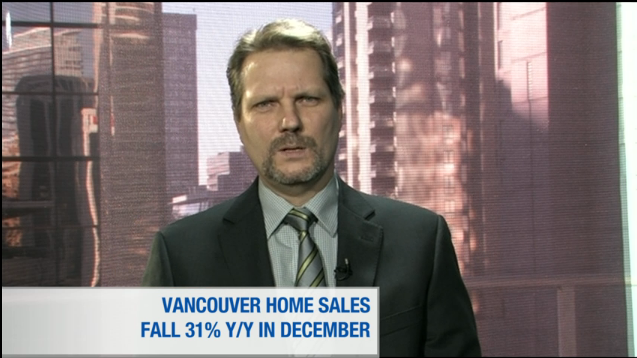
As if to point out the absurdity of his comments, while Muir was insisting the Vancouver market has been 'flat' since 2008/2009, BNN flashed across the screen the fact that Vancouver home sales were down 31% year over year in December.


BNN notes how jarring the statistics for sales declines are. Does this not concern Muir?

As always our buddy Cameron dismisses the poor sales, insisting all signs are for positive growth. Muir jumps on the fact that November and December saw sharp pull backs in the number of listings on the market - conveniently ignoring that this happens every year in November and December.

But as we showed yesterday, the number of active listings on the market right now is far higher than in previous years.

BNN contrasts this with comments from Paul Ferley, assistant chief economist at RBC Capital Markets.  Ferley says the bank's research on housing affordability in Vancouver showes that prices in the city had become frothy.
"Certainly the Vancouver numbers have been suggesting stresses in that market with affordability deteriorating and at some point a correction was likely going to have to play out. It was a market looking like it was poised for a correction."
Ferley adds that while prices have yet to fall as dramatically as sales, the city could be headed for "double digit" declines in home prices.
“You're seeing a correction in Vancouver – a fairly sizable one."
The focus on the Spring Market ramps higher with each passing day and the stage is set with Muir and Somerville firmly staking their reputations on a crash not happening.


(hat tip VREAA for Van. Sun image)

==================

Photobucket
Email: village_whisperer@live.ca
Click 'comments' below to contribute to this post.

Please read disclaimer at bottom of blog.

Thursday, December 20, 2012

"The price increases of the last decade are long gone."


You've got to wonder just how significant the shifting mindset amongst the public is regarding real estate when even Global TV is now openly saying the following:
"... there hasn't been a crash, thankfully, but Ottawa and the Bank of Canada are desperate to raise interest rates once the economy improves. Economists are expecting the rates to start inching upwards by late 2014 - meaning the price increases of the last decade are long gone."
Kinda kills the whole campaign to get people to buy the current dip, doesn't it?

Of course the same talking heads who want you to buy the current dip also want to insist there is no dip - prices are just flat and will remain flat (real estate never goes down, don't you know?).

Meanwhile Cameron Muir wants you to know that:
Last year’s figures must be taken “with a grain of salt,” Muir said because the prices were inflated by a large number of luxury homes for sale in West Vancouver, Richmond and Vancouver’s West End.
Really?

In all the breathless monthly reports we saw last year from the BCREA, does anyone recall being told to take those figures with "a grain of salt?"

Muir also wants you to know that:
"The federal government’s decision to reduce the maximum amortization period for a government-insured mortgage to 25 years from 30 years also affected home sales.

That could add up to $160 on the monthly payment of a $350,000 house.

That no doubt has squeezed some potential buyers out of the market."
So buyers are extending themselves so thin that an extra $160 a month collapsed the real estate market?

If so, imagine what a few interest rate points might do?

(hat tip to LM and GreenhornRET)

On another note, isn't the world supposed to end tomorrow?


==================

Photobucket
Email: village_whisperer@live.ca
Click 'comments' below to contribute to this post.

Please read disclaimer at bottom of blog.

Sunday, November 25, 2012

Blindness: We didn't crash in 2008, why would we now?


Yesterday we mentioned that one of the most interesting side shows in the public arena right now is in watching the frustration develop by the real estate industry as they watch their ability to manage their message in the media slip away.

For years they have easily massaged and manipulated the mainstream message about real estate,  but that ability seems to be slipping away as the mainstream media finally begins to highlight the conditions around our housing bubble.

That frustration was brought in a post by the Chief Economist of the British Columbia Real Estate Association (Cameron Muir) who is “now convinced that we will never hear the end of housing bubble speak.”

Muir's comments come from an article in BC Homes titled, "Speaking in Circles: Time to burst the bubble speak."

Real estate agent Larry Yatkowsky also picked up on Muir's diatribe and gave us a fuller version.

Muir, as we all know, has spent the better part of the year countering bubble fears by arguing that if we hadn't seen the market collapse after the Great Financial Crisis in 2008, we would we now?  Where is the big financial shock that will push us over the edge?  Why all the fears our bubble is bursting?
"The premise is now as firmly entrenched in popular consciousness as carbon emissions and TMZ. It has taken the form of idolatry in the blogosphere, where any countervailing narrative is demonized. It has catapulted university dropouts into media darlings because of a hackneyed webpage and an opinion. It has been tarted up by so-called experts who predict impending doom year after year, despite being completely wrong every time."
It seems ongoing events have struck a nerve in the reserved and rational nature of BC's Pumper-in-chief.

Clearly Muir is feeling the frustration:
"Now, I’m not wearing tinted glasses. Housing markets go up and they go down. However, my point is that sharp and significant declines in home prices are usually created by massive economic shocks, like the 21 per cent mortgage rates and recession of 1982. Yes, there can be short term speculative bubbles that float back to earth after the circus leaves town, but home prices in Vancouver, for example, have been incongruous with other Canadian markets for decades."
For Muir, it all boils down to the litmus test of 2008:
"The big test was 2008. That was the year of the doom sayers, when the largest financial crisis since the Great Depression besieged us and the collateral damage hurled us into a global recession, one from which we still haven’t fully recovered. The airwaves were all a buzz with end of the world prophets and those predicting home prices would be chopped in half, at least. It was going to be the big one! The housing market had gone through a significant inflationary period leading up to 2008. Unlike today, speculation was clearly evident. Accusations abounded that Vancouver was overvalued, unsustainable and frothy. One financial institution even had a publication called Housing Bubble Watch, now defunct, in which Vancouver was always the straw man.

So what happened? Home prices fell 15 per cent from peak to trough, but that was short-lived. Indeed, once the clouds of uncertainty dissipated only a few months later, buyers came back in droves.

The most dramatic turnaround ever recorded occurred in Vancouver during 2009, when the year began with 1980s level consumer demand and ended with sales tracking near record levels. Prices came right back to where they were before the crisis, and have stayed there, for the most part, for the past three years. If such a severe financial crisis and global recession couldn’t trigger a meltdown of the housing market or pop any asset balloon, what could?"
Of course we all know that the only thing that allowed up to escape the implosion of the 2008 Financial crisis was the ongoing injection of the crack cocaine of easy credit as CMHC cap was forced upward from $100 Billion in 2006 to $600 Billion in 2012.

Should we increase it another six fold over the next six years?  Should we go from $600 Billion today to $3.6 Trillion in 2018?

This is the blindness of a long term speculative mania. When even seasoned, rational real estate agents become blind to the conditions of the ever growing bubble.
"The main misconception about housing markets is that they behave like the stock market. They don’t. Bad news can drive stocks lower in a matter of seconds, whereas homes are relatively illiquid; they take a long time to sell and have higher closing costs. In addition, owner-occupiers typically don’t speculate with the family home. In times of hardship, the home is typically the last thing to go. Instead, they hold off on other expenditures like lattes, movie tickets, new TVs and vacations."
But our Canadian market is filled with speculative mania.  In Toronto it is estimated that 90-95% of all condo presales were to speculative investors.  In Vancouver the epidemic of pre-sale condo and single family home flipping is almost as extreme. It won't be the panic sale of the 'family home' that triggers any collapse.
"In a market that has a well-diversified economy and expanding population, fire sales are extremely uncommon. Unless there is household financial catastrophe on a large scale, potential home sellers simply wait until market conditions improve."
Our's is a well-diversified economy? Does our market have incomes that support these valuations?  Can we count on money from other markets (where incomes can support those valuations) endlessly coming into our hamlet for that support?
"I write this piece as home sales in Vancouver and many other markets stagnate and homes prices tread water (see the Canadian Real Estate Association’s Multiple Listing Service® Home Price Index for an accurate reading). I have no doubt that the voices of impending doom will soon renew their bellicose refrain. Perhaps their tea leaves will be right this time and the market will indeed collapse, leaving homes selling for 50 cents on the dollar. I’d put my money on that refrain continuing for a long time to come."
Presumably Muir wants to "put his money on that refrain" (from the bears that the market will collapse) because the bubble won't burst and bears have to keep saying it it will.

But the issue isn't the voices of impending doom.

Bears cannot blow down the housing bubble no matter how much they are demonized. The Federal Government won't change policy because of the clamouring of the blogosphere.

The issue is the mounds of debt.  And it seems we may have truly achieved that mythical level of tulip bulb blindness to the real issue.

==================

Photobucket
Email: village_whisperer@live.ca
Click 'comments' below to contribute to this post.

Please read disclaimer at bottom of blog.

Saturday, October 27, 2012

Media notes R/E groups attempting to "calm fears of a local housing crash"


On Thursday we told you how the media was filled with economists and 'experts' who were now predicting that prices will, in fact drop, but will do so by a moderate level that does not resemble the U.S. crash.

The purpose of all these ascertains? Preventing panic. A fact the Vancouver Sun noted yesterday:
Greater Vancouver will see home sales tumble by one-fifth this year, but the market should rebound in 2013, the B.C. Real Estate Association says in its new forecast as the group moves to calm fears of a local housing crash.
It is exactly those types of fears which are encouraging sellers to accept 75 cents on the dollar for properties (examples of which we have profiled over the past couple of weeks).

Of course the sellers aren't actually taking only 75 cents/dollar on their real estate.  Most bought before the big blow-up of the bubble during the 00's and they are still enjoying a large capital gain.  They just see the writing on the wall and are cashing out while there are still profits to be realized.

And those signs are everywhere.

Vancouver movers are reporting stiff declines in business due to the falling real estate market and the slowdown is effecting a broad segment of society:
Tradesmen, Builders and Craftsmen, worry about the later half of 2012 and the speculation around the slow down of the Vancouver Real Estate Market... Competitively priced houses are now sitting on the market for an average of 5 to 7 months. 
Scott Moe of RE/MAX says: "All across the board people are saying how slow it is out there. I have 24 listings right now and only had 4 showings on the weekend!" The slow down of BC's real estate industry extends well beyond just builders and realtors. Many local businesses are affected by slow real estate sales.
Which is why early signs of panic are now starting to pop up.

And there signs of more problems ahead.

Concerns are spreading through the Chinese media with headlines that: “All Canadian banks will introduce new mortgage rules by November 1st, 2012”What will those new rules entail?
All-Canadian banks and financial institutions will start on the 1st of next month to take up increased tightening housing mortgage measures. There will be new rules for those without sufficient proof of income documents.  This will include the self-employed who will only be able to obtain no more than 65% of the mortgage property value in their loans. Prior to the implementation of the new requirements, some banks allowed self-employed people up to 75-80% of property values in a mortgage. 
Mortgage experts believe that the new measures will have the greatest impact on new immigrants.
As one contributor on VCI noted (hat tip VMD), the OSFI will require lenders to limit maximum LTV ratios of “nonconforming residential mortgages” (eg. Self-employed without adequate income verification) to 65%, meaning the borrowers will need to put 35% up as a down payment.

New immigrants will be impacted due to inadequate income documentation, which looks at average income of the last 2 years. - (Previously new immigrants were required to put down 30% DP) - 

HELOC LTV limitations will be implemented by Nov 1st as well.

In other words, the saviour of wealthy Asians buying our overvalued property at prices high above what local incomes can support is about to take another big hit.

Combine that with tightening regulations on what entry level buyers can now overspend on greasing the property ladder at the entry levels and you have a recipe for even steeper declines.

Perhaps that's why a Winnipeg real estate agent is now running this ad (hat tip Makaya):


 ==================

Photobucket
Email: village_whisperer@live.ca
Click 'comments' below to contribute to this post.

Please read disclaimer at bottom of blog.

Friday, October 26, 2012

It's not just the million dollar homes falling below assessed value

L


Reading this blog you know we are watching the comments of the likes of BCREA chief economist Cameron Muir and UBC Sauder Associate Professor Tsur Somerville with keen interest.

Last month we have Somerville saying:
“Most people don’t have to sell their house,” he said. “You bought it for $200,000. The price is now $150,000. Unless you have to, why would you sell it?” 
For prices to go down ­significantly, contended Somerville, “You need people who have to sell, either because the economy has collapsed and they don’t have any income or developers have built a whole bunch of units that are unsold and the bank is screaming at them or foreclosing or something like that.”
None of those conditions appears imminent. 
This week he changed his tune and said Vancouver home prices could drop by 10% next year.

Meanwhile Cameron Muir insists:
"we don’t see a recession on the horizon, and we don’t see interest rates going up any time soon, so what kind of financial calamity is going to happen in Vancouver to get people to sell for 75 cents on the dollar?
We've shown you examples of Vancouver detached houses that currently have asking prices 23% below assessed value and Richmond detached houses 25% below assessed value.

Some have suggested that these are these extreme examples and that no such worry exists on the lower end of the spectrum where the average Vancouver income earner resides.

Without getting into the debate about whether the 'average Vancouver income earner' is into million dollar properties or not, a quick check of the comment section on the excellent blog Vancouver Condo Info turns up an immediate example to reference (hat tip Teddybear).

Here is an example of a Vancouver condo from a lower price range.

This is #2905-438 Seymour Street in the downtown core of Vancouver (click images to enlarge): 


It's a 1 bedroom, 1 bathroom condo which is currently listed at $319,000.

The $319,000 asking price, btw, is a big reduction.  It was originally listed for $389,000 on August 20th, 2012.

Now for those that discount that a $70,000 asking price cut (detractors will tell you idiots can always ask wild prices, doesn't mean squat in the big picture), the real test comes when we look at the assessed value:


As you can see... this property is assessed at $376,000.

So in a so-called 'flat' period (according to Somerville), the owners of this property have cut their asking price to more than 15% below assessed value.

Toss in another 10% drop in value next year (again... according to Somerville) and you have a property that would come in at 25% below assessed value.

Muir wants to know what is going to happen in Vancouver to get people to sell for 75 cents on the dollar?

Perhaps he should give the folks at 498 Seymour Street a call and ask them?

I suspect it has something to do with the fact that the listing indicates that this is the first time this unit has been on the market since the original sale. 

The building was built in 1996. Since then we have seen a huge loosening of credit (which triggered our massive housing boom -see our post here).  As a result it's not hard to surmise we have a situation very similar to the Boomer Trigger - i.e. people can move on price, so they will - and in doing so they still get out with a healthy capital gain.

This is an element that both Muir and Somerville appear to completely ignore. Many of these people selling for below assessed value aren't taking 75 cents on the dollar for their original 'investment'. 

It's a factor could wind up having a profound effect in the coming year.

If anyone knows the original purchase price of this unit, it would be nice to compare that to the current asking price/current assessed value  - let us know.

==================

Photobucket
Email: village_whisperer@live.ca
Click 'comments' below to contribute to this post.

Please read disclaimer at bottom of blog.

Wednesday, October 24, 2012

After insisting prices would remain flat, Tsur Somerville concedes prices could drop 10% next year


Was it only last month, on September 5th, 2012, that everyone's favourite industry shill Tsur Somerville was trotted out to declare prices would not come down!:
Tsur Somerville, who holds a real estate foundation professorship at the University of B.C., expects prices to stay flat for a while “because our prices are high relative to what people think they should be,” Somerville said. “Our price adjustment will come from prices being flat for awhile and letting income catch up to where prices are.”
If fact it was just after this, on September 14th, 2012 that Somerville came out and tried to halt all concerns and worries about a possible collapsing of prices by infamously declaring you can't burst a bubble that isn't there.
If there was a large number of unsold units coming onto the market or a huge change in the economic environment, Somerville said, “that would really cause prices to tank.” 
“Most people don’t have to sell their house,” he said. “You bought it for $200,000. The price is now $150,000. Unless you have to, why would you sell it?” 
For prices to go down ­significantly, contended Somerville, “You need people who have to sell, either because the economy has collapsed and they don’t have any income or developers have built a whole bunch of units that are unsold and the bank is screaming at them or foreclosing or something like that.”
None of those conditions appears imminent. 
Somerville said it would take “some negative shock,” such as an ­economic meltdown or mortgage interest rates jumping from four per cent to nine or 10 per cent, to trigger lower prices.
So no lower prices then?

What a difference a month makes.

Yesterday the Vancouver Province headlined Somerville's latest comments by trumpeting Vancouver home prices could drop by 10% next year.

Prices could drop?

So much for remaining flat.  As noted in the Province article:
“As home sales continue to plummet in Vancouver, it wouldn’t be surprising to see 10-per-cent price declines next year." That’s the view of University of B.C. real-estate economist Tsur Somerville, who was asked to respond to new market forecasts released by the B.C. Real Estate Association.
So what is this forecast from the BCREA that has changed Somerville's outlook?
On Tuesday, BCREA chief economist Cameron Muir said tighter mortgage rules implemented by Ottawa this summer triggered a 20.5-per-cent drop in Vancouver home sales, in a market that was already softening. The plunge in sales will cause a six-per-cent price decline in Vancouver’s average home price, Muir said, to $734,000. The association sees sales rebounding by 13.7 per cent in 2013, but predicts prices will slide by another two per cent, to $720,000.
So prices will slide but sales will rebound?  

Hmm... sounds like another prediction to be revised at a later date to me.

The best quote from the article is this one:
These declines should be seen in the context of unrealistic gains in 2011, Muir said.
Say wha????

Unrealistic gains in 2011. Quick... search those BCREA monthly market reports. Does anyone recall the BCREA proclaiming "unrealistic market gains" at any time in 2011?

But don't worry, homeowners, Somerville hasn't abandoned the flat prices theory.  You assets might fall 10% in value next year, but:
"(Somerville) expects prices to be more or less flat in 2014."
As for Cameron Muir, he wants to disuade all those bargain hunters sitting on the sidelines:
Right now, buyers seem content to sit on the sidelines in Vancouver, but people expecting to win massive discounts a few years down the road will be disappointed, Muir says. “We don’t see a recession on the horizon, and we don’t see interest rates going up any time soon, so what kind of financial calamity is going to happen in Vancouver to get people to sell for 75 cents on the dollar?” Muir asked.
I dunno... the same 'calamity' that already has them selling for 23% below assessed value in Vancouver  and 25% below assessed value in Richmond?

Just a thought.

==================

Photobucket
Email: village_whisperer@live.ca
Click 'comments' below to contribute to this post.

Please read disclaimer at bottom of blog.
Thursday, September 27, 2012

The Fall(ing) Market


You may recall our post about Vancouver realtor Keith Roy whose July declaration that it was time to cash out of the Vancouver housing market garnered national headlines.

Well Roy is back with another local housing analysis.  And it might just surprise you.

Real Estate sales in September are rivalling the benchmark dismal month of 2008, and may close out worse than that fateful month during the GFC.

These September sales totals come, as you know, after what has been a absolutely abysmal summer.

But what if results for the rest of Fall are even worse than the dreadful summer of 2012?

Roy takes a look at Vancouver detached housing sales on the west side of Vancouver in Fall from the past 10 years and suggests this is exactly what is about to occur (click on image to enlarge).

Says Roy:
If we can agree that ‘summer’ is June, July and August and ‘fall’ is September, October and November, then for 8 of the last 9 years, summer has been busier than fall - in up and down markets. 
Given that today’s market is widely considered to be slower than last year’s and buyers are much more hesitant than they have been in the past, coupled with the fact that many prospective buyers have yet to sell their home, I can easily suggest that fall will once again be slower than summer.
But that's just detached houses. What about the rest of the market?

Roy takes a look at the MLS sales numbers for all product types on the west side of Vancouver - houses, condos and townhomes combined - and while the results are a little bit different, Roy states that, once again, for 8 of the last 9 years sales have been busier in the summer than they were in the fall. The only difference is that when attached homes are included, the only fall that was better than summer was 2003 - which had an anomalous month in October 2003.


So Roy thinks sales will continue to suck. What about prices?

Once again realtor Keith Roy offers a very un-realtor-like assessment of what will happen to prices (while also taking a shot at the REBGV and BCREA):
The real estate board has taken great pains to assure and calm the public that the Greater Vancouver real estate market is strong and stable - particularly after my last blog post received so much media attention suggesting that the current trend of high supply and low demand will lead to an adjustment of prices. 
Unless someone can convince me otherwise, when it comes to short term pricing in the Vancouver market only two variables matter: Supply and Demand. 
Since my last blog post, supply has remained relatively static and sales have been slower that at any time in the last 10 years (with the exception of the August prior to the 2008 crash). 
As of September 16, 2012 there were 1014 homes for sale on the west side of Vancouver, down slightly from June’s 10 year high of 1078 available homes. After peak sales volume in February, sales in every month in 2012 have been lower than the month that preceded it reaching a low of only 75 home sales in August - 46% lower than the 10 year August average and 55 homes less than August 2011. 
We are only hearing anecdotal evidence of a busy fall market with new listings popping up, buyers coming to open houses again and some houses selling in multiple offers. But the typical fall buzz has yet to be seen.
Many Realtors are struggling to get offers on listings. In hopes of prices declining or another home coming on the market, many buyers are reluctant to write offers. 
September is not proving to be the saving grace many thought it would be.
In the end Roy believes the autumn market may best be re-termed the Fall(ing) Market as the dynamics of supply and demand play themselves out.

==================

Email: village_whisperer@live.ca
Click 'comments' below to contribute to this post.

Please read disclaimer at bottom of blog.

Monday, August 20, 2012

Canadian price declines called the "Vancouver Manouevre" - Royal Bank declares Vancouver market in a correction


Well it certainly appears the concern about what is going to happen in the Real Estate market this Autumn is ramping up.

After an abysmal summer and all the negative press, the fall market usually see a resurgence in listings... but will there be buyers?

Judging by the comments of Bank Economists, it appears everyone is bracing for dismal times.

The Financial Post tells us that Canadian home prices are falling steadily.

Much of the decline in the national Canadian average is being blamed on Vancouver.

An economist at BMO Financial Group called it the “Vancouver Manouevre”. Our city's price drops have brought down the national average despite 19 of 26 cities experiencing year-over-year increases.

As we have mentioned here before, Vancouver's average sale price dropped more than 12% year over year and 20% since May 2012.

RBC economist Robert Hogue said:
"We still believe that Vancouver is probably the most stressed market right now because of extremely poor affordability. Plot the resale figures over the last year or so and you see a fairly significant decline in resales, so I think that this does the fit the definition of correction.
Of course it does. When you have prices collapsing 20%, what other conclusion could you come to?

Naturally the British Columbia Real Estate Association (BCREA) disagrees.

(Surprise!)

BCREA chief economist Cameron Muir says:
“Typically to see a price correction you need to see a macroeconomic shock — recession, very high unemployment, for example — or you need to see interest rates go up very dramatically in a short period of time. Both of those we don’t see on the horizon.”
Cameron claims one-third of our market is first-time buyers and he insists there is no shortage of those 'first time buyers' to keep greasing the wheels of the property ladder:
“As long as we have first-time buyers that can get into the market to buy the homes from the people who are moving up, moving over, moving down, then the market should remain healthy.”
But if tighter mortgage regulations are making more difficult for potential first time buyers - and buyers are watching the market prices fall - when enter the market right now?

Watch for an unprecedented full out media campaign this fall promoting young first time buyers to do the 'smart' thing and get into the market.

In the absence of 'Hot Asian Money', what else will keep the ponzi going?

==================

Email: village_whisperer@live.ca
Click 'comments' below to contribute to this post.

Please read disclaimer at bottom of blog.


Saturday, July 14, 2012

Another West Side Realtor says the market is collapsing, tells clients "you must cut prices to sell"


Summer may have finally arrived on the Wet Coast, but the saying of the week remains 'when it rains, it pours.'

But instead of the endless Rainforest drizzle, the topic du jour is realtors.

For the last week and half the focus has been realtor Keith Roy.

But another horse has entered the Vancouver West Side race of realtors telling clients the market is crashing.

As profiled by Garth Turner yesterday, realtor Sam Wyatt is the latest to do a spit-take on the REBGV/BCREA/Sauder School of Business kool-aid.

Wyatt's synopsis of the Vancouver real estate market?
“This market is collapsing.”
You don't say Sam?

From his website:
Homes are simply not selling in the same volumes as they have been and the longer people wait to reduce prices, the larger the inventory will grow.

Last month I pointed out that the active listing volumes for detached Westside houses actually exceeded the highest volume during the credit crisis. In June the number of houses actively listed was even higher at 1078. During the credit crisis, the active listings of detached homes on the Westside never exceeded 1053 houses. Keep in mind also that the three year average number of active detached homes listed on the Westside between January 2009 and December 2011 was only 589. This is a very serious situation.

One of the most influential elements of the Vancouver West real estate market has been the large proportion of sales to foreign buyers, particularly from China. From a purely anecdotal point of view, the number of these sales has significantly diminished. We have been in a "top-down" market were the sale of the most expensive real estate has driven up prices in the rest of the market as sellers have opted to down-size or move to less costly neighbourhoods. By moving into lower price points, the sellers of higher priced real estate were able to drive up prices because they were relatively flush with cash compared to those making lateral or up-size moves. As a result, the closer to the entry level of the market, the fewer gains were made. Gastown apartments have made little price gains if any over the last 3 years while detached homes have nearly doubled. When houses prices fall, the rest of the market will almost certainly follow.

The new rules for Canadian Mortgage and Housing Corporation (CMHC) insured mortgages will have a detrimental effect on sales at the entry level of the market. Maximum amortization periods for insured mortgages have been reduced to 25 years. Over the past several years this maximum has fallen from 40 to 25. The most recent move from 30 to 25 years will be the most significant in that it will exclude many first time buyers from qualifying even while interest rates are near all time lows. If the banks follow suit and adopt the CMHC rules , as they almost always do, it will likely also dissuade many investor buyers from purchasing condos to rent out. I predict this because the lower amortization period will significantly increase monthly mortgage costs and lower the proportion of those payments that are tax-deductible interest.

Vancouver's real estate market is getting and is going to get hit from both ends. So, now that you are thoroughly depressed, here is the bright light: IF YOU SELL NOW, YOU WILL STILL BE SELLING NEAR THE TOP OF THE MARKET. If you plan to sell, you will need to price BELOW the most recent comparable sales prices. If you don't do this, your listing will stagnate.
While it lacks the flair Keith Roy had for kicking his industry under the bus, it's another indication - from a realtor himself - of the looming potential for our housing bubble to burst in spectacular fashion.

It also echo's Richmond realtor James Wong's advice that if you "want to sell your property, deep price cuts are needed."

With realtors seemly tripping over themselves to publicly tell you to bail on the market ASAP... it might almost make the average person begin to take notice of what's coming.

Horrors!

==================

Email: village_whisperer@live.ca
Click 'comments' below to contribute to this post.
Please read disclaimer at bottom of blog.