
Showing posts with label Cameron Muir. Show all posts

Thursday, June 6, 2013

Cameron calls a bottom


The Chief Pumper at the BC Real Estate Association is calling it the bottom over in Nanaimo today. Shilling in the Nanaimo Daily News, Cameron says:
"This is the second month, seasonally adjusted, we see a rising trend in consumer demand," said Cameron Muir, B.C. Real Estate Association chief economist. "I'm calling this a transition year. I think we're about to embark on another upswing."
Happy days are here again?

Never mind that every other market in the Island region, save Port Alberni, saw average selling prices decline.  In popular Parksville, they fell by as much as 6%.

We're in a transition to rising prices?... Woohoo!

Back on the mainland, rational realtors don't seem to share Muir's enthusiasm.

While west side realtor Sam Wyatt is also reporting an uptick in sales...
Months of Inventory (MOI) fell to 5 months for Vancouver detached homes. It remained at, and fell to under 5 months for attached homes and apartments respectively.
Vancouver real estate is now back to the MOI levels of last spring. I was pleasantly surprised that May was a such a good month for sales volumes for both my clients and the Vancouver market. Those sales volumes are what helped drive down the MOI in spite of high volumes of active listings.
... he doesn't view this as a springboard to a market surge:
Sales volumes generally peak in the Spring so it is likely that May will be the high point for the year (though I said that about March). May's real estate sales are comparable to May of last year but the trend to lower volumes of sales remains apparent. Unlike sales volumes, active listings don't typically peak until mid summer so It will be very interesting to see whether sales remain strong and listing volumes drop over the next few months. I will be surprised if either is the case.
Sounds like a rough transition, Cam.

==================

Photobucket
Email: village_whisperer@live.ca
Click 'comments' below to contribute to this post.

Please read disclaimer at bottom of blog.

Friday, March 15, 2013

Optimism become Hopium, but it's still a failed strategy


Real estate sales are down, way down.

"But low sales can only mean one thing:  the pool of eager buyers is building and the damn will burst, you just have to wait it out."

Essentially that's the message from BC Real Estate Association (BCREA) as they report on the dismal February sales statistics.

"B.C. real estate sales decline helps fuel drop in home prices" is the headline, which has to be frustrating because BCREA's Cameron Muir and Tsur Somerville (UBC Sauder School of Business) have spent so much time telling us prices won't be coming down.

But as buyers continue to stay away, Muir sends out a not-so-subtle message to sellers to bolster their confidence and hold firm on prices.
B.C. home sales continued at a modest pace in February," Muir said.  "Despite improved affordability, many potential buyers and sellers remain in a holding pattern.”

Muir’s estimate is that with sales down for such a long period, there are enough potential buyers who have put off decisions that there is what economists call “pent-up demand” building in the market and “it’s not a matter of if, but when home sales rise above their current pace.”

"Most B.C. markets have experienced relatively stable price levels during the first two months of the year."
Optimism or just Hopium?

In Vancouver, sales were down over 29% last month.

Across BC sales were down 24% in February compared to a year ago. This has brought the average BC price down 8%.

The South Okanagan Real Estate Board was worse.  They experienced a 33% sales decline.  The average South Okanagan price was down almost 20%. This region takes in Penticton and Osoyoos.

In Northern Lights, the area around Dawson Creek, sales in February were down 38%.

Perhaps it's time for another sermon from our buddy Somerville so he can tell us how prices simply can't come down any further and buyers shouldn't wait. Of course they would be much like the sermons he gave us on September 5th, 2012October 13, 2012, and November30th,2012.

Which reminds us, spring is here.

Wasn't it west side realtor Andrew Hasman who was echo'd the Muir/Somerville mime and told us in December and that if you wait until March 2013, you will have 'missed the boat' on a huge Spring surge in sales?

Hasman swallowed the Muir/Somerville Koolaid and told us:
We continued to see slow sluggish sales activity on the Westside during November. That being said there is some promising news. The number of homes on the market at the end of November has dropped substantially since peaking in mid-September. I have also noticed a lot more calls on our listed properties combining with more viewings too. Even though sales volumes continue to remain well below last year’s levels, the shrinking supply and stable sales volume over the past 6 months points to a stable market moving forward. In fact, I’m going to go out on a limb and predict a robust Winter Market with brisk activity in January and February.

For home owners thinking about selling in 2013, keep in mind if you list your home in March (based on the last 4 years of sales activity) you missed the best time for selling. Home owners that listed their homes just before Chinese New Year achieved the highest selling prices. The period of Late January to end of the February was the busiest time for housing sales the last 4 years. Why should this year be any different?
Seems that limb broke on poor Andrew. How did that whole Spring surge thing play out? Here's Andrew's month end review for February 2013:
When you read the real estate market stats in the newspaper and hear it in the media its quite evident that Vancouver’s housing market continues to remain cool. Sales in February across the region were down again in February some 29% compared to last year and year to date are down 23%... There have been some generous price declines on some properties where home owners need to sell. For those that do not have to sell, many homeowners have taken their homes off the market waiting for better times.
Why is it so many in the industry think that buyers 'have to buy' whereas sellers 'don't have to sell' and can wait out the buyers?

The reality is that neither side has to do anything. But with credit rates at historic lows, little to no sales occurring, and no chance whatsoever that the Federal Government is going to ease up on mortgage regulations; it won't be buyers making the first move here.

There is only one solution: -lower prices. And no amount of lecturing or hopium is going to change that.

Rather than focus on brow beating buyers, it's time for the Industry to focus it's efforts on educating sellers on the realities of the current economic situation.

Our markets need a painful adjustment to heal themselves.  The quicker it happens, the better things will be for everyone.

==================

Photobucket
Email: village_whisperer@live.ca
Click 'comments' below to contribute to this post.

Please read disclaimer at bottom of blog.

Thursday, January 31, 2013

Thur Post #1: CTV BC: Experts predict BC's real estate bubble will remain intact (played to the tune of 'when you wish upon a star')


Oh Tamara... really?

Is this the price we pay so that you can hang out regularly in Aquilini's box at Canuck games?

CTV BC came out with the above shill piece for the real estate industry's on-going campaign to tell you the real estate bubble won't burst - so you best buy now.

Sigh.

And the reason?

Supposedly, according to one real estate agent, there's "optimism in the air.  People are feeling happy, phones are ringing, it feels like we're back into selling real estate."

So it that what were hanging our hat on right now?  Attempts to manipulate buyer confidence?

Then we are fed the BS line that "new numbers are out today from the BC Real Estate association that back this up... signalling better times ahead"

Oh?  And what numbers are those?

Well BCREA pumper in chief, Cameron Muir, tells us that "the fundamentals in the market suggest that home sales should be stronger, higher than the levels were currently seeing."

Based on this wishful thinking we are shown this highly manipulative graph which - as the narrator tells you - is that "based on this, homes sales SHOULD be higher this year and next":

Really? Cameron claims his fundamentals say sales SHOULD be higher so we therefore forecast a 5.6% increase in sales this year and a 6.1% increase in 2014?

Then comes the gushing excitement that based on the fantasyland belief that sales "should be higher", then this means this "forecast uptick in sales is great for developers"  

Completing this daisy chain of fabricated logic is the Omni developer who says "we're seeing some real positive movement that buyers are coming off the fence."

Huh? OMG!

So... it's all about wishful thinking, now? That's what is going to make it all happen? And this passes as NEWS???

Incredibly that seems to be the level of desperation we're at.  Play the media with nothing more than BS to create the ideal that the market has no place to go but up in the hopes of creating some kind of buying frenzy.  Then you hype the 'fantasy frenzy' to manufacture the belief that a real estate uptick is underway and about to crest in the Spring air.

As always - you best buy now or be priced out forever.

Riiight. I truly believe we hit a new level in pathetic with this one.

==================
Photobucket

Email: village_whisperer@live.ca  Click 'comments' below to contribute to this post.

Please read disclaimer at bottom of blog.

Thursday, January 3, 2013

The correction going on in Vancouver is a "fairly sizable one" - RBC


Meet Paul Ferley, Assistant Chief Economist at RBC Capital Markets.

Ferley captures out attention for some comments he made on the Business News Network earlier today.

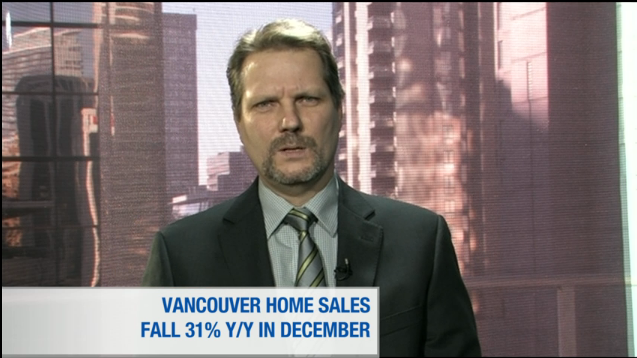
BNN was running a story on December's real estate numbers which showed Vancouver home sales plummeting again.  BNN started of talking with Cameron Muir, the Chief Economist from the B.C Real Estate Association.

Muir comes on the program carrying the "there is no bubble" standard that he and Tsur Somerville have been pounding for the last little while.

He insists that, after surviving the Great Financial Collapse of 2008, if the Vancouver Real Estate market hasn't collapsed yet then it won't.

As if to point out the absurdity of his comments, while Muir was insisting the Vancouver market has been 'flat' since 2008/2009, BNN flashed across the screen the fact that Vancouver home sales were down 31% year over year in December.


BNN notes how jarring the statistics for sales declines are. Does this not concern Muir?

As always our buddy Cameron dismisses the poor sales, insisting all signs are for positive growth. Muir jumps on the fact that November and December saw sharp pull backs in the number of listings on the market - conveniently ignoring that this happens every year in November and December.

But as we showed yesterday, the number of active listings on the market right now is far higher than in previous years.

BNN contrasts this with comments from Paul Ferley, assistant chief economist at RBC Capital Markets.  Ferley says the bank's research on housing affordability in Vancouver showes that prices in the city had become frothy.
"Certainly the Vancouver numbers have been suggesting stresses in that market with affordability deteriorating and at some point a correction was likely going to have to play out. It was a market looking like it was poised for a correction."
Ferley adds that while prices have yet to fall as dramatically as sales, the city could be headed for "double digit" declines in home prices.
“You're seeing a correction in Vancouver – a fairly sizable one."
The focus on the Spring Market ramps higher with each passing day and the stage is set with Muir and Somerville firmly staking their reputations on a crash not happening.


(hat tip VREAA for Van. Sun image)

==================

Photobucket
Email: village_whisperer@live.ca
Click 'comments' below to contribute to this post.

Please read disclaimer at bottom of blog.

Sunday, December 30, 2012

You can almost smell the desperation - buyer's once again told prices will not be coming down


It was back in the middle of October that Tsur Somerville first admonished home buyers who were sitting on the sidelines waiting for housing prices to come down.
Tsur Somerville, who holds a real estate foundation professorship at the University of B.C., expects prices to stay flat for a while “because our prices are high relative to what people think they should be,” Somerville said. “Our price adjustment will come from prices being flat for awhile and letting income catch up to where prices are.”
If fact it was just after this that Somerville came out and tried to halt all concerns and worries about a possible collapsing of prices by infamously declaring you can't burst a bubble that isn't there.
“Most people don’t have to sell their house,” he said. “You bought it for $200,000. The price is now $150,000. Unless you have to, why would you sell it?” 
For prices to go down ­significantly, contended Somerville, “You need people who have to sell, either because the economy has collapsed and they don’t have any income or developers have built a whole bunch of units that are unsold and the bank is screaming at them or foreclosing or something like that.”   
None of those conditions appears imminent. 
Somerville said it would take “some negative shock,” such as an ­economic meltdown or mortgage interest rates jumping from four per cent to nine or 10 per cent, to trigger lower prices.
In that October post we profiled some Vancouver westside properties that have dropped their asking prices to between 10%-23%, with no buyers in sight.

The response of Somerville et al?  Prices are flat... there is no decline.

Two and half months later, with the market still suffering with the start of the Spring Market looming, Somerville is back with BCREA Chief Economist Cameron Muir to trumpet the same message: Vancouver real estate buyers waiting for a price collapse in 2013 could be in for a long wait.
While prospective sellers are waiting, the numbers indicate that prospective buyers are a bit shy as well. “The market right now is both slow and tentative. There are a lot of people out there being very tentative because they’re not really sure where things are going,” Somerville said. “I can’t say how many buyers are in the market — I want to differentiate between that and the prices they are willing to pay. Maybe there are people who are actually interested in buying, but they’re either waiting for prices to be at a certain point, or they’re making offers that aren’t being accepted. I can’t differentiate between those things.”
And this is the frustrating thing for the industry right now.  They know there is an incredible amount of pent up demand - demand that knows the market is overvalued and they are prepared to wait for it to come down.

Hence the message:
“To get prices to really tank, you’ve got to have something happen. Either you’ve got to have overbuilding, or you’ve got to have some big change in the world of finance, such as large movement in interest rates or a financial disruption, or you’ve got to have a real negative economic shock,” Somerville said. “You’ve got to have some combination of those, or one of those to make prices drop dramatically.”

Overbuilding of single-family homes in Metro Vancouver is difficult because land is so limited, Somerville said.
It was left to Muir to deliver the R/E message of import:
Cameron Muir, B.C. Real Estate Association chief economist, thinks if buyers are waiting, they could be waiting a long time.

“Three years ago we saw the largest financial crisis since the Great Depression and an ensuing global recession. If that’s wasn’t enough to trigger a correction in an asset bubble, I don’t know what is,” Muir said.

“The condo market in Vancouver has not been ‘hot’ since 2009, and perhaps even earlier than that. Prices on the condominium side have been relatively flat for three years, so that doesn’t signal any kind of asset bubble welling up,” Muir said. “There has also been little speculation in the marketplace over the past few years and home builders have been kept in check in terms of their total units in production.
You almost have to fall out of your chair with laughter here.
  • The condo market in Vancouver hasn't been hot since 2009? 
  • Little speculation in the market place? 
  • Home builders have been kept in check in terms of total units in production?
Riiight.

Wasn't it just last August that ScotiaBank declared the Vancouver market was in a full blown correction  and warned:
the risk of a more difficult adjustment will increase if builders do not soon begin to slow the pace of new construction.
Faithful readers will recall back in February 2012, Ozzie Jurock made reference to the exploding condo inventory on his Face Book page and described the spring/summer condo market as:
"a market that will have a lot of units for sale and more coming on stream."
In an OpEd piece in the Vancouver Sun, Jurock noted:
As of Feb. 29, 2012, there were 6,000-plus condos for sale through the Vancouver Real Estate Board - up 15% compared to the previous year.

At the same time, sales of used condos were down by 18%.

Add to this the fact that - according to MPC Intelligence - there are some 8,000 pre-sale condos being launched in the first six months of this year.
Ultimately Somerville and Muir are going for the soundbite... for the headline.  That's how you mould public opinion.

The problem is their target market - the buyer sitting on the sidelines - is not like Joe Q. Public who browses the media and pays half hearted attention to those headlines.

The buyer on the sidelines is keenly aware of the what is going on.

The buyer on the sidelines is keenly aware that prices have been coming down.

And the buyer on the sidelines is keenly aware Somerville and Muir are full of it.

Which is why they are not biting at those listings currently asking 25% below assessed value.

They are willing to wait.  And it's going to take more than Somerville and Muir berating them for waiting, to get them to buy.

==================

Photobucket
Email: village_whisperer@live.ca
Click 'comments' below to contribute to this post.

Please read disclaimer at bottom of blog.

Thursday, December 20, 2012

"The price increases of the last decade are long gone."


You've got to wonder just how significant the shifting mindset amongst the public is regarding real estate when even Global TV is now openly saying the following:
"... there hasn't been a crash, thankfully, but Ottawa and the Bank of Canada are desperate to raise interest rates once the economy improves. Economists are expecting the rates to start inching upwards by late 2014 - meaning the price increases of the last decade are long gone."
Kinda kills the whole campaign to get people to buy the current dip, doesn't it?

Of course the same talking heads who want you to buy the current dip also want to insist there is no dip - prices are just flat and will remain flat (real estate never goes down, don't you know?).

Meanwhile Cameron Muir wants you to know that:
Last year’s figures must be taken “with a grain of salt,” Muir said because the prices were inflated by a large number of luxury homes for sale in West Vancouver, Richmond and Vancouver’s West End.
Really?

In all the breathless monthly reports we saw last year from the BCREA, does anyone recall being told to take those figures with "a grain of salt?"

Muir also wants you to know that:
"The federal government’s decision to reduce the maximum amortization period for a government-insured mortgage to 25 years from 30 years also affected home sales.

That could add up to $160 on the monthly payment of a $350,000 house.

That no doubt has squeezed some potential buyers out of the market."
So buyers are extending themselves so thin that an extra $160 a month collapsed the real estate market?

If so, imagine what a few interest rate points might do?

(hat tip to LM and GreenhornRET)

On another note, isn't the world supposed to end tomorrow?


==================

Photobucket
Email: village_whisperer@live.ca
Click 'comments' below to contribute to this post.

Please read disclaimer at bottom of blog.

Sunday, November 25, 2012

Blindness: We didn't crash in 2008, why would we now?


Yesterday we mentioned that one of the most interesting side shows in the public arena right now is in watching the frustration develop by the real estate industry as they watch their ability to manage their message in the media slip away.

For years they have easily massaged and manipulated the mainstream message about real estate,  but that ability seems to be slipping away as the mainstream media finally begins to highlight the conditions around our housing bubble.

That frustration was brought in a post by the Chief Economist of the British Columbia Real Estate Association (Cameron Muir) who is “now convinced that we will never hear the end of housing bubble speak.”

Muir's comments come from an article in BC Homes titled, "Speaking in Circles: Time to burst the bubble speak."

Real estate agent Larry Yatkowsky also picked up on Muir's diatribe and gave us a fuller version.

Muir, as we all know, has spent the better part of the year countering bubble fears by arguing that if we hadn't seen the market collapse after the Great Financial Crisis in 2008, we would we now?  Where is the big financial shock that will push us over the edge?  Why all the fears our bubble is bursting?
"The premise is now as firmly entrenched in popular consciousness as carbon emissions and TMZ. It has taken the form of idolatry in the blogosphere, where any countervailing narrative is demonized. It has catapulted university dropouts into media darlings because of a hackneyed webpage and an opinion. It has been tarted up by so-called experts who predict impending doom year after year, despite being completely wrong every time."
It seems ongoing events have struck a nerve in the reserved and rational nature of BC's Pumper-in-chief.

Clearly Muir is feeling the frustration:
"Now, I’m not wearing tinted glasses. Housing markets go up and they go down. However, my point is that sharp and significant declines in home prices are usually created by massive economic shocks, like the 21 per cent mortgage rates and recession of 1982. Yes, there can be short term speculative bubbles that float back to earth after the circus leaves town, but home prices in Vancouver, for example, have been incongruous with other Canadian markets for decades."
For Muir, it all boils down to the litmus test of 2008:
"The big test was 2008. That was the year of the doom sayers, when the largest financial crisis since the Great Depression besieged us and the collateral damage hurled us into a global recession, one from which we still haven’t fully recovered. The airwaves were all a buzz with end of the world prophets and those predicting home prices would be chopped in half, at least. It was going to be the big one! The housing market had gone through a significant inflationary period leading up to 2008. Unlike today, speculation was clearly evident. Accusations abounded that Vancouver was overvalued, unsustainable and frothy. One financial institution even had a publication called Housing Bubble Watch, now defunct, in which Vancouver was always the straw man.

So what happened? Home prices fell 15 per cent from peak to trough, but that was short-lived. Indeed, once the clouds of uncertainty dissipated only a few months later, buyers came back in droves.

The most dramatic turnaround ever recorded occurred in Vancouver during 2009, when the year began with 1980s level consumer demand and ended with sales tracking near record levels. Prices came right back to where they were before the crisis, and have stayed there, for the most part, for the past three years. If such a severe financial crisis and global recession couldn’t trigger a meltdown of the housing market or pop any asset balloon, what could?"
Of course we all know that the only thing that allowed up to escape the implosion of the 2008 Financial crisis was the ongoing injection of the crack cocaine of easy credit as CMHC cap was forced upward from $100 Billion in 2006 to $600 Billion in 2012.

Should we increase it another six fold over the next six years?  Should we go from $600 Billion today to $3.6 Trillion in 2018?

This is the blindness of a long term speculative mania. When even seasoned, rational real estate agents become blind to the conditions of the ever growing bubble.
"The main misconception about housing markets is that they behave like the stock market. They don’t. Bad news can drive stocks lower in a matter of seconds, whereas homes are relatively illiquid; they take a long time to sell and have higher closing costs. In addition, owner-occupiers typically don’t speculate with the family home. In times of hardship, the home is typically the last thing to go. Instead, they hold off on other expenditures like lattes, movie tickets, new TVs and vacations."
But our Canadian market is filled with speculative mania.  In Toronto it is estimated that 90-95% of all condo presales were to speculative investors.  In Vancouver the epidemic of pre-sale condo and single family home flipping is almost as extreme. It won't be the panic sale of the 'family home' that triggers any collapse.
"In a market that has a well-diversified economy and expanding population, fire sales are extremely uncommon. Unless there is household financial catastrophe on a large scale, potential home sellers simply wait until market conditions improve."
Our's is a well-diversified economy? Does our market have incomes that support these valuations?  Can we count on money from other markets (where incomes can support those valuations) endlessly coming into our hamlet for that support?
"I write this piece as home sales in Vancouver and many other markets stagnate and homes prices tread water (see the Canadian Real Estate Association’s Multiple Listing Service® Home Price Index for an accurate reading). I have no doubt that the voices of impending doom will soon renew their bellicose refrain. Perhaps their tea leaves will be right this time and the market will indeed collapse, leaving homes selling for 50 cents on the dollar. I’d put my money on that refrain continuing for a long time to come."
Presumably Muir wants to "put his money on that refrain" (from the bears that the market will collapse) because the bubble won't burst and bears have to keep saying it it will.

But the issue isn't the voices of impending doom.

Bears cannot blow down the housing bubble no matter how much they are demonized. The Federal Government won't change policy because of the clamouring of the blogosphere.

The issue is the mounds of debt.  And it seems we may have truly achieved that mythical level of tulip bulb blindness to the real issue.

==================

Photobucket
Email: village_whisperer@live.ca
Click 'comments' below to contribute to this post.

Please read disclaimer at bottom of blog.

Friday, October 26, 2012

It's not just the million dollar homes falling below assessed value

L


Reading this blog you know we are watching the comments of the likes of BCREA chief economist Cameron Muir and UBC Sauder Associate Professor Tsur Somerville with keen interest.

Last month we have Somerville saying:
“Most people don’t have to sell their house,” he said. “You bought it for $200,000. The price is now $150,000. Unless you have to, why would you sell it?” 
For prices to go down ­significantly, contended Somerville, “You need people who have to sell, either because the economy has collapsed and they don’t have any income or developers have built a whole bunch of units that are unsold and the bank is screaming at them or foreclosing or something like that.”
None of those conditions appears imminent. 
This week he changed his tune and said Vancouver home prices could drop by 10% next year.

Meanwhile Cameron Muir insists:
"we don’t see a recession on the horizon, and we don’t see interest rates going up any time soon, so what kind of financial calamity is going to happen in Vancouver to get people to sell for 75 cents on the dollar?
We've shown you examples of Vancouver detached houses that currently have asking prices 23% below assessed value and Richmond detached houses 25% below assessed value.

Some have suggested that these are these extreme examples and that no such worry exists on the lower end of the spectrum where the average Vancouver income earner resides.

Without getting into the debate about whether the 'average Vancouver income earner' is into million dollar properties or not, a quick check of the comment section on the excellent blog Vancouver Condo Info turns up an immediate example to reference (hat tip Teddybear).

Here is an example of a Vancouver condo from a lower price range.

This is #2905-438 Seymour Street in the downtown core of Vancouver (click images to enlarge): 


It's a 1 bedroom, 1 bathroom condo which is currently listed at $319,000.

The $319,000 asking price, btw, is a big reduction.  It was originally listed for $389,000 on August 20th, 2012.

Now for those that discount that a $70,000 asking price cut (detractors will tell you idiots can always ask wild prices, doesn't mean squat in the big picture), the real test comes when we look at the assessed value:


As you can see... this property is assessed at $376,000.

So in a so-called 'flat' period (according to Somerville), the owners of this property have cut their asking price to more than 15% below assessed value.

Toss in another 10% drop in value next year (again... according to Somerville) and you have a property that would come in at 25% below assessed value.

Muir wants to know what is going to happen in Vancouver to get people to sell for 75 cents on the dollar?

Perhaps he should give the folks at 498 Seymour Street a call and ask them?

I suspect it has something to do with the fact that the listing indicates that this is the first time this unit has been on the market since the original sale. 

The building was built in 1996. Since then we have seen a huge loosening of credit (which triggered our massive housing boom -see our post here).  As a result it's not hard to surmise we have a situation very similar to the Boomer Trigger - i.e. people can move on price, so they will - and in doing so they still get out with a healthy capital gain.

This is an element that both Muir and Somerville appear to completely ignore. Many of these people selling for below assessed value aren't taking 75 cents on the dollar for their original 'investment'. 

It's a factor could wind up having a profound effect in the coming year.

If anyone knows the original purchase price of this unit, it would be nice to compare that to the current asking price/current assessed value  - let us know.

==================

Photobucket
Email: village_whisperer@live.ca
Click 'comments' below to contribute to this post.

Please read disclaimer at bottom of blog.

Thursday, October 25, 2012

The Evolution of Rationalization


We seem to have entered an interesting phase in the media coverage of our housing collapse.

Instead of denying there is even a bubble to burst in the first place, now the media is filled with economists and 'experts' who predict that prices will fall but by a moderate level that does not resemble the U.S. crash.

The latest to join the chorus (after Muir and Somerville yesterday) is CIBC deputy-chief economist Benjamin Tal.

Tal, however, takes it beyond accepting there will be some price declines and minimizing them. For Tal it's about ensuring slipping prices don't trigger a collapse in buyer/seller confidence.
"There is nothing to fear but fear itself... Panic is the worst thing that could happen because when that mentality sets in and people become irrational, it’s hard to forecast how low prices will go."
Tal, Muir and Somerville have one central worry: that Canadians are starting to talk themselves into a housing crash by creating a scenario in which every new statistic is interpreted in the most negative way with an eye on trying to constantly compare the Canadian housing market with what Americans experienced just before their housing prices plummeted by as much as 50% in some markets.

Which is why each and everyone of them keeps insisting/re-assuring that there will be no U.S. style crash in Canada.

Says Tal:
"When you see headlines screaming that Canadian household debt has reached a record level, an eerily similar spot to where Americans were before the market crashed there, it adds to concern. But the similarity ends with the headline-grabbing number. The quality of the debt is much different here."
Err... quality?

Tal maintains the people who have taken on more debt have a much higher credit score than the Americans who did the same prior to their market crash.

Ummm... But if Canadians are such a better risk than what do you make of a Bank of Montreal report that BMO came out with on Monday that noted that almost three-quarters of Canadian homeowners would feel a significant squeeze from even a small rise in interest rates?

The report basically says 73% of the people surveyed can’t afford their own homes. And a lot of them are already feeling the pinch.

A third of these people have already cut back on other spending so they can make the mortgage payment.

One in six has been forced to raid their savings to pay current costs.

This is at a time when interest rates are at historic lows, which means they can only go up. That they will rise, eventually, is inevitable. Yet 16% of the people in the survey said they might not be able to make their payments if rates rose by even a tenth.

So much for Canadian debt being of a higher quality.

Another key factor that Tal insists is ignored in the current housing bubble discussion is how much of our Canadian mortgage debt is locked in for longer terms and not subject to the vagaries of rising rates.

Tal says 70% to 80% of Americans were in variable products at the peak while the Canadian figure is 29% (Tal cites the latest survey from the Canadian Association of Mortgage Professionals for this statistic).

Umm... just a quick question here.  When you say only 29% of Canadians are in variable products... does that mean we don't count a mortgage that resets to a different interest rate after five years?

I mean, aren't ALL Canadians in variable products when you consider this factor?  How many Canadians have 30 year locked in mortgages like in the United States?

Blink... blink.

Sorry Tal... I know I'm afraid.

==================

Photobucket
Email: village_whisperer@live.ca
Click 'comments' below to contribute to this post.

Please read disclaimer at bottom of blog.
Wednesday, October 24, 2012

After insisting prices would remain flat, Tsur Somerville concedes prices could drop 10% next year


Was it only last month, on September 5th, 2012, that everyone's favourite industry shill Tsur Somerville was trotted out to declare prices would not come down!:
Tsur Somerville, who holds a real estate foundation professorship at the University of B.C., expects prices to stay flat for a while “because our prices are high relative to what people think they should be,” Somerville said. “Our price adjustment will come from prices being flat for awhile and letting income catch up to where prices are.”
If fact it was just after this, on September 14th, 2012 that Somerville came out and tried to halt all concerns and worries about a possible collapsing of prices by infamously declaring you can't burst a bubble that isn't there.
If there was a large number of unsold units coming onto the market or a huge change in the economic environment, Somerville said, “that would really cause prices to tank.” 
“Most people don’t have to sell their house,” he said. “You bought it for $200,000. The price is now $150,000. Unless you have to, why would you sell it?” 
For prices to go down ­significantly, contended Somerville, “You need people who have to sell, either because the economy has collapsed and they don’t have any income or developers have built a whole bunch of units that are unsold and the bank is screaming at them or foreclosing or something like that.”
None of those conditions appears imminent. 
Somerville said it would take “some negative shock,” such as an ­economic meltdown or mortgage interest rates jumping from four per cent to nine or 10 per cent, to trigger lower prices.
So no lower prices then?

What a difference a month makes.

Yesterday the Vancouver Province headlined Somerville's latest comments by trumpeting Vancouver home prices could drop by 10% next year.

Prices could drop?

So much for remaining flat.  As noted in the Province article:
“As home sales continue to plummet in Vancouver, it wouldn’t be surprising to see 10-per-cent price declines next year." That’s the view of University of B.C. real-estate economist Tsur Somerville, who was asked to respond to new market forecasts released by the B.C. Real Estate Association.
So what is this forecast from the BCREA that has changed Somerville's outlook?
On Tuesday, BCREA chief economist Cameron Muir said tighter mortgage rules implemented by Ottawa this summer triggered a 20.5-per-cent drop in Vancouver home sales, in a market that was already softening. The plunge in sales will cause a six-per-cent price decline in Vancouver’s average home price, Muir said, to $734,000. The association sees sales rebounding by 13.7 per cent in 2013, but predicts prices will slide by another two per cent, to $720,000.
So prices will slide but sales will rebound?  

Hmm... sounds like another prediction to be revised at a later date to me.

The best quote from the article is this one:
These declines should be seen in the context of unrealistic gains in 2011, Muir said.
Say wha????

Unrealistic gains in 2011. Quick... search those BCREA monthly market reports. Does anyone recall the BCREA proclaiming "unrealistic market gains" at any time in 2011?

But don't worry, homeowners, Somerville hasn't abandoned the flat prices theory.  You assets might fall 10% in value next year, but:
"(Somerville) expects prices to be more or less flat in 2014."
As for Cameron Muir, he wants to disuade all those bargain hunters sitting on the sidelines:
Right now, buyers seem content to sit on the sidelines in Vancouver, but people expecting to win massive discounts a few years down the road will be disappointed, Muir says. “We don’t see a recession on the horizon, and we don’t see interest rates going up any time soon, so what kind of financial calamity is going to happen in Vancouver to get people to sell for 75 cents on the dollar?” Muir asked.
I dunno... the same 'calamity' that already has them selling for 23% below assessed value in Vancouver  and 25% below assessed value in Richmond?

Just a thought.

==================

Photobucket
Email: village_whisperer@live.ca
Click 'comments' below to contribute to this post.

Please read disclaimer at bottom of blog.

Wednesday, October 3, 2012

Wed Post #1: Conflicting messages. Should the Federal Government back off on their mortgage changes?


After dismal sales in March, April, May, June, July, and August; September was supposed to begin a fall surge that would lift real estate out of it's malaise this year.

Instead the worst September sales numbers on record has the real estate industry reeling in panic. 

Unable to hide what's going on with their muddled statistics, the Federal Government is now getting the blame.

We all knew that was coming.

Never mind that sales were plummeting even before mortgage changes were enacted in July, the full court press is ramping up against the Federal Government to undo the mortgage regulations they recently imposed.

As if that was the cause of the problem.

The problem, as blog fans know all to0 well, is the housing bubble and the easy credit that fuelled this mess.

In 1999, the National Housing Act and the Canada Mortgage and Housing Corporation Act were modified allowing for the introduction of a 5% down payment. Just a few years earlier you needed to plunk down 25%.

In 2003 CMHC decided to remove price ceilings limitations and would now insure any mortgage regardless of the cost of the home.

In 2005 and 2006, CMHC went from insuring only 25 year amortized mortgages and to insuring 30, then 35 year amortizations.

In 2007, CMHC allowed people to purchase a home with no down payment and allowed them to amortize it over 40 years.

It was excess credit, credit which flooded the housing market... and prices soared.

And even though the 5% down payment was reintroduced in 2008 and maximum amortizations scaled back to 35 years in 2008, the Great Financial Crisis resulted in a tremendous slashing of interest rates. Emergency level interest rates negating the rule changes.

One only has to look at CMHC's allowable mortgage cap.  The Crown Corp has gone from $100 Billion in mortgages in 2006 to $600 Billion in 2012.

In that one statistic alone lies the housing bubble.

Earlier this year the CEOs of Canada's banks began putting pressure on Finance Minister Flaherty and Prime Minister Harper to curb debt levels by raising down payment requirements and/or shortening maximum mortgage amortization lengths.

With mortgages representing nearly 70% of total household credit - and with household credit reaching record highs - limiting the expansion of that form of debt is crucial.

As real estate goes through withdrawal pangs from the partial removal of it's addictive drug (imagine the screaming if we had gone back to 25% down?), the Industry is having the shakes.

Rather than blaming liquidity for blowing a bubble to begin with, the Industry is attacking government for denying it the crucial drug they so desperately desire.

With the September surge now rendered a false hope, blame begins.

The Globe and Mail picks up on the Industry's wrath:
The federal government eliminated the approval of 30-year amortization periods on government-backed mortgages in June – and the decision’s impact can now be seen most vividly in the cooling off of Greater Vancouver’s market, with sales falling for everything from entry-level homes to luxury houses... Real estate sales across Greater Vancouver are sinking. There were 1,516 residential properties that changed hands in September in the region, down nearly 33 per cent from the same month last year. In West Vancouver, where the posh British Properties are located, the number of detached homes sold fell to 43 last month from 71 a year earlier.
The Industry's thrust is that the mortgage changes are hurting everyone, not just the entry level buyer. It's hurting you.  Ergo... you should pressure the government to turn the taps back on.

But should the Canadian Federal Government back off on the changes to the mortgage rules they introduced in June?

Eugene Klein, President of the Real Estate Board of Greater Vancouver certainly thinks so:
“There’s been a clear reduction in buyer demand in the three months since the federal government eliminated the availability of a 30-year amortization on government-insured mortgages. This makes homes less affordable for the people of the region.”
Hmm... sounds like a problem, doesn't it?

Bank of Montreal senior economist Sal Guatieri also suggested that there has been a domino effect in the Vancouver region.

As condo sellers - who can’t unload their places - aren’t able to then purchase larger residences, the result is a dampening effect in the overall market.

Even in the higher end of real estate, buyers who could borrow heavily in the past are no longer able to qualify for as much mortgage funding.

So these government policies are really hurting the Real Estate industry - and by extension - average Canadians, right?

Well... there's some conflicting opinions on this.  So let's ask some industry experts.

First up, Cameron Muir - Chief Economist of the BC Real Estate Association.

Mr. Muir... Eugene Klein is concerned buyers are staying away from buying real estate and that government policies are to blame. Your thoughts?
"I am predicting increased sales in 2013 because of continuing low interest rates, population growth and more full-time jobs."

Oh?  Ummm... Ok. So Klein's concerns that there are no buyers right now, that won't be an issue in 2013.

But what about sales for the rest of this year, in 2012?
"Employment growth in the ­Greater Vancouver area in the first ­seven months of the year has been 3.5 to 4 per cent ­higher than the same period last year. I would expect to see sales pick up before the end of the year, at least on a seasonally adjusted basis."

Oh? Umm... Ok.

So the position of the BCREA is that Eugene Klein and the REBGV are completely off the mark with their concerns that the outlook for real estate sales is bleak because of changes to government mortgage regulations?

Good to know.

Let's check with another local expert, Tsur Somerville of the UBC Sauder School of Business.

Mr. Somerville... Eugene Klein is worried that there has been a clear reduction in buyer demand and this is a threat to the market. Will prices be going down anytime soon because of the government tightening of mortgage regulations?
"If there was a large number of unsold units coming onto the market or a huge change in the economic environment, that would really cause prices to tank. Most people don’t have to sell their house. You bought it for $200,000. The price is now $150,000. Unless you have to, why would you sell it?” For prices to go down ­significantly, you need people who have to sell, either because the economy has collapsed and they don’t have any income or developers have built a whole bunch of units that are unsold and the bank is screaming at them or foreclosing or something like that. None of those conditions appears imminent. It would take some negative shock, such as an ­economic meltdown or mortgage interest rates jumping from four per cent to nine or 10 per cent, to trigger lower prices."

Really? 

Ok.

So all these concerns that sales are stagnating, that this will prevent move up buyers, which will - in turn - fail to keep the market moving thus creating a domino effect leading to a drop in prices... this is all a load of shite?

Good to know.

Did you catch that Mr. Harper, Flaherty and Carney?

==================

Photobucket
Email: village_whisperer@live.ca
Click 'comments' below to contribute to this post.

Please read disclaimer at bottom of blog.

Monday, August 20, 2012

Canadian price declines called the "Vancouver Manouevre" - Royal Bank declares Vancouver market in a correction


Well it certainly appears the concern about what is going to happen in the Real Estate market this Autumn is ramping up.

After an abysmal summer and all the negative press, the fall market usually see a resurgence in listings... but will there be buyers?

Judging by the comments of Bank Economists, it appears everyone is bracing for dismal times.

The Financial Post tells us that Canadian home prices are falling steadily.

Much of the decline in the national Canadian average is being blamed on Vancouver.

An economist at BMO Financial Group called it the “Vancouver Manouevre”. Our city's price drops have brought down the national average despite 19 of 26 cities experiencing year-over-year increases.

As we have mentioned here before, Vancouver's average sale price dropped more than 12% year over year and 20% since May 2012.

RBC economist Robert Hogue said:
"We still believe that Vancouver is probably the most stressed market right now because of extremely poor affordability. Plot the resale figures over the last year or so and you see a fairly significant decline in resales, so I think that this does the fit the definition of correction.
Of course it does. When you have prices collapsing 20%, what other conclusion could you come to?

Naturally the British Columbia Real Estate Association (BCREA) disagrees.

(Surprise!)

BCREA chief economist Cameron Muir says:
“Typically to see a price correction you need to see a macroeconomic shock — recession, very high unemployment, for example — or you need to see interest rates go up very dramatically in a short period of time. Both of those we don’t see on the horizon.”
Cameron claims one-third of our market is first-time buyers and he insists there is no shortage of those 'first time buyers' to keep greasing the wheels of the property ladder:
“As long as we have first-time buyers that can get into the market to buy the homes from the people who are moving up, moving over, moving down, then the market should remain healthy.”
But if tighter mortgage regulations are making more difficult for potential first time buyers - and buyers are watching the market prices fall - when enter the market right now?

Watch for an unprecedented full out media campaign this fall promoting young first time buyers to do the 'smart' thing and get into the market.

In the absence of 'Hot Asian Money', what else will keep the ponzi going?

==================

Email: village_whisperer@live.ca
Click 'comments' below to contribute to this post.

Please read disclaimer at bottom of blog.


Wednesday, June 6, 2012

The falling knife


On Monday we told you how Eugen Klein, president of the Real Estate Board of Greater Vancouver (REBGV), called May's negative real estate sales numbers a signal we were entering "a stabilizing period."

Most readers of this blog probably covered their mouths and coughed "horsesh*t" as they read that line.

Yesterday it was Tsur Sommerville's turn and his analysis was a little more bang on,

In the Vancouver Sun, Sommerville said he latest Metro Vancouver real estate numbers are "very clear signs" of a slowdown in the market.
"We're getting this consistently now. We're in a market that's much slower than what we're used to and I think that will transfer into much more sluggish prices, at best."
Much more sluggish prices, AT BEST, is right.

The negative feedback loop has now cycled into full gear and each day it seems the gloom and doom is making the mainstream news and permeating public consciousness.

Naturally the real estate industry will bend over backwards from portraying these conditions as anything near 'negative'.

Cameron Muir, chief economist for the B.C. Real Estate Association, maintained that the market remains balanced.
"Overall, the market remains in balanced territory, which means no particular advantage for either the buyer or seller. We won't see much upward or downward pressure on the pricing side."
Plunging sales combined with soaring listings... how could that influence prices?

Unfortunately for the spin meisters, the reality is reflected in quotes like that from realtor Larry Yatkowsky:
"On average, about a 150 or 160 homes in Vancouver are reducing their price every day in the hope of catching, getting ahead of the train and maybe get out before they can't."
Who would want to play catch in this market?

Who would council someone to play catch in this market?

All I can do is sigh and shake my head.

==================

Email: village_whisperer@live.ca
Click 'comments' below to contribute to this post.
Please read disclaimer at bottom of blog.