Thursday, December 27, 2012

Mainstream media begins examining what created our housing bubble


As 2012 winds down to a close, the cherry on top of this astonishing year comes with an excellent examination of what created the housing bubble by the Globe and Mail newspaper.

Titled CMHC: Ottawa’s $800-billion housing problem, the G&M notes home prices have doubled nationwide over the last decade, propelled by low rates and easy mortgage terms.

But as the U.S. experience proved, soaring property values can come with an ugly downside.

Yesterday the Globe and Mail started a series examining the foundation of Canada's historic real estate boom.  With the comments of the former Bank of Canada Governor, David Dodge, this is one of the most important articles of the year. It makes some significant points and basically outlines what this blog has been telling you for several years now.

Here is the article in full:

==================

CMBC: Ottawa's $800-Billion housing problem

TARA PERKINS, GRANT ROBERTSON
The Globe and Mail
Published Wednesday, Dec. 26 2012, 7:00 PM EST
Last updated Wednesday, Dec. 26 2012, 7:12 PM EST

The governor of the Bank of Canada was getting angry.

It was a sweltering afternoon in July, 2006, and David Dodge was meeting with executives at Canada Mortgage and Housing Corp. in Ottawa, in search of the answer to a pressing question: Why were they lowering their standards in such a reckless fashion?
As Canada’s largest mortgage insurer, federally-run CMHC is a gatekeeper to the housing market, influencing who gets to buy a home and who doesn’t. For decades it has sought to make it easier for people to enter the housing market, but it has also enforced some strict rules, requiring home buyers to make minimum down payments and pay off their mortgages in 25 years.
Now CMHC was abandoning its old ways. It was starting to allow more exotic kinds of mortgages, similar to what lenders were offering in the United States – 35-year loans, and loans on which the buyers had to pay only the interest at first, giving them low monthly payments at first but saddling them with more debt down the road.
To Mr. Dodge, these were irresponsible moves that would encourage some people to borrow too much or jump into the market before they were ready, creating new risks for the economy. “This is a mistake,” he told CMHC brass bluntly.
Lower mortgage standards were going to cause already-frothy house prices to inflate even more – an “excessive exuberance,” the governor called it – as buyers rushed in, borrowing greater amounts of money and purchasing bigger homes than they could otherwise afford.
“This is absolutely not the appropriate thing to do,” a frustrated Mr. Dodge told the meeting.
CMHC president Karen Kinsley defended the changes, arguing that the mortgage insurer wasn’t getting lax, and that borrowers would be as closely scrutinized as ever. But she had other concerns. For months, competitive pressure had been mounting on the Crown corporation to bring in more business.
Created in 1946 to help returning Second World War veterans find homes, CMHC had morphed over the years into a multibillion-dollar goliath that fuels bank lending and housing demand by insuring riskier mortgages, especially those in which the buyer has only a small down payment. Without that insurance, many more people would be shut out of the real estate market, unable to get a mortgage from a chartered bank.
It has also been a lucrative venture for the government. But that business was now being eroded as a result of the arrival of aggressive U.S. insurers into Canada.
The American companies were willing to do things CMHC had never done. Some were even backing “zero-down” mortgages in which the buyer borrowed every dollar needed to pay for the home.
It was a race to the bottom, and CMHC was playing along. “We didn’t lead it … As we lost market share, we would follow what the American companies were doing,” said former CMHC chairman Dino Chiesa. With money available and the economy booming, home buyers streamed into the market and prices soared.
Mr. Dodge’s warnings didn’t cause CMHC to change course. But later, convulsions in the U.S. economy would. The bursting of the American property bubble showed that a rapid rise in home prices and household debt, built on a foundation of low interest rates and easy mortgages, could be a toxic combination. When the boom ended, it left a legacy of failed banks, foreclosed homes, recession and government debt.
It is a path that Canada is trying to avoid after a period in which home prices have risen much faster than incomes – faster than any other decade since the 1950s. To afford those houses and condos, Canadians now hold nearly $1.2-trillion of mortgage debt, nearly three times what they had in 2000. Households have almost $1.65 in debt for every $1 in after-tax income, the highest since Statistics Canada began keeping the data in 1990.
And in the process, the federal government has been taking on bigger risks as well. The federal government now backstops some $800-billion in mortgages, mostly through CMHC, the equivalent of almost half of Canada’s annual economic output.
Those are the reasons that Finance Minister Jim Flaherty has been trying to halt the rise in debt and engineer a soft landing in the real estate market. A crash in home prices wouldn’t just cause untold financial pain for Canadian homeowners – it has the potential to expose the federal government to huge liabilities for their mortgages.
How we got to this place is not merely the story of a historic boom in real estate. It’s also the story of an institution that has grown into something it was never intended to be. 
The evolution of CMHC
CMHC was an idea of the postwar government of Mackenzie King, who saw a need for federal intervention to find a place to live for tens of thousands of soldiers who were coming home. It also built some of the first social-housing projects in Canada.
At the time, home ownership was out of reach for many Canadians, even those in the burgeoning middle class. Lenders usually required a down payment of about 50 per cent, and the mortgage business was not very competitive, dominated by a small number of trust companies and insurers.
In the mid-1950s, Ottawa moved to change that, opening the doors to banks to grant mortgages and asking CMHC to begin offering mortgage insurance. The insurance kicks in if the homeowner fails to make payments on the loan, compensating the lender for any losses.
The creation of a federal guarantee knocked down one of the major barriers to entry in the housing market. Now it was possible to buy a home with a down payment of just 10 per cent; lenders would advance the money, knowing they were protected by Ottawa from bad borrowers and falling property markets. Home ownership rates went up; by the early 1970s, about six in 10 Canadians lived in a house they owned.
Still, the system had its limits. One was on length: CMHC would only guarantee mortgages of 25 years or less, to encourage people to pay off their homes in a reasonable time.
The length of a mortgage has a major impact on its cost to the borrower. Consider two homeowners taking out an identical $400,000 mortgage, at 4 per cent interest, making monthly payments.
The first pays off the loan in 25 years, shelling out $231,000 in interest over that time. The other takes 30 years, in order to enjoy lower payments along the way. But that extra five years adds more than $53,000 to his interest bill.
Mortgage insurance is also expensive, and in the past, most home buyers tried hard to scrape together the minimum down payment needed to avoid it. (Since 2007, that minimum has been 20 per cent of the purchase price; before that, it was 25 per cent.) In 1992, just one in five mortgages was insured.
CMHC quietly served this slice of the home-buying public and was largely ignored by its political masters. Canadians are reliable when it comes to repaying their mortgages, so insurance claims were minimal, and the company made money for the government.
Meanwhile, after an early-1990s correction in some regions, Canadian home prices began a long upward march. By the middle of the past decade, the country was in the middle of a virtuous circle. Higher home prices made a lot of consumers feel wealthier, fuelling consumer confidence, which in turn pushed up house prices even more. In 2006, the average price of a home in Canada had surpassed $250,000.
But prices were just about to really take off.
In 2006, the new Conservative government in Ottawa allowed CMHC to tinker with its tried-and-true formula. One of the key changes was in mortgage length: CMHC would insure mortgages 35 and 40 years in length.
The measures helped people like Sarah O’Brien, who bought her first home at the age of 26. She and her husband, Darryl Silva, purchased a condo three years ago in Etobicoke, on the western side of Toronto, with a down payment of just 5 per cent. Mortgage rates were low, which helped. But so did the bank’s willingness to give them a CMHC-insured 35-year mortgage. The longer amortization held their biweekly payments to about $700.
“We’re young to be getting into the real estate market, so if the monthly amounts were significantly higher, we probably wouldn’t have,” Ms. O’Brien said. “We probably would have waited.”
The arrival of buyers like Ms. O’Brien and Mr. Silva has changed the market, however. Home buyers have responded to low rates and easy mortgage rules “by bidding up the price of houses,” said bank analyst Peter Routledge at National Bank Financial. Since 2000, the price of houses across Canada has risen 127 per cent; they’ve gone up nearly 50 per cent since 2006.
“You can never really provide cheap housing,” argues Moin Yahya, associate professor of law at the University of Alberta. “All you can really do is provide cheap cash, which of course then drives up the price of housing. You’re only distorting the market.”
How much did the mortgage rule changes contribute to the steep rise in home prices? That’s not clear. Low rates and rising incomes have been significant factors, as has a perception that real estate is a more stable place to invest than, say, the stock market.
What is beyond dispute is that CMHC’s rules have enabled a change in behaviour among home buyers like Ashleigh Egerton. When she and her boyfriend bought a townhouse in Brampton, Ont., in May, 2008, they could have made a 5 per cent down payment – but opted to put nothing down instead.
“Instead of putting that money into the house, we felt like we’d be off to a better start if we had some money to furnish the house,” Ms. Egerton says. “I wasn’t under the impression that I would be paying this house off. This wasn’t the house that we would be staying in forever, it was just about getting into the market, getting a place.”
But the zero-down mortgages created a new problem in the housing market: Buyers who weren’t building any equity in their properties, since the payments were primarily covering the interest in the early stages of the loan. When Ms. Egerton moved out about two years later after splitting up with her boyfriend, the pair still didn’t have any equity in the home.
The market starts to unravel
As CMHC was making it easier than ever to get a mortgage in Canada, it was also profiting from the boom. Its profits soared, rising from $376-million in 2000 to $1.03-billion in 2006.
Its balance sheet swelled. In 1996, CMHC was the insurer on $131-billion worth of mortgages; a decade later, it had more than doubled, to $291-billion. (It has since almost doubled again, to $576-billion by the end of September.)
By 2006, the year Stephen Harper’s Conservatives took office, Department of Finance officials started to think about how to take some of that risk off the government’s books. They mooted the idea of privatization. CMHC was a large, healthy corporation, already competing with private sector rivals. It looked strong enough to go out on its own.
A source close to the CMHC told The Globe and Mail that the discussions were serious. Had the global economy stayed robust, it’s likely the Tories would have proceeded with selling the business.
That, of course, is not what happened.
By the summer of 2007, two things had become obvious. First, the U.S. real estate market was in trouble, with serious implications for its economy; second, problems in “subprime” mortgages – those given to riskier borrowers – were beginning to choke the credit markets.
Within a year, Fannie Mae and Freddie Mac – two U.S. financial institutions whose mandate, like CMHC’s, is to promote home ownership by greasing the wheels of the home lending market – were nearing collapse and Washington started planning their nationalization.
The risks of easy money were now clear, and Mr. Flaherty was forced to respond. In July, 2008, he announced that government-backed mortgage insurance would no longer be eligible on 40-year mortgages. The new maximum was 35, and a down payment of at least 5 per cent would be required. The rules were scheduled to kick in Oct. 15.
By the time that date arrived, though, bad mortgage debt had tipped the world into a full-blown financial crisis; a global recession soon followed. Oil prices plunged, Canada’s manufacturing sector seized up, and companies began laying off thousands of workers.
Ottawa had a few levers to try to cushion the drop. The real estate market was one of them. Mr. Flaherty and his mandarins realized that CMHC could play a useful role. By using its balance sheet, it could ensure that banks had the money so they would keep lending during the crisis.
So in early October – the week before his new mortgage rules took effect – Mr. Flaherty placed a call to a high-ranking CMHC official to deliver a command. The Crown corporation would need to start buying tens of billions of dollars in mortgages from Canada’s banks, giving those banks cash to make new loans.
Under those orders, CMHC bought $69-billion worth of mortgages. It was a strategic move by the government: The banks continued to lend, Canadians continued to borrow, and after a short downturn, housing prices began to snap back in early 2009, helping to lead the country out of recession.
Fears of a housing bubble
Ottawa’s plan worked – too well. By early 2010, home prices were rising so quickly that a number of bank CEOs had become concerned.
Mr. Flaherty asked officials in the Finance Department to get him more information on real estate speculation, according to 773 pages of government documents that were released to The Globe and Mail on Dec. 24, nearly seven months after they were requested under the Access to Information Act.
The minister’s officials responded with a memo marked ``Secret`` on Feb 5, 2010, which included a section on mortgage insurance products.
Most of the memo has been redacted, and it is unclear what influence the memo had on Mr. Flaherty’s next move. On Feb. 16, he announced new restrictions on CMHC insurance covering investment properties. He also cut the amount of equity that people were allowed to take out of their homes when refinancing.
The moves were made so quickly that Finance had yet to work out the details. In fact, the documents show that 10 days after Mr. Flaherty`s announcement, he received another memo that was labelled “secret” about how the changes would be implemented. “We plan to define an owner-occupied property as one where the borrower, or an immediate family member, occupies the premise,” it said.
Yet questions about the housing market persisted. In April, 2010, Mr. Flaherty’s department sent him an analysis of household debt, which noted that some analysts were raising concerns about a potential bubble.
“While the broad conclusion of this presentation is that there is no clear evidence that a housing bubble exists this is not to suggest that a housing bubble could not develop overtime [sic] in Canada,” the internal memo said.
The economic risks associated with a bubble were significant, the memo said. “A house is most likely to be the single most important asset that Canadian consumers own. Housing is also the largest asset class in the economy. Changes in home prices, therefore, affect directly the wealth position of consumers and impact their spending patterns.”
The mortgage insurance ‘sandbox’
Mr. Flaherty’s swipe at CMHC did little to dampen enthusiasm for real estate. Vancouver`s runaway housing market, which saw prices rise by 19 per cent in the year leading up to April, 2010, was poised for further increases and had economists worrying that the situation was out of control.
By December of that year, Finance Department policy makers were plotting further changes to the mortgage insurance “sandbox,” as they now called it, according to internal documents obtained by The Globe. They wrote a memo seeking a decision from Mr. Flaherty on possible new rules, under the subject line ``Sandbox Options: Housing Finance Changes.”
The next moves came in January, 2011. Thirty-five year mortgages like Sarah O’Brien’s were banned from the sandbox. The government further reduced the amount of equity that could be taken out, and said it would no longer guarantee insurance on home equity lines of credit.
In normal times, those steps might have been enough to cool the market. But as Europe tumbled into a severe economic and political crisis in 2010 and 2011 and the global economic recovery got weaker, interest rates stayed low, making mortgages cheap.
Canada`s banks added to that problem by getting caught up in a mortgage price war. Even so, Mr. Flaherty took no action.
Then, this past June, he and central bank governor Mark Carney flew off to G20 meetings in Los Cabos, Mexico.
By that point, Mr. Flaherty had already been contemplating yet another tightening of mortgage rules for at least a month, according to the documents obtained by The Globe. The Mexico summit reinforced one crucial point for the two men: The euro zone disaster will take years to repair. That meant central bankers like Mr. Carney would be unable to raise interest rates for fear of discouraging business activity.
But those same historically low rates were stoking the housing market. So Mr. Flaherty and Mr. Carney plotted one more move on mortgage insurance, a topic they stewed over on the six-hour flight home from Mexico.
The surprise announcement came the morning of June 21. The government cut the maximum length of an insured mortgage back to 25 years, effectively ending much of the experimentation of the past six years. CMHC would only back mortgages on homes bought for less than $1-million, and refinancing rules were changed for a third time.
Only a few years earlier, in the depths of the crisis, government policy encouraged consumers to borrow. Now the message has changed. First-time buyers are particularly affected by the new regime. People such as Ms. O’Brien and Ms. Egerton, who benefited from the easing of government policies before, would no longer be able to buy homes on those same terms today.
CMHC’s future role
Six months after Mr. Flaherty’s latest crackdown, the “excessive exuberance” that once defined Canada’s housing market has disappeared.
Home prices have not fallen much, but sales activity has, particularly in Greater Vancouver. Some who earn their living in the real estate business now blame the government for overcompensating in response to the heated housing market, and that Ottawa should not have meddled a fourth time in CMHC’s rules.
But it will take much longer to answer the really big questions. Has the government managed to engineer a healthy correction in home prices – or something much worse? If prices do fall sharply, what will that mean for CMHC and its competitors, who now backstop nearly three out of four mortgages?
CMHC, which dominates the market by a wide margin, had about $286-billion of insurance outstanding, as of the end of 2011, on mortgages where the homeowner had a down payment of less than 20 per cent. It has a large cushion to absorb potential losses, but how steep would those losses be if the property market were to suffer a hard landing? “What’s immediately at risk in the event of a significant downturn is the capital of CMHC, which is about $12-billion, so once they blow through that, then they start turning to the public purse,” says Finn Poschmann, vice-president of research at the C.D. Howe Institute.
“To blow through that, you need unemployment that stays high for a little while and a significant increase in the number of mortgage defaults. That’s not farfetched – it has happened before. We like to think that it won’t happen, and that we’re better at managing those risks, but good things happen and bad things happen and they’re very difficult to predict.”
Ms. Kinsley, CMHC’s CEO, declined several interview requests from The Globe and would not comment for this article.
Whatever happens in the housing market, former central bank governor David Dodge thinks there’s a bigger issue at stake. The rules that shape the housing market should not be subject to the whims of politicians, he says. Finance ministers should not be allowed to make them up on the fly, in the manner that Ottawa has over the past several years.
Mr. Dodge believes a system should be devised to measure house prices against other benchmarks, to determine when mortgage insurance rules need to be tightened or loosened, regardless of political considerations.
“There are different ways one can go at that, but you don’t want it all in the hands of the Minister of Finance. Because generally, the pressures on the Minister of Finance are to do the wrong thing,” he said.
Mr. Dodge also believes that the mortgage insurance system places too much emphasis on keeping banks healthy by protecting them from mortgage losses, rather than keeping the economy healthy by ensuring that housing supply is in line with demand.
Looking back on that angry meeting with CMHC executives in 2006, and with the benefit of seeing what has happened to the housing market, he stands by his criticism. “I have no reason to revise what I said at the time at all. I think [loosening the rules] was a mistake,” Mr. Dodge said.
Even some former CMHC insiders are now calling for a radical rethinking of what the institution does.
Gary Mooney, a former director on CMHC’s board, says “it is now time for root and branch reform,” including “an honest evaluation of CMHC’s relationship with our major financial institutions.” Private competitors – of which there are currently only two – could play a bigger role in providing mortgage insurance, he suggests.
Mr. Flaherty has gone even further, asking whether the federal government should be in the business of guaranteeing loans for the benefit of banks. In a recent interview with The Globe, he said he wants Ottawa to look at privatizing CMHC in the next five to 10 years. Proponents of that idea say one of the main benefits would be to reduce the taxpayer’s exposure to mortgages – and to a housing slump.
But Mr. Dodge argues that’s not really the case. Ottawa is already in too deep.
“The system as a whole is too big to fail,” he says.
“And when something is too big to fail, the government will come in.”

==================

Photobucket
Email: village_whisperer@live.ca
Click 'comments' below to contribute to this post.

Please read disclaimer at bottom of blog.

Wednesday, December 26, 2012

Boxing Day

Ahh... Boxing Day evening.

Every year, for your faithful scribe, the pre-Christmas rush gives way to the post-Christmas wind-down.

Not being too enamoured with frenzy of the Boxing Week sales, this period between Christmas and New Year's is leisure time for me.

But news stories today are filled with reports of the post-Christmas commercial frenzy... and with the tremendous success of those sales.

Christmas and Hanukkah celebrations represent more than one-third of annual sales for retailers. It is the reason why we are bombarded with relentless advertisements for all that glitters from Halloween until New Year's.

And it has grown.

In what seems like a horrendous, natural progression, the ad blitz seemed to pass right through Christmas this year.

In year's past it seemed we would at least get a reprieve Christmas Eve until Christmas night.

No longer.

The on-line revolution now means 'Boxing Day' sales stated as early as 8:00pm Christmas Eve, the consumption orgy now never-ending.

Curiously, an interesting statistic is coming out.

You may recall the media trumpeting how the shopping orgy known as Black Friday (the day after American Thanksgiving) was a success and a great kick-off to the holiday shopping season.

The fanaticism and fervor of this year’s Black Friday did not disappoint. There was hair tugging at the Wii U display in Target, a shooting outside of Wal-Mart and long lines as consumers nationwide waited to bust down the doors the day after Thanksgiving.

But while Black Friday did not disappoint, the even bigger success story here is that of Cyber Monday’s explosive sales growth in light of a quickly evolving retail landscape. This analysis puts together the numbers behind both major sales dates, comparing traditional versus online shopping, to find 3 key takeaways:
  • Black Friday 2012 outperformed the past 5 years in stock market performance, while Cyber Monday 2012 was likely the busiest ecommerce day in history;
  • Traditional shoppers became more tech savvy consumers this year both online and in stores, with in-person shoppers using both apps and smartphones to try to secure better deals;  
  • Online shopping exploded on both Black Friday and Cyber Monday, seeing higher conversion rates this year.
But was it as successful as first reported?

Seems the holiday shopping season was actually a huge bust as the Globe and Mail reports that U.S. retailers recorded the worst holiday season since 2008.
The 2012 holiday season may have been the worst for retailers since the financial crisis, with sales growth far below expectations, forcing many to offer massive post-Christmas discounts in hopes of shedding excess inventory.
It's almost as if the media regurgitates retail hype in hopes of building consumer confidence to encourage economic spending.

Sound familiar?

It's the exact complaint many bearish blogs have about the cosy relationship between media and the real estate industry.

You almost expect some PR rep or economist working for the local Chamber of Commerce to come out and correct those negative news stories with an analysis that says: "sales aren't below expectations... they're just flatlining."

In Canada, our Black Friday is the Boxing Day sale.

As we watch the news tonight about the huge the success experienced by cramped stores across the nation today... I wonder what retail reports several weeks from now will tell us?

With record levels of personal debt in Canada, will the orgy prove not to be quite the success being portrayed in the media tonight?

==================

Photobucket
Email: village_whisperer@live.ca
Click 'comments' below to contribute to this post.

Please read disclaimer at bottom of blog.

Tuesday, December 25, 2012

Merry Christmas


Photobucket


Perhaps the happiest and most joyous times of my life have come around Christmas time and on Christmas morning/day.

Christmas Eve, a day of anticipation, last-minute preparations, or perhaps both was followed by the magic of Christmas Day!

I adored dragging out the ornaments - antique and new - to turn a beautiful tree into a splendid one. With the Nativity scene and all the packages under the tree, it was the focus of our living room until New Year's Day.

Earlier this week I hung my wreath on the door in memory of my family's traditions and today I will awake to repeat the traditions of my lifetime.

I hope you have a wonderful Christmas. Even if you don't celebrate Christmas as a religious holiday, it's such a festive time of year - a national holiday, a day of dinners with family and friends, a day of recollections.

Regardless of your beliefs and traditions, I hope you allow me to wish you the happiest of times.

May you all have a very, Merry Christmas.


==================

Photobucket
Email: village_whisperer@live.ca
Click 'comments' below to contribute to this post.

Please read disclaimer at bottom of blog.

Monday, December 24, 2012

Twas the night before Christmas


To all who come to this blog today I wish for you the happiest of holidays. Thank you for dropping by to indulge my thoughts, my viewpoints, my ramblings.

Holiday cheer to all the realtors, bloggers, R/E watchers and interested parties in precious metals and economic policy.

I enjoy this blog and I enjoy the emails/comments you send and post. If you pop by today, take a moment to leave a comment. I would love to hear from you.

To those who so diligently send me links, thoughts and comments, it is greatly appreciated despite the fact I may not necessary respond personally to each one.

Happy Christmas to all... the best of the season to you and your families... And to all a good night.

"Trim every blessed needle on the blessed Christmas tree. Christmas comes tomorrow. Trim you, trim me."


==================

Photobucket
Email: village_whisperer@live.ca
Click 'comments' below to contribute to this post.

Please read disclaimer at bottom of blog.

Sunday, December 23, 2012

A Festivus for the Restuvus


Happy Festivus everyone!

Wanted to take a moment an hilight a post made yesterday over on VREAA.

This is 5575 Elm Street on Vancouver's west side:


This 5 bedroom, 6 full bathroom, 1 half bathroom, 5,101 sq ft single family home sits on an 8,114 sq ft lot and is described as such:
The perfect "10" Kerrisdale custom-built home by Loukas Designs with over 5000 sq ft luxury home. Large 50' x 162' lot. East-facing front to greet the morning sun. 10' to 11' ceiling all over, gourmet kitchen with carrera marble countertops, Sub-Zero fridges, Miele D/W, Thermador stainless steel stove, French doors open to huge west-facing gas-heated covered patio w/ built-in BBQ overlooks the blue swimming pool & hot tub. Total of 5 bedrooms, 6 baths, a media room & exercise room. Bsmt offers suite potential for nanny or the in-laws. H/W floors throughout, radiant heat, built-in surround music system and 3 car garage. The fenced backyard is a kid's heaven. Priced to sell.
On July 27th, 2012 it was listed for $4,880,000.

On December 9th, 2012 it's asking price was reduced to $3,990,000 and advertised as 'priced to sell.'


Priced to sell?  Hardly. It's assessed value is $3,545,000.


As VREAA notes, at 20% off it's original asking price it is still overpriced - particularly in a market where single family homes are now selling at below assessed value.

But it gives you an example of how much further our market has to go.

The first signpost along the path of reckoning in 2013 will be Chinese New Year.  This has sort-of become the orgy period of excessive property over-bidding in our market - until last year.

There will be many holding out with expectations that HAM (Hot Asian Money) will be returning in 2013 (we will discuss this more in a future post).

It it doesn't, the sellers will seriously re-evaluate things.

According to a contributor at VREAA (hat tip Canadian Watchdog), this home sold on May 31, 2010 for $3,079,000.  It is an example of our speculative frenzy that this purchaser could turn around and ask for $4,880,000 a mere 2.5 years later (an increase of 58%).

I would love to know what this home sold for in 2006 when it was originally built (if anyone knows, please advise and this post will be updated).

I sincerely believe even those with a bearish view of the market will be shocked to see how far values fall to eyes accustomed to 2011/2012 prices.

2013 will be the year many begin to accept that the values established over the past year are not coming back and that to sell, homes will have to be listed below assessed value.  As Global TV noted, the price increases of the last decade are long gone.

We will keep our eyes on this property as the New Year moves along.

==================


Photobucket
Email: village_whisperer@live.ca
Click 'comments' below to contribute to this post.

Please read disclaimer at bottom of blog.

Saturday, December 22, 2012

Confidential government documents reveal concerns about mortgage lending in Canada


The Globe and Mail newspaper has an article today titled: Confidential government documents reveal concerns about mortgage lending in Canada
Since 1996, the use of automated computer systems by banks to determine how much should be lent in a mortgage or home refinancing has flourished in Canada. For banks these computer models were cheaper and faster than conducting a full appraisal. However documents showing discussions between Canada’s banking regulator and the financial and real estate sectors show serious concerns about the accuracy of these automated systems, and an over-reliance on them by banks. This adds risk to the housing market.

The documents, marked Protected – For Internal Purposes Only, were obtained by The Globe and Mail through Access to Information during an investigation into lending practices in the housing sector over the past decade. Below are excerpts, along with an explanation of what is being said. All names of the parties speaking have been blacked out by the federal government. Only comments from Canada’s banking regulator, the Office of the Superintendent of Financial Institutions (OSFI), are identified.
The full documents can be seen by following the Globe and Mail link above. Below are the key sections and the notes made by the Globe and Mail about those excerpts (click on images to enlarge):


==================

Photobucket
Email: village_whisperer@live.ca
Click 'comments' below to contribute to this post.

Please read disclaimer at bottom of blog.

Thursday, December 20, 2012

"The price increases of the last decade are long gone."


You've got to wonder just how significant the shifting mindset amongst the public is regarding real estate when even Global TV is now openly saying the following:
"... there hasn't been a crash, thankfully, but Ottawa and the Bank of Canada are desperate to raise interest rates once the economy improves. Economists are expecting the rates to start inching upwards by late 2014 - meaning the price increases of the last decade are long gone."
Kinda kills the whole campaign to get people to buy the current dip, doesn't it?

Of course the same talking heads who want you to buy the current dip also want to insist there is no dip - prices are just flat and will remain flat (real estate never goes down, don't you know?).

Meanwhile Cameron Muir wants you to know that:
Last year’s figures must be taken “with a grain of salt,” Muir said because the prices were inflated by a large number of luxury homes for sale in West Vancouver, Richmond and Vancouver’s West End.
Really?

In all the breathless monthly reports we saw last year from the BCREA, does anyone recall being told to take those figures with "a grain of salt?"

Muir also wants you to know that:
"The federal government’s decision to reduce the maximum amortization period for a government-insured mortgage to 25 years from 30 years also affected home sales.

That could add up to $160 on the monthly payment of a $350,000 house.

That no doubt has squeezed some potential buyers out of the market."
So buyers are extending themselves so thin that an extra $160 a month collapsed the real estate market?

If so, imagine what a few interest rate points might do?

(hat tip to LM and GreenhornRET)

On another note, isn't the world supposed to end tomorrow?


==================

Photobucket
Email: village_whisperer@live.ca
Click 'comments' below to contribute to this post.

Please read disclaimer at bottom of blog.

Tuesday, December 18, 2012

A Vancouver property assessment not worth the paper it's printed on?


Last week ushered in Vancouver's first entry in the -50% below assessed value club.

And while it technically falls just short of the -50% mark (it's currently listed at -47% below assessed value) you can be sure it will solidly join the club before long... with hundreds of other units quickly following suit.

Believe it or not, the property is located just to the west of the Olympic Village in False Creek.

Allow me to introduce you to #206-1477 Fountain Way:


This 2 bedroom, 2 bathroom condo which is 1,377 square feet in size is currently assessed at $463,000.


Current asking price? $250,000 or -47% below assessed value.

As with all our entries in the -50% club, this property has 'issues'.

#206-1477 Fountain Way is a leasehold property.  And the lease is owned by the City of Vancouver.

In the mid 1970s, housing was constructed along False Creek and leased for 60-year terms. The idea was to rehabilitate what was then contaminated industrial land by utilizing a combination of leased land and co-op housing programs to provide a mix of one-third social, one-third mid-market and one-third full market housing.

Thus was born the South West False Creek community plan. Cars were discouraged, transit was provided and Vancouver City Hall trumpeted how 5,000 residents built a strong, successful, sustainable community across from the downtown core.

By leasing the land, rather than selling it, the city boasted it had achieved affordable housing and retained the land value in the city’s Property Endowment Fund.

And by using densities that were considered high in their day — there isn’t a single family home in the entire area — the city-driven project sparked all the massive changes we now see around the Creek.

In return Condo residents on leased land paid monthly charges to the city that could be raised from time to time to market levels. Residents could also pre-pay a fixed amount for the outstanding term of the lease.

Fixed annual rents were set for the first 30 years of the leases, and increases were possible on the 30th, 40th, and 50th years of the leases. The increases were pre-determined by a formula outlined at the time the leases were signed.

But as the first 30 years came to a close in 2006, and it was time to re-examine the False Creek lease payments, land values in Vancouver increased far beyond what had been anticipated when the formulas were originally established. 

The City of Vancouver proposed raising lease fees to market levels.

But this was 2006, soon after Millennium had paid top dollar for the Olympic Village land nearby.  '

Market levels' were about to be massively distorted by the highest amount ever paid for land in the city to that time.

The 5,000 residents of the S.W. False Creek community plan - those who had  "built a strong, successful, sustainable community" - were about to suffered massive collateral damage from the Olympic Village land purchase.   In 2006 the newspaper, 24 hours, wrote:
"Richard Cooper woke yesterday to find his payments had jumped from $102 monthly to $785.

“I got up this morning and there was a bulletin,” Cooper told 24 hours.

Condo owner George Stratis was among the hardest hit. He wasn’t aware of the increase until he was contacted by 24 hours yesterday. “You’ve got to be kidding me! That’s absurd,” Stratis said, when told his payments had jumped by $1,400 a month. “That’s larger than a mortgage.”

Stratis could now owe the city about $20,000 a year. That’s on top of his regular property taxes.”

One owner has seen their payments raise from $121.50 to $2,000 – An incredible SIXTEEN HUNDRED PERCENT increase! The city claims that these lease rates have been stuck at a low value for thirty years and that todays increase reflects the current value of the land. Leasehold value has been a contentious issue between residents of False Creek and the city of Vancouver for years. Some residents claim this former industrial land is contaminated and overvalued by as much as 40-50 per cent.

“They’re simply boldly making the statement saying this land is worth top dollar and we should be getting as much rent for it as if it were clean,” said Renger, a senior city planner in another jurisdiction. “That’s not what market land value is about.”
As Director of Real Estate Services, Michael Flanigan, noted in a June 26, 2007 administrative report to city council, “Some leaseholders simply did not have the financial ability to prepay their leases on top of paying monthly mortgage debt, taxes, strata fees, ground rent, and special assessments.”

Ultimately the City agreed to go arbitration and to allow one more prepayment option. The end result were lease payments on a scale of $900 per month instead of an average increase of $1,200 per month.

And while the initial conflict over the lease increases has been resolved the damage has been done.

In a prophetic comment made earlier this summer Neil Hamilton, Senior Property Advisor with MacDonald Realty, identified the looming catastrophe which was clear to all to see:
“The thing you have to remember is, when you go into a lease, no matter how it’s set up, you have to know how long is left in it. Because once it gets under 10 years, and certainly under 5 years, the property is going to be much less saleable than one that has, say, 35 or 40 left on it. Because, at the end of that lease, nobody knows what’s going to happen to it. It’s like a game of musical chairs—or, in this case, musical buildings. When the music stops playing, you don’t want to be the person left holding the bag."
Hamilton, however, was overly optimistic. In the summer he predicted residents would have to wait until the lease gets under 10 years (which is 15 years from now) before they are left holding the bag.

But with 25 years left in those leases, it's already happening.

#206-1477 Fountain Way is assessed at $463,000. 

On November 05, 2010 it was listed for sale for $574,900. On March 28, 2011, after 143 days on the market, it was removed because no one wanted to touch it. It has been re-listed (and removed) four additional times since then - with a lower asking price on each successive listing.

On December 12, 2012 the property was listed for fifth time.  The asking price: $250,000... -47% below it's so-called assessed value.

In our collapsing housing bubble, leaseholders are now clearly holding that proverbial bag. And it's happening 15 years before local real estate agents predicted it would occur.

They're finding out - a little earlier than everyone else - that their 2011/2012 government property assessments aren't worth the paper their written on.

So there you have it.  2012 is topped off by ending with -50% below assessed value real estate listings  entering the City proper.

Who would have thunk it?

(Hat tip Observer @ Vancouver Price Drop)

==================

Photobucket
Email: village_whisperer@live.ca
Click 'comments' below to contribute to this post.

Please read disclaimer at bottom of blog.

Monday, December 17, 2012

Did you know that, for 7 months now, westside Vancouver houses have been dropping value at the rate of over $1,000 per day? - Updated


Post updated with info on Richmond home sale


Faithful readers know that the charting of the housing bubble has changed over the course of 2012.

We have seen a dramatic reversal from houses that were selling for hundreds of thousands of dollars over asking price (asking prices which were, of themselves, way over assessed value)... to one where we charted by how much sellers were cutting asking prices (which when cut, were still over assessed value)... to one where properties are listed below assessed value... to where we are now: were we charted the biggest drops below assessed value.

That is a MASSIVE change in the market.

Does it mean the market has crashed? Nope - not yet.

And because it has not 'crashed' yet, many express frustration at where were are.

In many ways it is like watching a pot boil.  The over all process is not that long, but because we hang on results every day it seems to take forever.

When we profile properties 40% and 50% below assessed value, some express disappointment that these are properties many would consider a POS.

How quick we are to discount what is happening in the broader market.

Many other properties, like this one at 6139 Dunsmuir Crescent in Richmond, are selling for more than 30% below assessed value.

6139 Dunsmuir Crescent is a 5 bedroom, 4 bath 2,,351 sq ft single family house in the prestigious Terra Nova neighbourhood in Richmond.


A newer home, it was assessed in 2011 at $1,470,000.


While on the market this year, the seller dropped the asking price as low as $1,188,888.


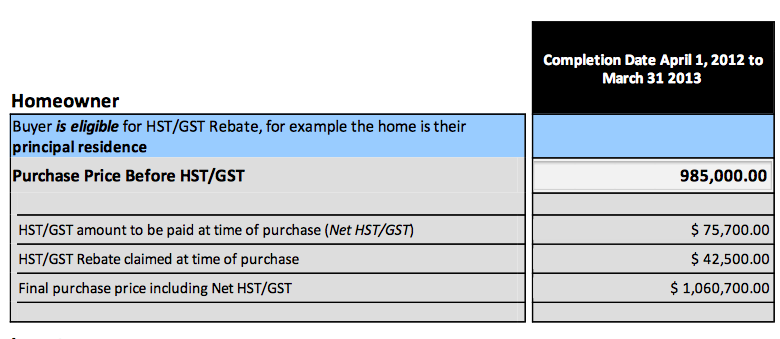
6139 Dunsmuir sold last week for $1,060,000... or 27% under assessed value (hat tip to one of the anonymous contributors to the comments section). We have since been advised that the home sold with HST included in the final sale price.

According to the calculator below, this means the house sold for $985,000 (click on image to enlarge):


The end result is that this home actually sold for 32% under assessed value.

We have shown you real estate agents like James Wong who are very honest and upfront about market conditions. They will tell you bluntly - if you aren't listing for at least 10-15% below assessed value right now, no one is looking at your home.

As this example shows you, brand new homes in Richmond are selling for more than 30% below assessed value. This is a stunning sea-change from the start of 2012.

Let's look at another set of statistics to put things into context.

The peak for the industry's franken average HPI (Home Price Index) for single family homes on the westside of Vancouver occurred in April 2012.  At that time the HPI was $2,268,500.

Last month (at the end of November 2012) that number had fallen to $2,029,300.

You may glaze over at those numbers - or dismiss them as still wildly insane - but that's a drop of $239,300 in 7 months.

Single family houses on the west side of Vancouver are losing value at the rate of $34,186 per month! 

Or phrased another way... $1,140 per day! 

(hat tip VMD @ VCI).

The unwinding of a bubble takes a long time to play out.  In the United States things started to drop in late 2005/early 2006, but the collapse of the housing market really didn't enter our consciousness until 2008.

We are only in the early stages here... but the early stages have already produced some dramatic results.    If those dramatic results continue into the Spring, the next phase of the collapse will kick into gear.

==================

Photobucket
Email: village_whisperer@live.ca
Click 'comments' below to contribute to this post.

Please read disclaimer at bottom of blog.

Sunday, December 16, 2012

Sunday Carol


==================

Photobucket
Email: village_whisperer@live.ca
Click 'comments' below to contribute to this post.

Please read disclaimer at bottom of blog.

Great source for Sunday reading


Quick Sunday evening post for you.

A blog that's part of the blog list on the right, The Retiring Boomer, posts a great list every Sunday of weekly news links.

I enjoy checking it out and recommend it for your Sunday browsing pleasure.  The blog is worth perusing too.

==================

WEEKLY NEWS LINKS

Here is a list of articles I found most interesting this past week:

Adrian Spitters is an avid writer and blogger who recognizes the need to publish on issues relating to the retiring boomer, by offering information and insight to help them transition into retirement and create sustainable multi-generational family wealth. As a Certified Financial Planner (CFP), Adrian Spitters offers financial advice that focus on investments, retirement, business succession, estate and tax planning in cooperation with his client’s own legal and accounting professionals.  Adrian offers comprehensive wealth management solutions in the Fraser Valley communities of Abbotsford, Langley, Surrey, and White Rock BC. He has extensive business experience that includes over two decades of helping individuals, business owners, farmers, professionals, and high-net worth families chart a path to achieve their lifetime goals. He is a Senior Financial Planner with Assante Capital Management Ltd. For further information please visithttp://www.assante.com/advisors/aspitters/

==================

Photobucket
Email: village_whisperer@live.ca
Click 'comments' below to contribute to this post.

Please read disclaimer at bottom of blog.

Saturday, December 15, 2012

Connecticut School Shootings


==================

Photobucket
Email: village_whisperer@live.ca
Click 'comments' below to contribute to this post.

Please read disclaimer at bottom of blog.