Showing posts with label hat tip VMD. Show all posts

Saturday, March 1, 2014

Sat Post #2: Vancouver's Average Detached Home Price sets another record high


Once again we thank realtor Larry Yatkowsky who promptly provides monthly statistics for the interested to peruse.

The big news for this month? Vancouver's detached home price hits another record high at $1, 361,023.

VMD over on Vancouver Condo Info provides an interesting comment on February's real estate sales.

Vancouver February 2014 estimated sales will come in at approximately 2,500.  That's an impressive 39% increase over February 2013.  Presumably the R/E media will highlight this fact as evidence the real estate market is surging back.

On the flip side, the February 2014 sales are -4% when compared to the 10 year average.  January 2014 sales, when compared to the 10 year average, had surged 6%.  So February 2014's totals failed to maintain that sales surge.

As VMD says, wonder which number the papers will use as headline?

==================

Photobucket
Email: village_whisperer@live.ca
Click 'comments' below to contribute to this post.

Please read disclaimer at bottom of blog.

Monday, June 17, 2013

Making the news in China - Canada vulnerable to 'big deleveraging shock'


The Chinese headline reads: 诺奖得主:加拿大经济极端脆弱 楼市泡沫要破灭

If your Mandarin is a little rusty, it reads: "Nobel Laureate: Canadian economy is extremely fragile. Housing bubble about to burst” (hat tip VMD on Vancouver Condo Info)

It's Paul Krugman's article, which on this side of the ocean has been headlined: Paul Krugman warns Canada vulnerable to a ‘big deleveraging shock’
The Nobel prize winner suggested Canada is an important test case for what lies behind the 2008-09 recession and the sluggish recovery. In other words, if the U.S. experience is anything to go by, Canada might be undergoing a housing and debt bubble, and if so, he advised people to watch what happens next.

With interest rates at ultra-low levels and Canadian household debt and housing market stabilizing, market strategists and economists like Krugman here are scrutinizing every bit of economic data for clues on what the economic outlook will bring....

Krugman sees potential red flags in the large spread between U.S. and Canadian house prices, and the fact that Canadian household debt levels are climbing even as U.S. ones are declining.

"So if the new non-centered bank view is right, Canada ought to be quite vulnerable to a big deleveraging shock despite its boring banks," he wrote. “Of course, people have been saying this for several years, and it hasn’t happened yet — but remember, the U.S. housing bubble took a long time to pop, too."
So Krugman now joins the chorus waiting for the Canadian bubble to burst, it's lofty real estate values not appearing to have realistic means of support.

And more importantly that viewpoint is gaining coverage in China.

Meanwhile Scotiabank is out with a report that notes:
"housing corrections often last years...and this one is unlikely to be any different"
So if HAM (Hot Asian Money) is going to come flooding back to support our housing values, it's going to have to buck the conventional wisdom that Vancouver is overvalued and a sure investment loser.

Meanwhile locals continue to insist Vancouver isn't overvalued.  The latest tidbit comes from our bud Helmut Pastick who insists:
"Prices in Vancouver are... fairly valued... It's a wonder that prices aren't even higher"
Are you ready for another round of R/E hype about how 'now's the time to buy?'

==================

Photobucket
Email: village_whisperer@live.ca
Click 'comments' below to contribute to this post.

Please read disclaimer at bottom of blog.

Sunday, February 24, 2013

MAC-gate helps expose the myth of HAM (Hot Asian Money). Early stats show Chinese New Year a sales disaster


One of the side bonuses to the MAC-gate scandal has been the exposing of the myth of HAM as something that is going to keep our housing bubble afloat.

The media has been quick to identify the main reason for MAC's media lie - perpetuating the import of the Chinese property buyer.

The deception was intended to create the impression that Chinese buyers were still queuing up to buy into Vancouver's teetering real estate market, which has long been fuelled by money from China and is now rated as the second least-affordable city in the world, behind Hong Kong, according to the Demographia consultancy.
(Note: the google translation incorrectly translates the figure as a 7% drop. The news article does actually use the number 70%.  Not sure why google turns a 70 into a 7).

... to an article in yesterday's Globe and Mail newspaper titled: There’s scant evidence behind the myth about foreign buyers of Vancouver real estate.
While the stunt was roundly slammed, it also reignited a debate among real estate observers: Just how much truth is in the long-standing narrative that foreign money is driving the local market? Anecdotes abound about foreign investors scooping up Metro Vancouver real estate, driving up prices and creating anxiety among locals – a bogeyman haunting the dream of home ownership – but evidence to support such a claim is scant.
... the word it out.

Don't get it wrong, all rumours have some basis in fact and the myth of HAM is no different.

But the excessive manipulation of this myth has been a criticism of the online community for years.

Garth Turner has spoken about it lots beforeand railed against the deceptive media ploys that have been used:
As many people now know, Amanda is a young administrative marketing assistant at MAC Marketing Solutions in Vancouver, a company developers hire to flog condos to the rabble. She crossed the ethical line last week when the company tried to (once again) milk the incredibly lazy, gullible and bush-league Van television media...

Of course, this is not the first time. In 2011 you might recall Cam Good, head of The Key – another house-flogging, Van-based professional pumping outfit – hiring a yellow helicopter to ferry around “Chinese investors” with three TV crews stuffed into the back of the chopper. The intentional buzzing of defenceless places like White Rock was intended to goose the myth of HAM – Hot Asian Money – and feed the meme that legions of oriental Donald Trumps were about to gobble up the region, pricing the locals out forever.

But as this blog pointed out days after Global and CBC ran their yellow peril stories, the Chinese dudes were actually Canadian realtors from the burbs, posing as rich vultures from Guangdong. Mr. Good’s company also tried to pass off an employee as a consumer in a weird scheme that brought the Groupon concept to selling condos.
And there have been many condo marketing ploys besides these. How about the fake condo sale line ups to create the media and buying frenzy?  As Turner notes:
People (Asians, preferably) were offered money, plus lawn chairs, portable heaters, food and porta-potties to camp out in from of a sales centre for 24 hours prior to opening. TV news crews were invited to come and witness the spontaneous news event and the stories they ran begat longer lines, people being the lemmings they are.
Turner originally covered this story in Feb, 2011 and we followed up on February 17, 2011 (with citations from numerous craigslist ads by VREAA).

The selling period associated with Chinese New Year (CNY) for 2013 is now coming to an end and statistics are proving the fabricated hype is once again just that: a fabrication.

The dedicated contributors to the comments section of Vancouver Condo Info show us the reality.

In the supposed HAM hotbed of Richmond there are 399 homes on the market with an asking price of over $1.4 million. That's a MOI (months of inventory) of 28 months!  There are 65 homes on the market asking over $2.4 million.  Only 15 such homes have sold in the past 12 months meaning there is a stunning 52 MOI!

Contributor VMD shares with us this translated Chinese news article revealing that there has been a 70% Drop in Home Sales Since Chinese New Year.

Contrary to what the condo marketers were telling us, there actually was no rush of buyers coming into the market this Spring. The CNY sales period has been a disaster.

As Garth Turner observes, there have been lots of high-end houses bought by people who made their money in Mainland China, and that will continue. But many of the realtor shenanigans portrayed in our local media as 'news' are nothing more that the work of shrewd marketers out to create anxiety and competition amongst local buyers.

This time one of those marketers got caught.

In the coming weeks it's crucial that the governing bodies that oversee the integrity of the real estate industry take severe and strong action to ensure these "dishonest tactics" aren't used again.

The people of Vancouver deserve nothing less.

(hat tip: yvr2zhr, VHB, VMD, VREA, Vancouver Condo Info)

==================

Photobucket
Email: village_whisperer@live.ca
Click 'comments' below to contribute to this post.

Please read disclaimer at bottom of blog.

Thursday, January 17, 2013

Canadian Business Magazine asks: How low will house prices go?


Canadian Business Magazine joins the media attention on our housing bubble with an article that asks: How Low Will House Prices Go?
Before every housing correction, there’s a Looney Tunes moment. In the animated universe, there’s a gravitational peculiarity that briefly suspends an overzealous pursuer in mid-air, just long enough to flash a HELP! sign, before plummeting off the cliff he failed to navigate. When it comes to overheated real estate, there is a pause that follows the outset of a correction, during which the market fails to realize there is nothing below but air.

Ahh yes, the Wile E. Coyote moment.  Two weeks ago it was Macleans insisting that we were there, now it's Canadian Business Magazine.
The pattern is familiar: it starts with slowing sales activity. Listings begin to generate fewer offers. Would-be homeowners start to see the sense in holding off. In Toronto, where less than a year ago a rundown semi-detached could sell for $100,000 or more over asking price, the era of the bidding war is fading. “Buyers are sensing that prices are going to come down, so why buy now?” says Thomas Neal, a Royal LePage agent in Toronto, where housing transactions in December slid by 25% from the prior year. In Vancouver, the number of homes sold last year trailed the 10-year average by 25%. It is in those two markets where the twin epicentres of the Canadian housing shakeup reside. But the ground is beginning to shift under the national market as a whole. Those kinds of numbers support the view that “a potentially severe housing correction is underway,” says David Madani, an economist at Capital Economics, who for months has been predicting a 25% decline in Canadian home prices.
Which brings us to where we are now... the denial stage where sellers refuse to acknowledge the shifting market.

The real estate industry insists sellers will hold firm forcing buyers to capitulate and continue to pay higher and higher prices.  Canadian Business has a different take:
As usual, one-half of the market refuses to look down. “We’ve got a number of sellers who say, ‘If we’re not going to sell for a particular value, we’re not going to sell at all,’” says Victoria real estate agent Tony Joe. “A lot of people are still pricing their properties based on yesterday’s market.” So, even though demand is weakening, prices have yet to fall for most of the country.

The reluctance of sellers to compromise is understandable, given recent history. For more than a decade, real estate in Canada appreciated almost without interruption. Even the financial crisis and ensuing Great Recession registered as little more than a blip. Meanwhile, most economists take the current trends as indicative of a “soft landing” for the sector, with just a slight moderation in prices afoot. But asking a bank economist or real estate market insider about the likelihood of a soft landing is like “asking your barber if you need a haircut,” says George Athanassakos, a finance professor at the Richard Ivey School of Business, who expects a “severe correction,” and soon. The current resilience in home values could simply be the brief mid-air pause before physics brings about the plunge fated for inflated housing markets and cartoon coyotes alike.


People tend to have short memories about real estate, Neal says. Since 2000, the average home price in Canada has shot up by 125%, which has reinforced the perception that residential real estate is infallible.
So what will trigger a slide?
Just as excessive faith in home appreciation can overheat a market, so too can a change in sentiment accelerate and intensify the downside. With the rate of home ownership now close to 70%, and with household debt at a record high, much of the financial health of Canadian households is inextricably linked to home values, making it the kind of dominant concern that not only affects household finances, but consumer psychology and confidence.

Even most bank economists believe Canadian housing is overpriced somewhere in the range of 10% to 20%, perhaps more so for the hottest condo markets. That’s manageable as long as interest rates and unemployment remain low, says Doug Porter, deputy chief economist at BMO Capital Markets. Absent an external economic shock that would ultimately put Canadians out of work, there is no reason to expect markets to correct hard and fast, he argues. “What would force people to feel that they have to sell at much deeper prices, given that the interest rate environment is likely to remain quite benign at least through next year?” Without a trigger, there should be no national housing crash, Porter says.
Ahh yes, the lack of a national trigger. That's been Tsur Somerville's argument.
But there are some mortgage professionals who argue that the catalyst for a national reaction has already arrived by way of the federal government, which deliberately cooled the market by tightening mortgage regulations. Those changes would have disqualified almost 10% of all 2010 homebuyers, according to a report by Will Dunning, chief economist for the Canadian Association of Accredited Mortgage Professionals. “That’s taking a lot of demand out of the market,” Dunning says. “You’re putting the housing market at risk, and the broader economy.” Now Dunning says the market is “weak enough it could result in prices falling in many places across the country.”
And under these conditions, which group of seller's might panic and bail on the market?
In 2011, Toronto had record condo sales of more than 28,000 units. “The kind of construction we’ve seen is absolutely off the charts,” Porter says. “It is the kind of market that is so heavily supported by investor demand, we could have a temporary spell of a pretty serious correction.” Investors are potentially more likely to sell when prices decline, which could ultimately flood the condo market with resale listings. With 240,000 more planned condo units yet to be built in the Toronto area, many are worried about a burgeoning supply-demand imbalance. Already, investors are backing away from the Toronto condo market, which reported a drop in third-quarter unit sales of 30%. Developers reacted to both slowing sales and a record high level of unsold inventory by launching just five new projects in the third quarter in the 416 area, which typically sees 15 to 20 new projects per quarter. 
Investment demand also looms over Vancouver, where the condo market spent most of the year in full retreat. Since May, the benchmark condo price in Vancouver has already fallen by 13%. If the expectation of appreciation disappears, another layer of demand could shrink from the market. Ohad Lederer, an analyst at Veritas Investment Research, calculates that investors buying condos to supply the rental market are accepting annual returns of less than 4%. “That only makes sense if buyers believe that prices will go up.” But if prices in those two markets fall significantly, as Lederer believes they will, condo investors could face some tough decisions. “That’s where the intestinal fortitude of those investors will be tested,” he says.
The market has 'softened', to use the R/E industry phrase, but it has not crashed hard - yet. So we still have a saw-off in analysis which each side firmly sticking to their positions about where we are going:
The stability of housing in Canada relies on a Goldilocks economy—not too strong and not too weak. Economic expansion could lead to rate hikes, which would expose the unsustainable finances of many indebted households. On the other hand, a destabilizing economic event could trigger the housing crash Canada avoided in 2009. The historic crash in the United States is not likely to be repeated here. The U.S. bubble was more a product of risky lending. “A lot of people were allowed to take on debt with little or no prospect of paying it back,” Porter says. In Canada, debt is better distributed among middle and upper-income borrowers, he says. “There still is a relatively solid credit-vetting process in Canada.” Still, many Canadian homeowners are stretched thin. According to a Euro Pacific Capital report, high-risk mortgages make up more than $500 billion of Canada’s $1.1 trillion housing market.

The average home price, at more than $350,000 (which is double the median existing home price in the United States), now sits at about five times the average household income. Housing investment is close to peak levels at more than 7% of GDP—about the measure reached in both the late 1970s and late 1980s, Athanassakos says. “Right after that, the market collapsed in both cycles.”

Canadian demographics no longer support inflated prices, Athanassakos argues. The proportion of Canadians of the age when homes are typically purchased is at a turning point and is set to decline, which historically has been a powerful indicator of housing trends. “The long cycle is most of the time affected by demographics,” he says. And a very long cycle it could be. He foresees a 20-year span of declining home prices. There need not be an explicit economic trigger for an acute housing correction. The imbalances are already there. Changing sentiment could be the spark, Lederer says. “When it turns, it turns very fast.”
And Canadian Business Magazine gives Athanassakos' prediction prominence making it clear where they think we are going:


(hat tip VMD)

==================

Photobucket
Email: village_whisperer@live.ca
Click 'comments' below to contribute to this post.

Please read disclaimer at bottom of blog.

Saturday, January 12, 2013

Sat Post #1: Is this what 'flat' looks like?


The spin from the R/E propaganda machine is that sellers would rather pull their properties off the market than sell for less than their house is 'worth.'

The reality, naturally, is that some sellers simply allowed their listings to lapse during the traditionally slow Christmas selling period... a pattern we see every year.

Other sellers have kept their homes on the market.  And they are demonstrating they are quite willing to accept far less than their house is 'worth' in order to find a greater fool.

The latest example to come our way is this home in West Vancouver:


1083 Duchess Avenue located in Ambleside in West Vancouver was listed in March of 2012 for $3,299,000 (V922019).

It's 2012 assessment value? $3,224,000 (click image to enlarge):


1083 Duchess Ave sold yesterday for $2,626,000.

That's $598,000 below assessed value or -18.5%.

Doesn't exactly meet the definition of a 'flat' market now, does it?

(hat tip VMD and Observer)

==================

Photobucket
Email: village_whisperer@live.ca
Click 'comments' below to contribute to this post.

Please read disclaimer at bottom of blog.

Monday, December 17, 2012

Did you know that, for 7 months now, westside Vancouver houses have been dropping value at the rate of over $1,000 per day? - Updated


Post updated with info on Richmond home sale


Faithful readers know that the charting of the housing bubble has changed over the course of 2012.

We have seen a dramatic reversal from houses that were selling for hundreds of thousands of dollars over asking price (asking prices which were, of themselves, way over assessed value)... to one where we charted by how much sellers were cutting asking prices (which when cut, were still over assessed value)... to one where properties are listed below assessed value... to where we are now: were we charted the biggest drops below assessed value.

That is a MASSIVE change in the market.

Does it mean the market has crashed? Nope - not yet.

And because it has not 'crashed' yet, many express frustration at where were are.

In many ways it is like watching a pot boil.  The over all process is not that long, but because we hang on results every day it seems to take forever.

When we profile properties 40% and 50% below assessed value, some express disappointment that these are properties many would consider a POS.

How quick we are to discount what is happening in the broader market.

Many other properties, like this one at 6139 Dunsmuir Crescent in Richmond, are selling for more than 30% below assessed value.

6139 Dunsmuir Crescent is a 5 bedroom, 4 bath 2,,351 sq ft single family house in the prestigious Terra Nova neighbourhood in Richmond.


A newer home, it was assessed in 2011 at $1,470,000.


While on the market this year, the seller dropped the asking price as low as $1,188,888.


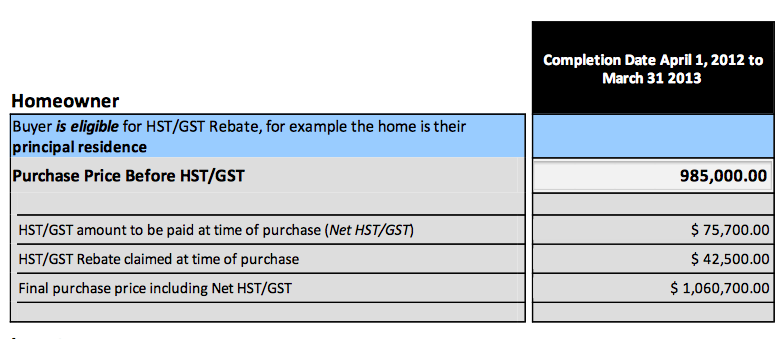
6139 Dunsmuir sold last week for $1,060,000... or 27% under assessed value (hat tip to one of the anonymous contributors to the comments section). We have since been advised that the home sold with HST included in the final sale price.

According to the calculator below, this means the house sold for $985,000 (click on image to enlarge):


The end result is that this home actually sold for 32% under assessed value.

We have shown you real estate agents like James Wong who are very honest and upfront about market conditions. They will tell you bluntly - if you aren't listing for at least 10-15% below assessed value right now, no one is looking at your home.

As this example shows you, brand new homes in Richmond are selling for more than 30% below assessed value. This is a stunning sea-change from the start of 2012.

Let's look at another set of statistics to put things into context.

The peak for the industry's franken average HPI (Home Price Index) for single family homes on the westside of Vancouver occurred in April 2012.  At that time the HPI was $2,268,500.

Last month (at the end of November 2012) that number had fallen to $2,029,300.

You may glaze over at those numbers - or dismiss them as still wildly insane - but that's a drop of $239,300 in 7 months.

Single family houses on the west side of Vancouver are losing value at the rate of $34,186 per month! 

Or phrased another way... $1,140 per day! 

(hat tip VMD @ VCI).

The unwinding of a bubble takes a long time to play out.  In the United States things started to drop in late 2005/early 2006, but the collapse of the housing market really didn't enter our consciousness until 2008.

We are only in the early stages here... but the early stages have already produced some dramatic results.    If those dramatic results continue into the Spring, the next phase of the collapse will kick into gear.

==================

Photobucket
Email: village_whisperer@live.ca
Click 'comments' below to contribute to this post.

Please read disclaimer at bottom of blog.

Saturday, October 27, 2012

Media notes R/E groups attempting to "calm fears of a local housing crash"


On Thursday we told you how the media was filled with economists and 'experts' who were now predicting that prices will, in fact drop, but will do so by a moderate level that does not resemble the U.S. crash.

The purpose of all these ascertains? Preventing panic. A fact the Vancouver Sun noted yesterday:
Greater Vancouver will see home sales tumble by one-fifth this year, but the market should rebound in 2013, the B.C. Real Estate Association says in its new forecast as the group moves to calm fears of a local housing crash.
It is exactly those types of fears which are encouraging sellers to accept 75 cents on the dollar for properties (examples of which we have profiled over the past couple of weeks).

Of course the sellers aren't actually taking only 75 cents/dollar on their real estate.  Most bought before the big blow-up of the bubble during the 00's and they are still enjoying a large capital gain.  They just see the writing on the wall and are cashing out while there are still profits to be realized.

And those signs are everywhere.

Vancouver movers are reporting stiff declines in business due to the falling real estate market and the slowdown is effecting a broad segment of society:
Tradesmen, Builders and Craftsmen, worry about the later half of 2012 and the speculation around the slow down of the Vancouver Real Estate Market... Competitively priced houses are now sitting on the market for an average of 5 to 7 months. 
Scott Moe of RE/MAX says: "All across the board people are saying how slow it is out there. I have 24 listings right now and only had 4 showings on the weekend!" The slow down of BC's real estate industry extends well beyond just builders and realtors. Many local businesses are affected by slow real estate sales.
Which is why early signs of panic are now starting to pop up.

And there signs of more problems ahead.

Concerns are spreading through the Chinese media with headlines that: “All Canadian banks will introduce new mortgage rules by November 1st, 2012”What will those new rules entail?
All-Canadian banks and financial institutions will start on the 1st of next month to take up increased tightening housing mortgage measures. There will be new rules for those without sufficient proof of income documents.  This will include the self-employed who will only be able to obtain no more than 65% of the mortgage property value in their loans. Prior to the implementation of the new requirements, some banks allowed self-employed people up to 75-80% of property values in a mortgage. 
Mortgage experts believe that the new measures will have the greatest impact on new immigrants.
As one contributor on VCI noted (hat tip VMD), the OSFI will require lenders to limit maximum LTV ratios of “nonconforming residential mortgages” (eg. Self-employed without adequate income verification) to 65%, meaning the borrowers will need to put 35% up as a down payment.

New immigrants will be impacted due to inadequate income documentation, which looks at average income of the last 2 years. - (Previously new immigrants were required to put down 30% DP) - 

HELOC LTV limitations will be implemented by Nov 1st as well.

In other words, the saviour of wealthy Asians buying our overvalued property at prices high above what local incomes can support is about to take another big hit.

Combine that with tightening regulations on what entry level buyers can now overspend on greasing the property ladder at the entry levels and you have a recipe for even steeper declines.

Perhaps that's why a Winnipeg real estate agent is now running this ad (hat tip Makaya):


 ==================

Photobucket
Email: village_whisperer@live.ca
Click 'comments' below to contribute to this post.

Please read disclaimer at bottom of blog.

Thursday, October 18, 2012

Thurs Post #2: Vancouver newspaper proclaims - "Greater Vancouver realtors are now forced to quit and find new jobs"


Speaking of Craigslist occupying the time of idle real estate agents, it seems all of them are not content to twiddle their thumbs while clicking a computer mouse.

Month after month now we have chronicled how bad the monthly real estate statistics have been.

And a sign of the turbulent times for real estate agents in the Village on the Edge of the Rainforest has to be this article in the Singtao Chinese newspaper (hat tip VMD via Vancouver Condo Info blog):
Greater Vancouver realtors are now forced to quit and find new jobs  
Mr Shen, a newly minted realtor since 2011 had been working for a year without reaching a single sale. He had just quit RE and is training to be an electrician... 
When interviewed by SingTao, Mr Shen said he had a university degree in business administration. Upon seeing the hot RE market in early 2011, he paid $5000 for a realtor prep-course and obtained his realtor license. 
Ever since he’s working as a realtor. He’s been busy every weekend showing houses, one client even had him show 10 units. 
He had a total of 20 clients in the first half year, but no sale. 
Mr Shen said, in the current housing downturn, even seasoned realtors are having a hard time. 
Another realtor, Mr Sun of Macdonald realty, said that in 2011 he averaged 2 sales per month, this year some months even went without a single sale. 
Many realtors are leasing expensive cars, paying expensive fuel, hosting networking dinners – averaging $2000 per month of overhead. Without sufficient sales numbers, many realtors cannot survive.
The Real Estate Board of Greater Vancouver (REBGV) states that it has more than 11,000 real estate agents in it's association from Whistler to Maple Ridge to Tsawwassen.

With recent sales often totalling less than 100 per day, these are lean times indeed.

==================

Photobucket
Email: village_whisperer@live.ca
Click 'comments' below to contribute to this post.

Please read disclaimer at bottom of blog.

Tuesday, August 7, 2012

Thought of the day - How bad is it in Burnaby for high end sales?


A brief, quickie post for you tonight.

Interesting statistic for you from Observer, who puts together the blog Vancouver Price Drop.

The Vancouver suburb of Burnaby sold 5 "high-end" homes in July that were valued at $1.4 million or higher.

There are currently 154 homes in Burnaby listed at $1.4 million or more.

That's a shocking 30.8 month of inventory for these "high end" homes.

Meanwhile VMD has grouped together the July 2012 sales data and taken the total inventory and divided it by the published sales figures. Here is what he gets for Single Family Houses (SFH) and months of inventory (MOI):

Richmond SFH: 19.5 MOI
Van West SFH: 12.5 MOI
West Van SFH: 11.5 MOI
Burnaby SFH: 10.5 MOI
Coquitlam SFH: 8.2 MOI
Van East SFH: 6.7 MOI

==================

Email: village_whisperer@live.ca
Click 'comments' below to contribute to this post.

Please read disclaimer at bottom of blog.

Thursday, August 2, 2012

Vancouver Market in "Full Retreat"


For the past few years the central focus of the real estate market has been the all important "buyer confidence."

Hundreds of hours through press releases and millions of dollars have been spent by the Real Estate Industry on advertising, etc.  All to build up that crucial "buyer confidence."

And a crucial component of massaging that confidence has been the mainstream media (MSM).

While there have been countless articles this year about Housing Bubbles and the threat of a collapsing market, the person on the street has been somewhat oblivious to what is going on.

But this may well be the week in which Joe Q. Public truly begins to take notice of those negative real estate stories in the MSM.

I don't think anything can compare to the headlines that have come out in today's papers.

You can't ignore paper's like the National Post screaming "Vancouver real estate market in full retreat", it's a moniker that says it all:
Realtors are calling it a “summer lull,” but the latest statistics show Vancouver’s housing market is mired in a 10-year low for sales with no immediate end in sight.

Each month is starting to look worse than the previous one for Canada’s most expensive housing market as property sales in July dropped 11.2% from June — marking a decade low for activity.
The Industry can't hide the reality of the market any longer.
The Real Estate Board of Greater Vancouver reported the worst July since 2000, and 31.2% below the 10-year average for the month of 3,051 sales.

The board said there were 2,098 residential property sales of detached, attached and apartment properties in July — off 18.4% from a year ago.
Things are getting so bad that Vancouver's average detached home price declined for five straight months now.

The average price is now down 15.7% from February's high of $1,235,244 to sit at $1,041,325 - a plunge of $193,919!

And as the August month kicks into high gear, sales are truly collapsing. Results today for all sectors of the market totalled only 49 sales!!

It's the first sub-50 sales day of the year.

If this keeps up for the rest of the month, July's numbers will look like a sales bonanza in comparison.

What were sales in July like?

Single Family Home sales in July 2011 vs July 2012:

Richmond: -51%
Jul/12 = 60 sales
Jul/11 = 123 sales

West Van: -47%
Jul/12 = 46 sales
Jul/11 = 86 sales

Coquitlam: -43%
Jul/12 = 67 sales
Jul/11 = 100 sales

Van West: -40%
Jul/12 = 83 sales
Jul/11 = 139 sales

Burnaby: -39%
Jul/12 = 58 sales
Jul/11 = 95 sales

North Van: -35%
Jul/12 = 60 sales
JUl/11 = 92 sales

East Van: -24%
Jul/12 = 109 sales
Jul/11 = 144 sales

(Hat Tip VMD)

Ugly doesn't begin to describe these numbers. As the Financial Post screamed, the market is in full retreat.

All that remains for the perfect storm is seller panic.

And the dog days of Summer may well provide the fuel to incite pandemonium.

==================

Email: village_whisperer@live.ca
Click 'comments' below to contribute to this post.

Please read disclaimer at bottom of blog.

Thursday, June 28, 2012

Seller's Unite!


On Tuesday we were telling you just how bad it is for real estate sales in Richmond right now.

Realtor James Wong's monthly R/E report, released June 16th but covering the May 2012 sales data, advised that total listings have hit all time highs, daily price reductions are common, and detached home listings in the million dollar plus category are dying on the vine.

Of the 556 homes on the market with an asking price north of $1,200,000, sales have been so bad that there were 17.7 months of inventory on the market by the end of last month.

Wong's advice to sellers was blunt: If you have to sell, much deeper price cuts are needed.

And if the data from the month of May was bad, June's results are abysmal.

Using sales reported between May 27, 2012 and June 26, 2012, and actives as of today... there is now 23 months of inventory on the Richmond Real Estate market.

Word has it that for the majority of those rare sales that are occurring, most are closing below assessed value of the property as some sellers are obviously taking Mr. Wong up on his sage advice.

But as you can imagine, this is causing a great deal of consternation for other Richmond sellers.

One Chinese real estate forum is calling on 'sellers to unite' to prevent further price drops. (hat tip to VMD on Vancouver Condo Info).
“A brand new house in good area of West Richmond, 8111 Dalemore Rd, was just sold for $1.58M, $170k lower than assessed price of $1.75M. It’s a shame that the (owner) went through so much to purchase this property and build a new house, hoping to earn some money while doing a service to the community, only to (then) recklessly slash (the) price. I call on the sellers to withhold giving in to under-asking offers. We should all pull our listings and wait until a better market to sell in a bidding war situation”
Of course, as VMD notes, do not lament too long for the hardships endured by the seller at 8111 Dalemore Road.


The 5 bedroom, 5 bath mansion was built in 2010 to replace an old-timer teardown which last changed hands for $533,000.

And while the property did recently sell for $170,000 below the 'current' assessed market value of $1,750,000, a final sale price of $1,580,000 hardly qualifies as hardship for this seller - right?

Or does it?

Maybe it really is "a shame that the buyer went through so much to purchase the property and build a new house" and not have it sell in the type of bidding war that one year ago would have realized offers of $300,000 - $400,000 over asking.

Perhaps I am being callous to the needs, hopes and dreams of the Richmond speculator?

Proletariat Unite! Protect the Richmond real estate flipper now!

==================

Now on Twitter @village_whisper

==================

Email: village_whisperer@live.ca
Click 'comments' below to contribute to this post.
Please read disclaimer at bottom of blog.

Tuesday, June 5, 2012

Random thoughts


A few random items for you this morning.

(1) On the topic of HAM

The topic of Hot Asian Money (HAM) in Vancouver is a strong one. There have been lots of stories about how west side houses have been snapped up by HAM and sit vacant (the Courier newspaper did an article about this, but I don't have the link at the moment).

In a report released by the Bejing News, google translated here, Bejing alone has 3.8 million vacant houses, presumably bought by speculators in the real estate frenzy there and those homes are being held for the right time to 'flip'.

3.8 million?  Even in the United States, five years into a bursting housing bubble, it is estimated only 2.54 million homes are available for SALE!

Imagine the panic to dump if the China/world economy turns significantly downward?

(2) On the topic of Vancouver Speculators

Speaking of not ending well, a discussion went on the other day over in the comments section of the blog Vancouver Condo Info. Contributor 'Patsan' noticed that one person (Gary) was advertising 3 homes for rent on the west side of Vancouver and the tone of the craigslist ad seemed 'desperate'.

I noted that if the phone number listed was 'googled', there were a whole host of properties available for rent from this 'Gary' person. One diligent reader of the site did some research and noted:
"This Gary guy has at least 12 West Side and Richmond properties advertised for rent. They are all vacant and available now and if you goggle the address all were recently purchased. Most of the properties on the West Side sold for close to 3 million and the Richmond ones are in the 1.5 million range. The guy must be a rental agent or ring leader behind investors who have recently dropped at least 20 to 30 million on houses to rent. The ads all state minimum 1 year lease so they are not looking for quick flips. None of the ads have photos or much details. The guy doesn’t have any houses advertised that appear to have been previously rented so he must be a newby to the game."
And this is just ONE group of speculators in Vancouver.

Now multiply Gary's group by a couple of hundred and imagine the speculative panic here if the housing market in Vancouver turns downward.

(3) Comparing Statistics

Speaking of the euphoria that buyers were in a year ago, contributor VMD over on Vancouver Condo Info posted some comparisons of single family home sales from last May 2011 to this May 2012 to show just how bad sales are this year compared to last year.

1. Van West
Sales YoY -47%
Lists YoY +36%

2.West Van
Sales YoY -59%
Lists YoY +23%

3. Burnaby
Sales YoY -38%
Lists YoY +23%

4. Van East
Sales YoY -28%
Lists YoY +26%

5.Coquitlam
Sales YoY -21%
Lists YoY +21%

6. Richmond
Sales YoY -20%
Lists YoY +11%

VMD notes Richmond was the first to slow down last spring, so its numbers were pretty bad last May. This May is even worse.

Will Boomers pull the trigger in greater numbers as the market worsens and slash the price point they will accept even more? Thus pushing the drop from 12% to 20%?

Could the drop accelerate even greater than that?

(4) If we slide downward, how far could we go?

If you follow this blog, you already know my thoughts.

Consider this musing from Vancouver realtor Larry Yatkowsky who broaches the concept of a 32% drop in prices:
Let’s start at the highest average price ever reached in Vancouver for a detached home – a mere $1,235,244. Now let’s also assume this market is on the skids sliding down the drain faster than we think to bottom out at something most of us would not imagine – a market that drops so much it hits May 2009′s Average Price of $831,171.

With a price drop of $404,073... that's a 32% drop from the all time high.
Consider that a 32% drop in prices only takes us back to 2009.

Larry argues buyers will rush in at this point (and I agree), but rather than establish a bottom for the 'correction' - I can't help but recall the 'phases of a bubble' chart:


A rush of buyers into the market at this point would just about reflect these phases perfectly, wouldn't it?

Can you see all the pieces falling into place for a significant drop?

Is a 70-85% collapse in prices still all that hard to fathom if these elements come to pass: The China Trigger + The Speculator Trigger + The Boomer Trigger?

==================

Email: village_whisperer@live.ca
Click 'comments' below to contribute to this post.
Please read disclaimer at bottom of blog.