Friday, September 16, 2011

Friday Post #2: The case against JP Morgan for Silver Manipulation

Faithful readers know this blog is extremely bullish on Silver and agrees with those who call Silver the 'Opportunity of the Decade'.

Those same readers also know this blog writes extensively on the manipulation of the Silver price on the COMEX.

With that in mind we bring you the latest lawsuit filed in US Courts alleging Silver manipulation by JP Morgan.

This lawsuit, filed on September 12th, is not the first one we have seen filed against JP Morgan for Silver price manipulation, but it is the first that provides details on JPM's specific manipulation techniques.

If the topic of Silver interests you, this is a must read.

11-09-12 FINAL Consolidated Class Action Complaint

==================
Email: village_whisperer@live.ca
Click 'comments' below to contribute to this post.
Please read disclaimer at bottom of blog.

Friday Post #1: Why the bailout?


Yesterday we posted about the 2011 Great Global Bailout wherein the US Federal Reserve, the European Central Bank, the Swiss National Bank and the Bank of England have been working in concert in order to make liquidity available to prevent the European banking system from collapsing.

This is similar to what happened in North America in the autumn of 2008.

The blog, The Golden Truth, had a great examination what it all means.

In it's simplest terms European banks have dollar liabilities (shorter term loan funding of various sorts denominated in dollars) that are being used to finance non-dollar income-producing assets (mostly denominated in euros). Greek and Italian sovereign debt securities, for instance.

The assets are falling way short of being able to support the cash flows required to fund the liabilities so the European banking system is at the brink of "freezing up" and collapsing.

This 'liquidity problem' exists despite the fact the US Federal Reserve has had a $500 billion swap "liquidity" facility available for use, a resource that has been in place for awhile.

Even more startling, it turns out that some big U.S. banks have been engaging in private market repo transactions with some big Euro banks, who have been using crappy collateral.  

It shows how desperate European banks have become for cash.

But why are the big U.S. banks willing to take crappy collateral in exchange?

Traditionally repos are done using very short term Treasuries or Agency debt as collateral. Why would U.S. banks be willing to take this crap to keep Euro banks solvent? And why is the US Federal Reserve extending half a trillion of Taxpayer-backed funding to keep the Euro system from collapsing?

Analysts believe it is because if countries like Greece, Italy and Spain collapse, then the too-big-too-fail Euro banks collapse.

And if that happens, North America's  too-big-to-fail banks - primarily Citibank, JP Morgan and Goldman Sachs - would collapse under the weight of a very large amount of credit default derivatives and interest rate swaps that require Euro bank counter parties to be able to fund in the event the default parameters are triggered.

In other words, U.S. banks and the US Federal Reserve are just as desperate to keep the Euro banks alive as are the ECB/SNB/BOE bank members are desperate to stay alive.

This scenario is startlingly similar to what happened right before Lehman was allowed to tank, which triggered the big bailouts here. Only this time the scale is Lehman x 50 or 100 because it includes a couple of countries and all of the U.S./UK/European/Swiss To-Big-To-Fail Banks.

The global financial system is in a highly precarious position right now and it explains why the past week has seen relentless raiding on Gold and Silver by the paper shorts.

The bankers knew that the USA and all major central banks were orchestrating a massive dollar injection into Europe as the European banks were strapped for dollars.

==================
Email: village_whisperer@live.ca
Click 'comments' below to contribute to this post.
Please read disclaimer at bottom of blog.

Thursday, September 15, 2011

The 2011 Great Global Bailout


The big news today is a massive bailout of the banks of Europe by the US Federal Reserve and the world's reserve currency.

Faithful readers know that we are fond of saying the financial debt crisis of 2008 is very much alive and it is clear for everyone to see that it had only been treated with a paper band-aid known as Quantitative Easing 1 and QE2.

Those economic green shoots touted in 2009? Nothing more than weeds.

The breadth and depth of the financial earthquake the world suffered in 2008 was so great that the repercussion's are only just beginning to be understood.  And the recession it triggered has not ended... it has only just begun.

One of the news stories that flowed well under the mainstream media radar screen back in July was the results of an audit of the US Federal Reserve.

The first ever Government Accountability Office (GAO) audit of the US Federal Reserve Bank in the Fed's 100 year history indicate that the bank dished out $16 trillion in emergency aid to U.S. and foreign banks, corporations and governments in what the Fed calls all-inclusive loans during the financial crisis.

$16 Trillion!

In all the Fed disclosed more than 21,000 transactions which it utilized after Lehman failed to push as much liquidity into the worldwide financial system as possible to stabilize things.

Fast forward to today.

The debt escalating debt contagion stories coming out of Europe the past two weeks have been breath-taking.

It has forced the US Federal Reserve to step in again and bail out Europe's banks with unlimited access to US Dollars.

Here is the European Central Bank announcement:
  • The Governing Council of the European Central Bank (ECB) has decided, in coordination with the Federal Reserve, the Bank of England, the Bank of Japan and the Swiss National Bank, to conduct three US dollar liquidity-providing operations with a maturity of approximately three months covering the end of the year. These operations will be conducted in addition to the ongoing weekly seven-day operations announced on 10 May 2010.
As noted over on The Fundamental View, the global printing presses are now running full tilt in the most historic liquidity event ever.

In essence the Governing Council of the European Central Bank (ECB) has decided, in what is being deemed as a coordinated effort with the US Federal Reserve, the Bank of England, the Bank of Japan and the Swiss National Bank to conduct three US dollar liquidity-providing operations.

Short term this saves the Euro from the collapse it was facing just last week.

But as this story on Yahoo headlines "Dollar access no long-term fix for Europe's crisis but could buy time for banks"

Officially this confirms the view that the banks around the world are pretty much insolvent given their exposure to the mounds of toxic sovereign debt.

Basically governments and banks are broke because they lent money out to other banks and governments.

The ECB said it would hold three separate operations between October and December to help see banks through the year-end period. Basically the Americans, the British and the citizens of any non-Euro nation in the West are now watching their central bank printing dollars at the expense of their children's’ future’s so that it can bail out banks from other parts of the world.

This is what we get in a world of global economic collaboration when every bank is somehow tied to each other through invisible lifelines. Point being, if one major institution goes down, others will fall like dominoes given that they have all lent money to one another via exotic instruments in order to keep the global banking ponzi scheme alive.

The bottom line is that the US Federal Reserve - as it did in 2008 with $16 Trillion, just backstopped a massive loan to European banks to keep them solvent.  

As the Fundamental View asks, "How closely tied are American financial institutions to the European banks needing the bailout for the Fed to take such measures overseas?"

The world's problems are literally being papered over. But the reality is that the situation is much graver than most people realize.

And what just occurred was a very short term, temporary solution.

The breadth and depth of the financial earthquake the world suffered in 2008 is only just beginning to be understood.

And the recession it triggered has not ended... it has only just begun.

==================
Email: village_whisperer@live.ca
Click 'comments' below to contribute to this post.
Please read disclaimer at bottom of blog.

Wednesday, September 14, 2011

Silver and the massive JP Morgan short position


Faithful readers who follow this blog know that we extol the virtues and opportunities of Silver. 

The metal has been call 'The Opportunity of the Decade' by the likes of Eric Sprott of Sprott Asset Management.

But at the same time many of you have found Silver to be extraordinarily frustrating.

The precious metals are highly manipulated by the banking cartel's who are in line with the US Federal Reserve policy of market intervention to support the US Dollar.

And when it comes to Silver, the banking cartel is almost singlehandedly represented by JP Morgan which holds the largest short position in any commodity in the history of commodities trading.

In 2010, as summer wound down, we were very excited about the prospects for Silver.  It appeared conditions were lining up for a giant short squeeze which would force short covering by JP Morgan. The end result would be a significant increase in the price as this squeeze occurred.

Here is how the Silver spot price played out from August 2010 to April 2011.

In August 2010, Silver was sitting at just over $18 per ounce and jumped up to $19.00 (click on all images to enlarge).


During September 2010 we saw the spot price soar from $19.50 to $22.00.


In October 2010, Silver went from $22.00 to an intra month high of over $24.00.


In November 2010, Silver had a low of $24.00 and hit highs of almost $29.00.


December 2010 saw Silver on a roller coaster ride from $28.00 to over $30.60.


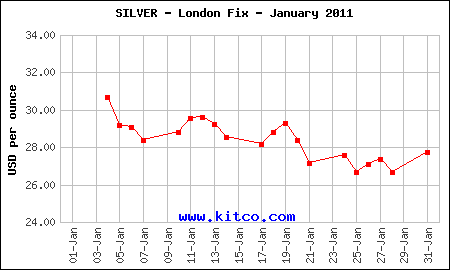
In January 2011, Silver got beaten down from $31.00 to $27.90.


Silver rebounded with a vengeance in February 2011 and went from $28.00 to just under $34.00.


In March 2011, Silver went from $34.00 to $38.00.


Then, in April 2011, Silver soared from $38.00 to over $49.00 per ounce.


Since then Silver has been beaten down and hovers in the $40.00 range.

You don't see much coverage of this short squeeze in the press. Most mainstream pundits and reporters have assumed that it was speculative buying that caused Silver's huge rise from $18.00 to $49.75.

There is no doubt that a lot of speculative money was starting to enter the fray towards the end of the winter run.

However, in futures markets, huge moves like we say from August 2010 - April 2011 are often the result of short squeezes.

And have no doubt, this is exactly what happened in Silver.

sentimentrader.com is a great resource and produced the following chart. It is produced from data compiled from the Commitment of Traders Report.  The chart shows both the Silver open interest and the speculative long position had been trending down prior to August 2010 and outlines for us exactly why Silver spiked in price.


Both Silver's open interest and the speculative long position continued to decline during the massive price move from $18.00 - $49.75. 

When open interest falls but price rises, its a short squeeze.

The same thing happened with Cotton just a few months earlier and the Commitment of Traders Report tells us that the commercial traders (which includes JP Morgan) were covering their shorts massively.

How much did they cover?

Back in August 2010 the size of that naked short position was 25,412 contracts.

Remember, each contract representing 5,000 ounces of Silver. That means JP Morgan held paper promises they had sold for over 127 million ounces of Silver (127,060,000).

And during the short squeeze JP Morgan likely covered 24 million ounces of their naked short silver position at a massive loss.

This is why Silver rose so dramatically in value.

It wasn't because Silver was in a bubble. It wasn't because of irrational speculation by average investors. It was JP Morgan covering their naked short silver position at a massive loss.

That's why this blog was so excited and focused on the short squeeze in Silver that analysts were expecting in the fall of 2010.

So what's happened since then?

Well... in May we saw the famous 'take-down' of Silverr.  Five margin hikes on traders in 8 days forced massive liquidation by investors trading on credit.  This was combined with massive short selling once again by JP Morgan.

Silver plunged from $49.75 to to $33.00 then recovered to hover around the $40.00 mark.


The September CFTC Bank Participation report indicates that four large US banks increased their silver shorts by 809 contracts in August from 23,775 to 24,584.

This is an increase of 4.05 Million ounces to the manipulative short position in silver in a single month. More importantly the total naked short position is up to 24,584 contracts.

Grasp what has happened here.

JP Morgan has been rebuilding their silver short position almost entirely back to the 25,412 contract position held prior to the massive short squeeze in August 2010. 

Worldwide demand for Silver and Gold during the latest phase of the Sovereign debt crisis is going berserk. Rather dampen demand and drive investors away from the metal because it is too volatile, buyers continue to accumulate Silver.

The banking cartel is desperately flooding the paper market with paper promises of Silver and Gold in a frantic attempt to keep a lid on the prices of both Silver and Gold.

And as panic slowly grips Europe in the unfolding debt quagmire, demand is increasing even more.

Another short squeeze is looming on the horizon... with a corresponding huge jump in the price of Silver.

Are you ready to take advantage of it?

==================
Email: village_whisperer@live.ca
Click 'comments' below to contribute to this post.
Please read disclaimer at bottom of blog.

Tuesday, September 13, 2011

Tues Post#2: I am not worthy


You read our comparison of a $900,000 home in West Palm Beach, Florida with a bungalow on the east side of Vancouver from earlier this morning. The West Palm Beach home is listed for $925,000.

Let's carry on the theme of comparing homes, this time instead of a dump in East Vancouver let's contrast the West Palm Beach house (6,898 sq. foot 5 bedroom home on 2.5 acres with a guest house and five car garage) with an opulant home on Vancouver Island.

From time to time I love checking out a website called Pricey Pads which profiles expensive properties for sale around North America.

Recently we were given a glimpse of Dunmora Estate in Saanich on Vancouver Island (click on images to enlarge).


Built in 1926, Dunmora Estate is a beautiful 10,047 square foot mansion with 5 bedrooms and 8 bathrooms.


With 3 fireplaces, the house sits on 6 acres of land with 420 feet of oceanfront property and a dock.  It also boasts a separate guest/staff suite, 2 garages and stables with paddocks.


Listed for $8.9 million it wasn't the hefty price tag for the Vancouver Island retreat that caught my attenion.  Rather it was the slick promotional video.
  • "To own a landmark such as Dunmora Estate is to declare a passion for legacy. Ownership will be an expression of pride in the responsible stewardship of a piece of history. To participate in the preservations of a property like this is to not only care for the connection to the past but also, create a piece of the story for future generations."
Watching the video I couldn't help but think of the recurring sketch 'Wayne's World' from Saturday Night Live and Mike Myers' immortal catch phrase "I am not worthy!"

I guess there is a niche for guilt marketing (although personally the script screamed 'money pit' to me).

Here is the video:


This home is clearly more luxurious than the West Palm Beach home, but Saanich doesn't quite have the same cachet, does it?

Is it really worth 9 times the value of the Palm Beach home?

I wonder how 'worthy' that $9 mil price tag will be in a few years?

==================
Email: village_whisperer@live.ca
Click 'comments' below to contribute to this post.
Please read disclaimer at bottom of blog.

Tues Post #1: Some reflections on our Housing Bubble


Yesterday we referenced a Vancouver Province article that trumpeted our "Housing Bubble about to burst"

That outcome is not universally accepted and poking around the local blogosphere turned up a couple of items worth passing on to you.

First, over at VREAA, they picked up on a great commented posted in reply a CBC article about the dilemma being faced by the Bank of Canada over interest rates:
  • “The housing bubble in Canada is fictional. … If you can’t afford $500K for a 600 sq ft condo, can you afford $450K? Can you afford $400K? The difference is only $400 to $500 a month which in downtown Vancouver is not a lot of money … If you want to live in one of the world’s most densely populated areas, then you pay the price…”
There are a number of 'myths' that get repeated over and over as we try to rationalize and justify our housing bubble. 

They include the idea that our area is different.

That Asian money will support our housing prices even when those prices surpass the ability of local incomes to support it.

There is also the idea that our hamlet is the next Manhattan, the next New York City. It isn't.

The idea that we are running out of land is also repeated ad nausem. Vancouver is NOT one of the most densely populated area's in the world.  As VREAA succinctly notes,
  • “This is the kind of throw away comment that is accepted as correct and perpetuates the mania... There will always be some weather/beauty premium on Vancouver over other Canadian cities, but this is currently disproportionately high. Property prices are two to three times fair value determined by fundamentals... In doing so [people] omit the most important cause of the 'insane' RE prices: a massive speculative mania driven by debt."
And evidence of that massive speculative mania driven by debt grows more obvious with each passing month as we compare what you can buy in Vancouver with what is available elsewhere in North America, especially the United States.

Over at Vancouver Condo Info, we get another recent example of this insanity.

Check out this home for sale in upscale West Palm Beach, Florida. It's a 6,898 sq. foot 5 bedroom home on 2.5 acres with a guest house and five car garage (click on images to enlarge).


It appears to have an average kitchen...


But I don't think you can find a theatre room in your 'average' home...


Nor will you find a beautiful pool like this with giant glass enclosure over it...


The price for this palacial hut? $925,000.

Hmmm....

Okay, let's check out Vancouver.  What can you get on the east side in Killarney for $978,000?

How about this 1,958 sq foot, 3 bedroom home on a 41.6x131.8 irregular lot.


Is this what the CBC commenter meant when he says you pay the 'price' to live here?

I would suggest that far more than above average 'price' is being sacraficed to live here right now.... so is rationality.

This will not end well for anyone foolish enough to plunge themselves into massive debt to buy here. How can people not see this?

==================
Email: village_whisperer@live.ca
Click 'comments' below to contribute to this post.
Please read disclaimer at bottom of blog.

Monday, September 12, 2011

Our housing bubble "bound to burst"


One of the greatest complaints in the local blogosphere is that our mainstream media seems so beholden to the Real Estate industry because of the tremendous revenue stream they deliver via advertising.

That's why an article on Friday in the Vancouver daily newspaper, The Province, is such a pleasant surprise.

Saying what the blogosphere has known now for several years, The Province headlined "Housing Bubble Bound to Burst: When it does, the result isn't going to be pretty, economist says"
  • With fresh signs from the Bank of Canada that interest rates will stay lower for longer, Canada's still-hot housing market has many of the hallmarks of the U.S. situation just a few years ago.

    House prices dipped during the recession, but bounced straight back and have kept climbing since. And homebuyers are taking on record debt to buy houses at historically high prices.

    When interest rates eventually rise, some forecasters warn the result isn't going to be pretty. "Our view is that we are in a housing bubble, that housing prices have risen very sharply over the last 10 years, and that there is a big disconnect between housing prices and fundamentals, including interest rates," said David Madani, an economist at Capital Economics in Toronto.

    "It really does look like a housing bubble that will have a very unhappy ending."
Now the economist making this prediction is David Madani of Capital Economics.  We have profiled Madani before and these statements are consistent with comments made earlier this year.

What is so surprising is to see one of Vancouver's two main daily newspapers headlining the news is such dramatic fashion.

The article notes what I believe will become a crucial point in the coming years when the collapse is well underway:
  • "The government, fretting about high debt levels, is working to engineer [a]  soft landing with tighter rules for government-backed insured mortgages that took effect in March. The changes cap mortgage terms at 30 years rather than 35 and cut the amount homeowners could borrow against their homes to 85%  from 90%."
The Government is aware.  We have seen that in the comments of both Bank of Canada Governor Mark Carney and Finance Minister Jim Flaherty.

Benjamin Tal, senior economist at CIBC World Markets says what is becoming the accepted wisdom on our current housing bubble:
  • "In order to crash you need two preconditions: a huge increase in rates as in 1991, which is unlikely, and a subprime type situation, namely very low-quality mortgages."
The faith in low interest rates is tied to the worsening economic climate and level of sovereign debt. For 20 years now we have enjoyed artificially low interest rates to support the economy.

Faith in this going forward is folly but not as much folly as what Tal the Province article closed with:
  • "Canada's national banks are more conservative lenders than America's fractured regional banks were, and there is virtually no sub-prime market, where riskier borrowers end up paying higher rates. Mortgage interest is not tax-deductible, so the incentive to buy a home is less. And a large slice of the mortgage market is insured by the government."
We have covered the folly of this extensively.  CMHC has enabled the lending through our banks and there most certainly sub prime borrowers out there... and in numbers that we believe will be proven to be far greater than in America.

So while it is pleasing to see the media cover the fact that this bubble will burst, it is disappointing to see the primary cause of the collapse continue to be justified.

==================
Email: village_whisperer@live.ca
Click 'comments' below to contribute to this post.
Please read disclaimer at bottom of blog.

Sunday, September 11, 2011

Sun Post #2: The Great Greek Domino (updated)


Over the counter (OTC) derivatives and credit default swaps (CDS) are mysterious terms that have been brought to the forefront since the 2008 Financial Crisis.

But it's important you understand what they are and what their implications are for the economy, monetary policy and their impact on Silver and Gold.

A derivative instrument is a contract between two parties that specifies conditions—in particular, dates and the resulting values of the underlying variables—under which payments, or payoffs, are to be made between the parties.

Within the derivatives markets, many products are traded through exchanges. An exchange has the benefit of facilitating liquidity and also mitigates all credit risk concerning the default of a member of the exchange.

Facilitating liquidity and mitigating credit risk is what derivatives are all about.

Products traded on the exchange must be well standardised to transparent trading.

But there are non-standard products ttraded in the so-called over-the-counter (OTC) derivatives markets.

OTC derivatives have less standard structure and are traded bilaterally (between two parties). OTC derivatives are significant in the asset classes such as interest rate, foreign exchange, equities and commodities.

They have become a crucial part of the world of global finance. The OTC derivatives markets have grown exponentially over the last two decades and have been driven by interest rate products, foreign exchange instruments and credit default swaps.

The notional outstanding of OTC derivatives markets has risen to the point where they totaled approximately US$601 trillion at December 31, 2010.

If something were to occur where payouts had to be made on only a small portion of this US$601 trillion total, the outcome could be catastrophic.

Many believe OTC derivatives and credit default swaps are financial instruments which are out of control.  Warren Buffet once called them "financial weapons of mass destruction. Time bombs that could harm the whole economic system".

Are those 'time bombs' about the detonate?

Enter the rapidly evolving sovereign debt situation in Europe.  Suddenly Buffet's famous derivatives statement is brought into sharp focus.

Europe is preparing for a domino to collapse that could set these "financial weapons of mass destruction" into motion.

Today the German newspaper der Spiegel announced that the German Finance Minister is preparing for a Greek bankruptcy.
  • "German Finance Minister Wolfgang Schäuble, who is reportedly doubtful that the country can be saved from bankruptcy, is preparing for the possibility of Greek insolvency. Officials in his ministry are currently reviewing scenarios for handling such a situation, exploring what it might mean for the rest of the euro zone."
The key concern of a Greek bankruptcy is that it could trigger a massive credit crunch larger than the one triggered by the collapse of Lehman Bros in 2008.

Credit lines provided to countries like Spain or Italy could evaporate if investors stop lending them money after a Greek bankruptcy.

Then there is the question of what happens to all the trillions in other interconnected debt.

Tonight every one's attention is focused on remembering the 10 year anniversary of the terrorist attacks of September 11th, 2001.

But tomorrow attention will return to Europe and the impending collapse of the Great Greek Domino.

The focus will be preventing these 'time bombs' from destroying the entire economic system.

 Can you say: "Ramp the paper money Printing Presses up even higher?"

Sure you can.

It is inevitable.

==================
Email: village_whisperer@live.ca
Click 'comments' below to contribute to this post.
Please read disclaimer at bottom of blog.

We remember the day the world changed


==================
Email: village_whisperer@live.ca
Click 'comments' below to contribute to this post.
Please read disclaimer at bottom of blog.

Saturday, September 10, 2011

Eric Sprott: Silver to hit $1,200 an ounce


Many of you already know about Eric Sprott.

A chartered chartered accountant who entered the investment industry as a research analyst at Merrill Lynch. In 1981, he founded Sprott Securities (now called Cormark Securities Inc.), which today is one of Canada's largest independently owned securities firms. After establishing Sprott Asset Management Inc. in December 2001 as a separate entity, Eric divested his entire ownership of Sprott Securities to its employees.

Sprott is a huge Silver bull and we have profiled his thoughs numerous times before.

And he remains resolute in his views on Silver which he reiterated yesterday:
  • “It could be a wild ride here. As you know there are groups that are short silver and they’ve lost a lot of money already. I think they are very active in the market and create these days where there are sudden downdrafts, but sure enough silver always comes back. The physical buyers always wear down the paper pushers.”

    “I think silver will outperform gold in the next decade. If silver should trade at a 16 to 1 ratio (to gold), it will probably trade at 10 to 1 because things tend to overshoot. Let’s use Jim Sinclair’s $12,000 target, that would suggest $1,200 silver, which is a thirty bagger from here.”

    “The outlook for gold stocks is particularly exciting right now. I think we can get a 50% move out of the gold stocks between now and December 31st. And of course if gold and silver really get lit up here, I mean who knows? We could go up hundreds of percent in these gold stocks in the next eighteen months.”

    “It could be very explosive as more and more people worry about (1) fiat currencies, (2) sovereign debt and (3) bank deposits. It would take very little to spill into gold to make a dramatic difference in where the price will be.”
Sprott's comments are particularly poignant in light of yesterday's G7 announcement.

The G7 is in full panic mode. It is now certain that the G7 will attempt some major intervention over the next 48 hours to inject a last dose of hope into capital markets to avoid Monday becoming an epic collapse.

To that end the G7 issued a statement titled Tackling Slowdown, Supporting Banks
  • “Monetary policies will maintain price stability and continue to support economic recovery. Central Banks stand ready to provide liquidity to banks as required... We will take all necessary actions to ensure the resilience of banking systems and financial markets. In this context we reaffirm our commitment to implement fully Basel III. We reaffirmed our shared interest in a strong and stable international financial system, and our support for market- determined exchange rates. Excess volatility and disorderly movements in exchange rates have adverse implications for economic and financial stability. We will consult closely in regard to actions in exchange markets and will cooperate as appropriate.
As we have said numerous times... not only is QE3 assured. So is QE4, 5 and 6.

==================

Email: village_whisperer@live.ca
Click 'comments' below to contribute to this post.
Please read disclaimer at bottom of blog.